
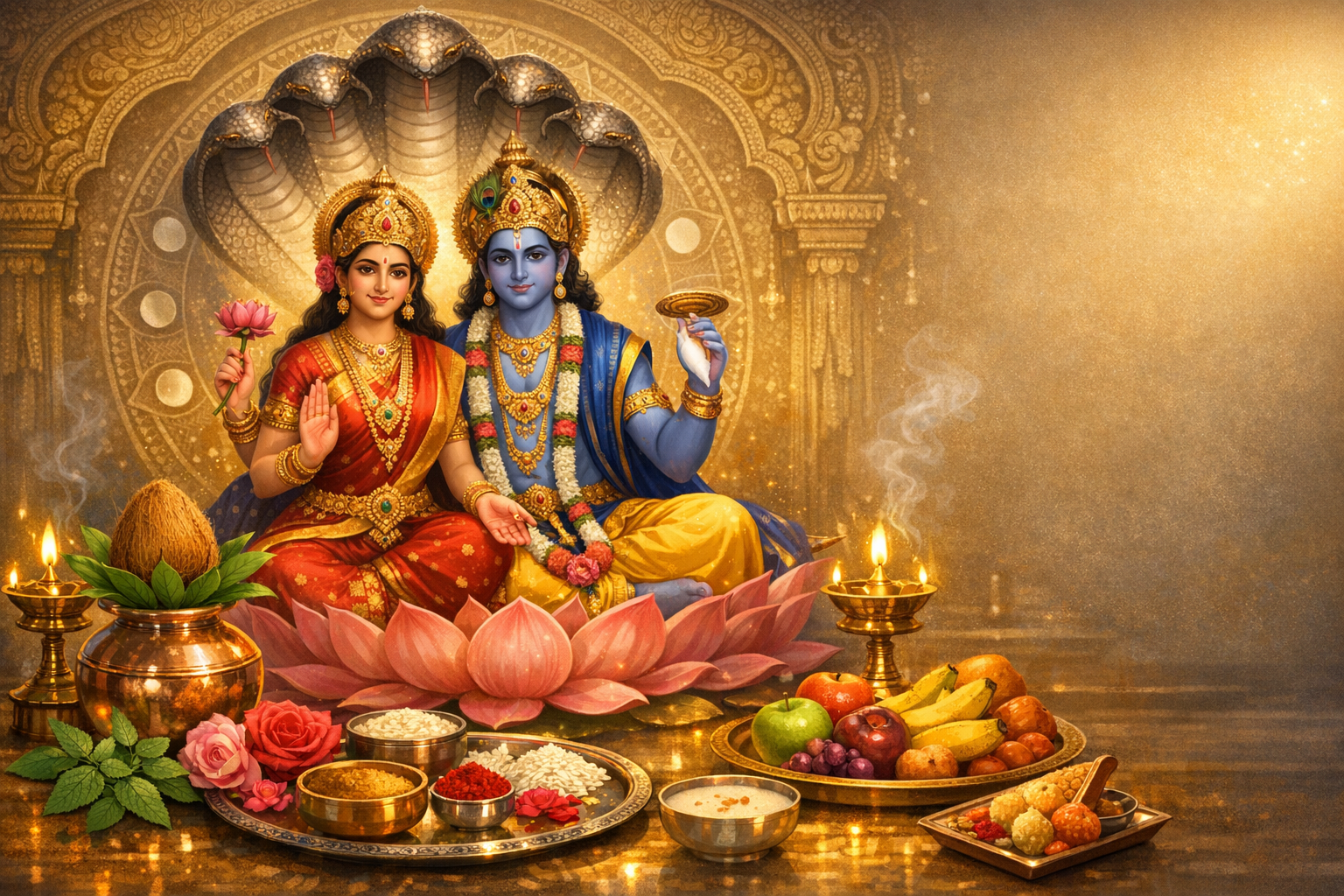
Lakshminarayan Vrat is a sacred Hindu observance that venerates the inseparable divine couple, Goddess Lakshmi (bestower of shri, abundance, and auspiciousness) and Lord Narayana (Vishnu, the preserver of cosmic order). The vow harmonizes prosperity with ethical stewardship, encouraging householders to cultivate material well-being under the guidance of dharma. It is valued for its integrative vision: wealth supported by righteousness and righteousness sustained by thoughtful resourcefulness.
Distinct from Dharmaprapti Vrat, which some traditions confine to a single lunar month, Lakshminarayan Vrat is observed dynamically across the year. Its dates and cycles vary by region and sampradaya, enabling families to align the vow with agrarian calendars, work commitments, and school schedules without compromising ritual integrity.
Theologically, Lakshmi and Narayana embody shakti (dynamic potency) and shaktiman (the possessor of power)—an indivisible polarity emphasized in Vaishnava thought. Their joint worship affirms that abundance devoid of ethics degrades, while ethics deprived of resources risks stagnation. The vow thus becomes a lived pedagogy of balance across artha (prosperity), dharma (duty), and the higher aims of life.
Puranic literature such as the Padma Purana, Skanda Purana, and Brahma Vaivarta Purana extols Lakshmi–Narayana upasana, while Pancharatra traditions detail methods of archana, homa, and daily worship. Although textual prescriptions vary, the constant emphasis is devotion (bhakti), purity of means, and distribution of prasada as acts of dana (charitable giving).
Scheduling patterns for Lakshminarayan Vrat are diverse. Common practices include monthly observance on a Shukla Paksha Ekadashi or Dwadashi; series-based vows on consecutive Thursdays (e.g., 11, 16, or 24 Guruvar) culminating in an udyapana (formal conclusion); and Margashirsha observances favored in parts of India due to the month’s auspicious association. Many Sri Vaishnava families also align special worship with major Ekadashi–Dwadashi pairs, including the Vaikuntha Ekadashi period, while maintaining the specific focus on Lakshmi–Narayana as a couple.
Astrologically informed timing follows the local Panchang. Families identify the tithi (lunar day) boundary by sunrise and prefer shubha muhurta not affected by Rahu Kaal. Vishnu worship traditionally favors morning hours, while Lakshmi worship is often performed in the evening or during pradosha. For the joint vow, households commonly choose a morning puja followed by evening deepa and kirtana, or a focused evening puja in pradosha, based on lineage guidance.
Participation is open and inclusive: householders, students, professionals, and retirees alike can observe the vow. Its emphasis on honest livelihood (artha), truthful conduct (satya), compassion (daya), and sharing (dana) resonates with the broader dharmic ethos. This spirit of unity supports harmonious understanding across Hindu, Buddhist, Jain, and Sikh communities, affirming a shared commitment to inner discipline, ethical work, and community well-being.
Preparation begins with physical and mental purification. The space of worship is cleaned and oriented, where feasible, toward the east or northeast. A sankalpa (resolution) articulates the devotee’s name, lineage, location, lunar date, and intent to worship Sri Lakshmi–Narayana for specified benefits—most importantly, for spiritual merit and the welfare of all beings. Involving all members of the household deepens the vow’s transformative quality.
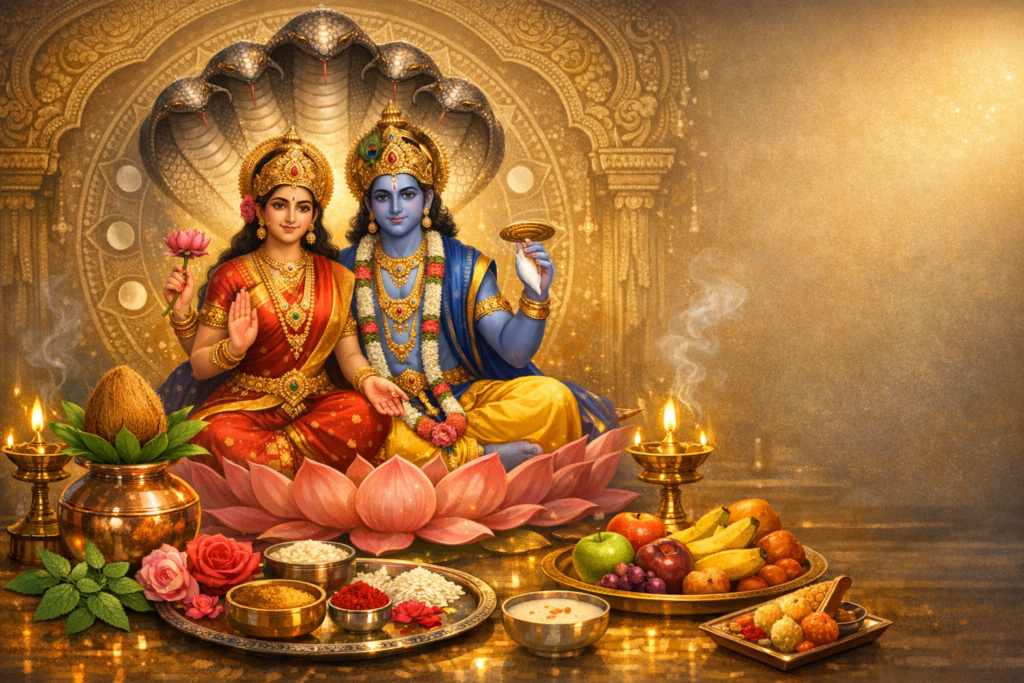
The altar is typically arranged with a kalasha (copper or silver pot) adorned with a swastika or auspicious thread, filled with sanctified water, grains, and a coin; fresh mango leaves and a coconut are placed atop. A picture or murti of Lakshmi–Narayana is set on a clean asana, flanked by lamps (deepa). Offerings may include Tulasi leaves for Narayana, lotus or rose for Lakshmi, sandalwood paste, kumkum, and seasonal fruits or ksheera (sweet rice/milk preparation) for naivedya.
Invocation and dhyana can be simple and heartfelt. Widely used verses include: “Shantakaram bhujaga-shayanam padmanabham suresham; vishvadharam gagana-sadrisham meghavarnam shubhangam; Lakshmi-kantam kamala-nayanam yogi-hrid-dhyana-gamyam; vande Vishnum bhava-bhaya-haram sarva-lokaika-natham” and “Namastestu maha-maye shri-pithe sura-pujite, shankha-chakra-gada-haste maha-lakshmi namo’stute.” The core mantras “Om Namo Narayanaya” and “Om Shreem Mahalakshmyai Namah” may be recited as japa, according to one’s capacity.
The puja typically follows Panchopachara or Shodashopachara krama. After avahana (invocation) and asana (seating), the classical sequence offers water for washing the feet (padyam), hands (arghyam), sipping (achamaniyam), and a symbolic snana or panchamrita abhisheka. The deities are then adorned with vastra (cloth) and alankara (flowers, tilaka), followed by gandha, akshata, and pushpa archana. Dhoopa (incense) and deepa (lamp) are waved, naivedya is offered with gratitude, and the rite concludes with tambula, stuti, and pranama.
For archana, households commonly recite Vishnu Sahasranama or the shorter Vishnu Ashtottara alongside Sri Lakshmi Ashtottara Sata Namavali. Where time is limited, a focused repetition of core names, followed by quiet meditation on the couple seated upon the lotus and Ananta Shesha, preserves the devotional mood while respecting daily constraints.
Fasting (upavasa) is undertaken according to health and sampradaya. Many observe a sattvic, onion- and garlic-free phalahara; others keep nirjala only if physically suitable. Moderate fasting with mindful eating, truthful speech, and mental restraint is fully in the spirit of the vow. Children, elders, pregnant women, and those with medical needs should adopt gentle dietary practices in consultation with family elders or healthcare professionals.
In numerous regions, a brief Lakshminarayan Vrat katha or a selected reading from the Puranas accompanies the puja. Satsang recitation, bhajans, or reflective reading from Vaishnava literature (for example, passages that praise Sri and Narayana together) foster shared learning and a serene devotional atmosphere. The distribution of prasada, especially when extended to guests or neighbors, transforms personal worship into community nourishment.
Parana (concluding the fast) follows the next appropriate interval, usually after sunrise or, when aligned with Ekadashi, on Dwadashi after the parana window noted in the Panchang. Udyapana, the formal completion after a series-based vow (e.g., the 11th or 16th Thursday), may include annadana, vastra-dana, or donations to temples or local charities—acts that align prosperity with compassion and responsibility.
Many families align the vow with Ekadashi for spiritual synergy. On Ekadashi, grains are traditionally avoided; parana occurs on Dwadashi within the prescribed time. When the vow is kept on other tithis, the same principles of sattvic restraint, prayerful focus, and timely parana apply. The goal is steady discipline, not rigidity, guided by one’s lineage and local calendar.
Regional variations are noteworthy. In western and southern India, households sometimes relate their Lakshminarayan worship to the broader cycle of Lakshmi observances; however, Lakshminarayan Vrat remains distinct from Varalakshmi Vrat (Shravana Shukra) which venerates Mahalakshmi alone. Observers are encouraged to honor their family tradition while recognizing the shared Vaishnava essence across practices.
The vow’s symbolism is profound: Lakshmi signifies flowing abundance, skills, and relational harmony; Narayana centers those capacities within dharma and long-term welfare. Together, they reflect shakti and shaktiman—a reminder that sustainable prosperity requires inner alignment, ethical choices, and a willingness to share. Householders often report that the regular cadence of the vow cultivates calm focus, prudent decision-making, and gratitude-filled work.
A practical pattern for busy families involves: a clear sankalpa; short dhyana with “Om Namo Narayanaya” and “Om Shreem Mahalakshmyai Namah”; Panchopachara offerings; brief recitation of Vishnu Sahasranama excerpts and Sri Lakshmi Ashtottara Sata Namavali; and measured fasting with wholesome prasada. Even a succinct, sincere observance performed consistently across the chosen cycle bears fruit when coupled with dana and compassionate living.
Frequently asked questions arise in practice. Who may observe? Anyone seeking to harmonize livelihood with ethics. What if fasting is difficult? Adopt a light sattvic diet and expand dana or seva that day. Must the vow occur only on one weekday? No; follow the family sampradaya and local Panchang. Can men observe? Yes; the vow benefits all devotees.
What if travel or work interrupts the schedule? Many households carry a minimal kit (small picture, tilaka, and a diya) and offer a shortened puja with mental japa, compensating later through additional archana or dana. If a day is inadvertently missed, resume in the next cycle without guilt; the heart of the vow is disciplined sincerity, not numerical perfection.
Ethical and sustainable practice enhances the vrata’s spirit. Use eco-friendly lamps and flowers, repurpose offerings respectfully, and direct surplus prasada to those in need. In this way, the worship of Lakshmi (abundance) and Narayana (preservation) becomes a living ethic of care for family, community, and environment—an ethos celebrated across dharmic wisdom streams.
In sum, Lakshminarayan Vrat integrates Puranic devotion, lineage-specific ritual technique (vidhi), calendar literacy (tithi and muhurta), and everyday ethics. Observed dynamically throughout the year, it offers a contemplative path to prosperity that uplifts households, strengthens social bonds through dana and prasada, and nurtures unity among dharmic traditions through shared values of non-harm, truthfulness, and service.
Note: Ritual details and mantras vary by region and lineage. Practitioners are encouraged to follow their family and temple guidelines and to refer to a reliable Panchang for local tithi and parana times.
Inspired by this post on Hindu Pad.









Leave a Reply
You must be logged in to post a comment.