Every human being seeks happiness. Yet when it is pursued primarily through relationships, wealth, status, and sensory stimulation, satisfaction proves brief and conditional. Hindu wisdom, developed over millennia of rigorous metaphysical inquiry and contemplative practice, articulates a different proposition: enduring happiness is the natural radiance of the inner self, accessible through a refined relationship with the Divine that dwells within and pervades all.
Hindu philosophy distinguishes between transient pleasure (sukha), relative peace (śānti), and the unconditional fullness called ānanda. Drawing on the Taittirīya Upaniṣad’s Ānanda-mīmāṁsā, it portrays ānanda not as the peak of sensory gratification but as the essential nature of realityānandaṁ brahma. This vision reframes the human quest: rather than amassing experiences that rise and fall, one learns to uncover the substratum of contentment already present as the ground of being.
The ontological foundations supporting this claim span multiple darśanas. Advaita Vedānta asserts the identity of ātman and Brahman; the apparent sense of separation arises from avidyā and resolves through jñāna that reveals the nondual Self as sat-cit-ānanda. Viśiṣṭādvaita Vedānta maintains the inseparable relation between the individual self and Īśvara, while Dvaita Vedānta emphasizes an eternal difference-in-relation. Across these schools, the axis of lasting happiness is a living bond with the Divinevariously grasped as Brahman, Nārāyaṇa, Śiva, Devī, or the all-pervading Paramātman.
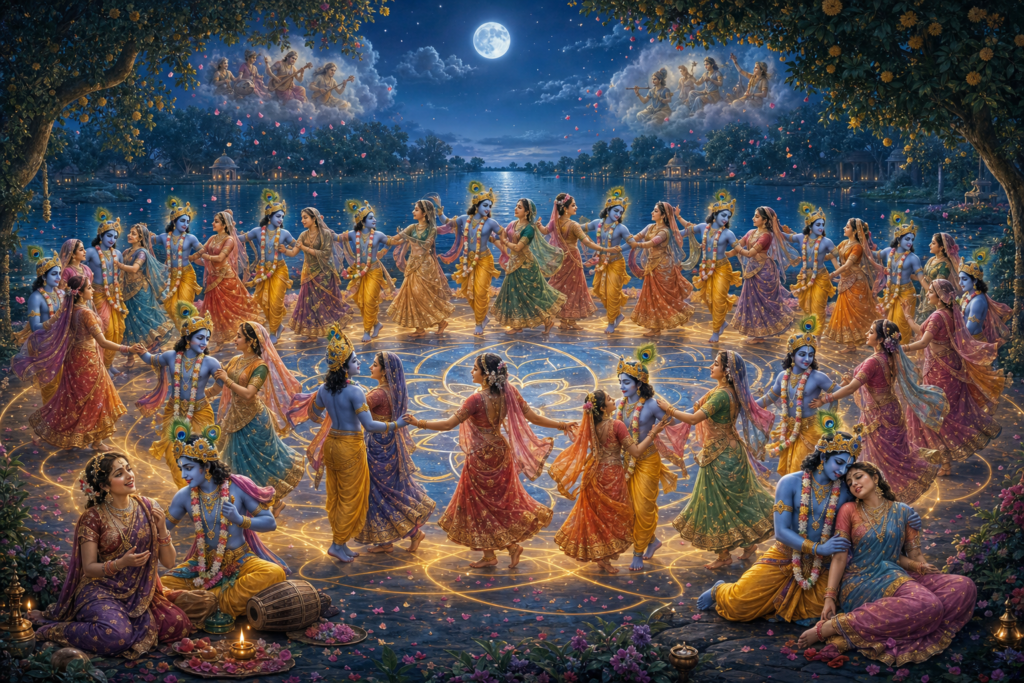
Bhakti traditions refine this relationship as loving devotion. From Gauḍīya Vaishnavism’s acintya-bhedābheda to Śaiva Siddhānta and the Śākta understanding of Śakti as the dynamic presence of the Absolute, devotion functions as an ontological bridge: it aligns the finite person with the infinite center. The Bhāgavata Purāṇa speaks of hearts softened and clarified by śravaṇam, kīrtanam, and smaraṇam, enabling the bliss of communion to shine through.
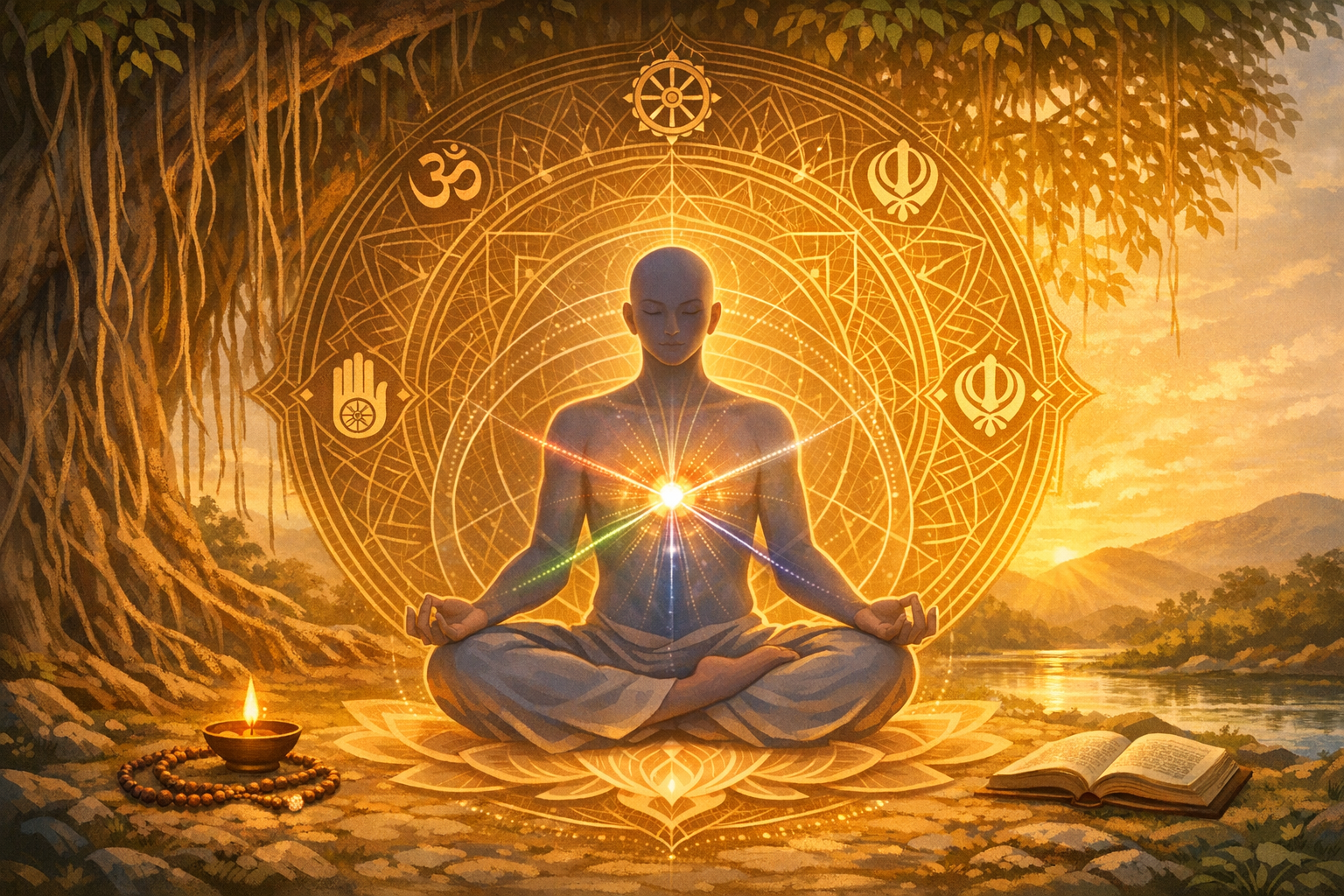
Dharmic unity enriches this vision beyond Hinduism alone. Buddhism diagnoses the instability of pleasure as dukkha and prescribes ethical clarity and meditation to realize equanimity and insight. Jainism articulates a rigorous ethics of ahiṁsā and aparigraha and culminates in kevala-jñāna, the soul’s pure luminosity. Sikhism declares Ik Onkar and cultivates sahaj through Nāma-simran and sevā. While these paths differ in metaphysical emphasissuch as the Hindu affirmation of ātman and the Buddhist analysis of anattāthey converge pragmatically on the discipline, compassion, and contemplative steadiness through which deep well-being emerges.
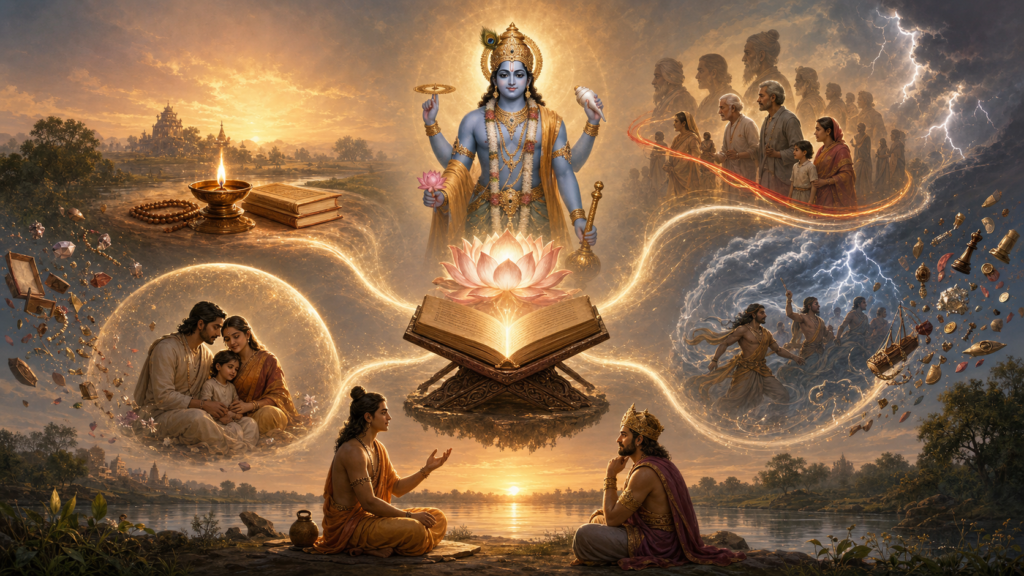
Scriptural guidance clarifies why external acquisition cannot secure abiding joy. The Bhagavad Gītā observes that contact-born experiences are finite, subject to arising and passing; one who does not cling to these, and is centered in the Self, abides in happiness that does not depend on circumstances. The Kaṭha Upaniṣad contrasts śreyas (the truly beneficial) with preyas (the merely pleasant), urging alignment with what liberates rather than what distracts.
These insights are not only metaphysical. Contemporary contemplative science suggests that steady meditation attenuates maladaptive stress responses, improves emotion regulation, and supports prosocial orientation. Practices aligned with Yoga philosophy can cultivate parasympathetic balance and healthier vagal tone, supporting the experiential shift from reactivity to clarity. While scientific models remain provisional, they echo what dharmic traditions have long maintained: a trained mind, grounded in ethics and insight, becomes a clear mirror for inner peace.
Diverse pathways operationalize this sacred connection. Bhakti Yoga surrenders self-centeredness into divine love through japa, kīrtan, pūjā, and heartfelt remembrance. Karma Yoga purifies intention through selfless service and dedication of results to the Divine. Jñāna Yoga employs inquiryśravaṇa, manana, nididhyāsanato reveal the Self as untouched awareness. Rāja Yoga organizes mind and body through the aṣṭāṅga systemyama, niyama, āsana, prāṇāyāma, pratyāhāra, dhāraṇā, dhyāna, samādhito stabilize attention and unveil the sweetness of inner stillness.
Bhakti centers the relational dimension of the Divine. Through nāma-japa and devotional song, attention gently turns from incessant evaluation to reverent presence. In many practitioners, the heart’s affective circuits become ordered by gratitude and reverence rather than craving and aversion. Over time, devotion ripens into ananya-bhakti, a single-pointed trust that simplifies the inner life and allows ānanda to be felt as a natural background.
Jñāna Yoga approaches the same telos with conceptual precision. It differentiates the witnessing ātman from the shifting body-mind complex by sustained discrimination (viveka) and dispassion (vairāgya). The sādhanā-catuṣṭayaviveka, vairāgya, śamādi-ṣaṭka-sampatti, and mumukṣutvaestablishes the psychological maturity for nondual insight to stabilize. Inquiry does not negate devotion; it refines it by clearing projections and revealing why love of the Divine is, in essence, love of Truth.
Karma Yoga translates sacred connection into social reality. When action is undertaken as yogafree from grasping at outcomes and dedicated to loka-saṅgrahait ceases to reinforce egoic identity. Sikh sevā and the Gītā’s nishkāma-karma illuminate the same law: service purifies motive, nourishes community, and opens the heart to the presence that works through all hands.
Rāja Yoga provides a systematic phenomenology of inner training. Ethical foundations (yama, niyama) align conduct; āsana and prāṇāyāma stabilize energy; pratyāhāra reclaims attention from compulsive stimulation; dhāraṇā and dhyāna consolidate focus; and samādhi reveals the seer by quieting fluctuations (citta-vṛtti-nirodhaḥ). In this clarity, happiness is no longer an acquisition but the signature of undisturbed awareness.
Some lineages describe awakening as the ascent of kuṇḍalinī through chakras, harmonizing the subtle body and culminating in sahasrāra. Others prefer non-conceptual immediacy without energetic models. Both perspectives converge in practice: steady virtue, careful breath, compassionate intention, and unwavering attention are the reliable means; sensationalism is not.
The pañca-kośa model from the Taittirīya Upaniṣad maps embodiment as annamaya, prāṇamaya, manomaya, vijñānamaya, and ānandamaya-kośa. A holistic sādhanā nourishes the physical sheath with sattvic food and rest, refines prāṇa through breath and posture, steadies manas with mantra and mindfulness, clarifies buddhi via svādhyāya and inquiry, and finally abides as the ānanda that is not a mood but one’s innermost nature.
Classical psychology of the antahkaraṇamanas, buddhi, ahaṁkāra, cittaexplains how inner noise obscures joy. When rajas compels and tamas dulls, perception fragments; as sattva increases, the mind becomes transparent, reflecting the Self like a still lake. Cultivating sattva through yamas, niyamas, and contemplative disciplines enables an organic recognition of the Divine within.
Hindu spirituality protects plurality through the principle of iṣṭa-devatā, affirming that different constitutions require distinct forms of approach to the same Reality. Jain anekāntavāda offers a complementary epistemic humility: truth is many-sided, and partial views invite dialogue rather than dogma. Dharmic traditions thus honor unity in spiritual diversity, encouraging seekers to progress along the path that genuinely harmonizes their temperament and duties.
Rituals such as pūjā and ārati concentrate attention and sacralize time. The consecration of images (prāṇa-pratiṣṭhā) is not idol-worship in a crude sense but a sophisticated technology of presence, enabling the mind-heart to relate to the formless through form. Equally, Buddhist mindfulness, Jain pratikraman, and Sikh kīrtan serve as living sacraments that tune the psyche to the sacred.
Ethics is not ancillary; it is transformative. Ahiṁsā, satya, asteya, brahmacarya, and aparigraha, together with śauca, santoṣa, tapas, svādhyāya, and Īśvara-praṇidhāna, recalibrate desire and stabilize conscience. Jainism’s profound ahiṁsā and aparigraha, Buddhism’s śīla, and Sikh rehat maryādā similarly affirm that moral clarity is the architecture in which inner freedom becomes livable.
Contemporary life challenges this work with hyper-stimulation and fragmentation. Yet the dharmic sciences remain practical. Morning silence with nāma-japa or breath awareness centers the day in remembrance. Mindful engagement at work, offered as yajña to the common good, reduces grasping. Evening svādhyāya with the Bhagavad Gītā or Upaniṣads, followed by gratitude and metta, gradually re-patterns the nervous system toward ease and benevolence.
Periodic immersion consolidates gains. Weekly satsang nourishes devotion and discernment. Occasional half-days of mauna or nature walks restore inner spaciousness. Annual pilgrimage or retreat, approached not as escape but as renewal, deepens commitment to dharma and service upon return.
Reliable markers of progress include a gentler baseline of affect, decreased compulsive evaluation, resilience amid praise and blame, an instinct toward fairness and kindness, and a natural preference for śreyas over preyas. These shifts need not be dramatic to be decisive; stability grows by consistent practice rather than sporadic intensity.
Obstacles are well-mapped. Patanjali’s kleśasavidyā, asmitā, rāga, dveṣa, abhiniveśaoperate through habitual narratives and somatic reflexes. The Gītā prescribes abhyāsa and vairāgya: steady re-orientation of attention and a wise release of clinging. When setbacks occur, compassionate self-honesty restores momentum more effectively than harsh judgment.
Misconceptions about Hinduism’s many deities dissolve when viewed through the lens of saguna and nirguna Brahman: the Infinite can be encountered as quality-less presence or as relational form. Multiplicity does not contradict unity; it expresses unity’s inexhaustible generosity. The same generosity is evident across Buddhism, Jainism, and Sikhism, which articulate complementary doorways into a shared aspiration: freedom from suffering and the flowering of wisdom and compassion.
Ultimately, the relationship with the Divine for happiness is not a distant metaphysical claim but a lived intimacy with realitymoment by moment, breath by breath. Whether cultivated as bhakti’s sweetness, jñāna’s clarity, karma’s generosity, or rāja yoga’s depth, the fruit converges: a resilient joy that neither clings nor resists, and a heart spacious enough to hold the world.
Hindu teachings therefore do not dismiss the value of relationships, vocation, or beauty; they situate them within a wider horizon. When the center returns to the Divine within, outward engagements become expressions of wholeness rather than substitutes for it. In that reframing, even ordinary days carry the quiet radiance of ānanda.
Inspired by this post on Hindu Blog.