
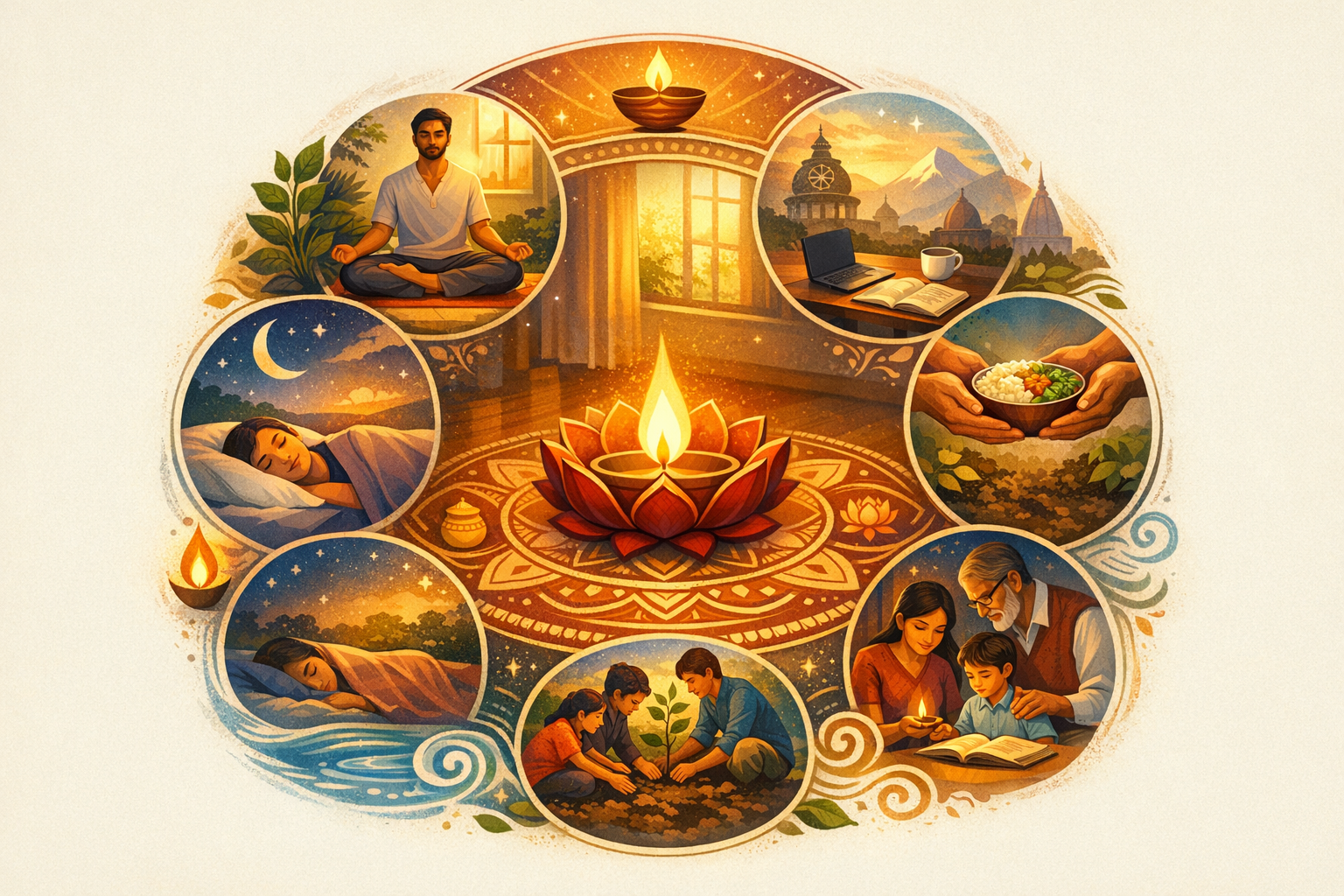
Hinduism, understood as Sanatana Dharma, extends far beyond the confines of temples and formal religious institutions. It operates as a civilizational way of life that infuses every moment with meaning, providing an integrative framework for ethical action, spiritual practice, and social responsibility. This Hindu way of life is not restricted to ritual spaces; rather, it is expressed in the cadence of daily routines, the ethics of work, the cultivation of inner stillness, and a continuous search for truth through many valid paths.
Classical sources frame even ordinary human experiences as spiritually significant. Deep sleep, for instance, is described in the Upanishads as suṣupti, a peaceful return to the lap of the Supreme Spirit where the mind rests in undifferentiated awareness. In this sense, every breath and each transition of the day can be read as liturgy and learning, reiterating that Hindu spirituality is woven into life’s natural rhythms rather than restricted to occasional ceremony.
At the heart of this living philosophy lie the puruṣārthas—dharma, artha, kāma, and mokṣa—which articulate a balanced blueprint for human flourishing. Dharma governs right conduct and social harmony; artha and kāma recognize material and aesthetic aspirations; mokṣa directs the seeker toward ultimate freedom. Far from denying worldly pursuits, Sanatana Dharma contextualizes them, making everyday decisions a field for sādhanā and ethical refinement.
The ashrama model—brahmacharya, gṛhastha, vānaprastha, and sannyāsa—maps spiritual intent onto the arc of a lifetime. It acknowledges education, householding, service, and renunciation as complementary phases, each affording distinctive duties and opportunities for insight. Modern life may not mirror these stages precisely, yet the underlying logic—lifelong learning, responsible stewardship, gradual simplification, and inner freedom—retains practical relevance.
Samskāras, from birth rites to antyeṣṭi, mark key transitions with remembrance and gratitude. In between, the texture of daily practice—lighting a lamp at dawn, offering simple prayers, or chanting mantras softly—operates as a gentle discipline of attention. These rhythms transform homes, workplaces, and public spaces into environments for mindful living, where reverence for life and responsibility to community remain in the foreground.
Ritual in Hinduism functions as a finely tuned technology of consciousness. In pūjā, attention is trained through sequence, symbolism, and care; in japa, the mind learns steadiness; in prāṇāyāma and meditation, breath, body, and awareness are harmonized. This layered toolkit—spanning Bhakti, Jñāna, Karma, and Rāja Yoga—ensures that different temperaments and capacities find suitable doors to the same inner sanctum.
Karma Yoga, emphasized in the Bhagavad Gita, sanctifies work as worship. Actions performed with diligence and without clinging to results purify motive and free the mind from agitation. In this vision, ethical enterprise, fair exchange, and excellence in craft become spiritual disciplines, knitting together productivity, compassion, and self-mastery.
Sacred time is cyclic and participatory. The lunisolar calendar, vratas, and festivals organize communal remembrance and ecological care, aligning daily life with cosmic rhythm. Observances such as Navaratri, Deepavali, and Gudi Padwa are not only cultural celebrations but also pedagogies of gratitude, restraint, and renewal that are accessible to all generations.
Sacred geography is both outward and inward. While tīrtha-yātrā connects individuals to sites of memory and merit, the household shrine, the kitchen where anna-dāna is prepared, and the workspace where integrity is practiced, are likewise sanctified arenas. In this sense, the temple is a powerful center—but never a boundary—for spiritual life.
The ethical grammar of Sanatana Dharma is grounded in virtues such as ahiṃsā, satya, dayā, and dāna, with seva as their lived expression. The civilizational motto Vasudhaiva Kutumbakam situates ethics within a universal kinship, urging environmental responsibility, social equity, and intergenerational stewardship. This ethic is not abstract; it is practiced through compassion in discourse, fairness in trade, and care for all beings.
Pluralism is integral rather than peripheral. The Ishta-devata principle honors a chosen focus for devotion without denying the legitimacy of other forms, whether saguna or nirguna. This intellectual and devotional hospitality resonates with concepts such as Anekantavada in Jainism and the plural ethos apparent in Buddhism and Sikhism, where the shared values of compassion, restraint, remembrance, and service reinforce dharmic unity.
Diversity in practice is a feature, not a flaw, of Hinduism’s inclusiveness. From aniconic forms such as the Shiva linga to richly iconic darshanas in Vaishnava and Shakta traditions, the spectrum invites multiple modes of contemplation. Such diversity allows individuals and communities to embrace methods that align with temperament, language, and historical memory while remaining connected to the same wellspring of meaning.
Sanatana Dharma provides an ecological consciousness rooted in reverence for the pañca-mahābhūtas—earth, water, fire, air, and space. Ritual purity, conservation practices, and seasonal observances embed sustainability into culture. When framed as dharma rather than only policy, environmental care becomes a shared vow rather than a periodic campaign.
Even rest is part of the path. Yogic insights into sleep and dream states, including practices like yoga nidra, complement scriptural reflections on suṣupti. Recovering balance through restorative sleep, gentle breathwork, and mindful nutrition exemplifies how the Hindu way of life integrates well-being with spiritual intent.
Mindfulness in this context goes beyond solitary technique. Sankalpa, a clear intention set at dawn or before a task, orients attention toward dharmic outcomes. Across a day—during study, caregiving, governance, or entrepreneurship—this gentle discipline reframes the ordinary as an opportunity for self-refinement and collective uplift.
Education retains a spiritual register. The guru–śiṣya relationship models learning as transmission of character, wisdom, and skill, not information alone. Modern institutions can mirror this spirit by valuing depth over rote, inquiry over dogma, and formation over mere performance, thereby preserving an educational dharma aligned with human flourishing.
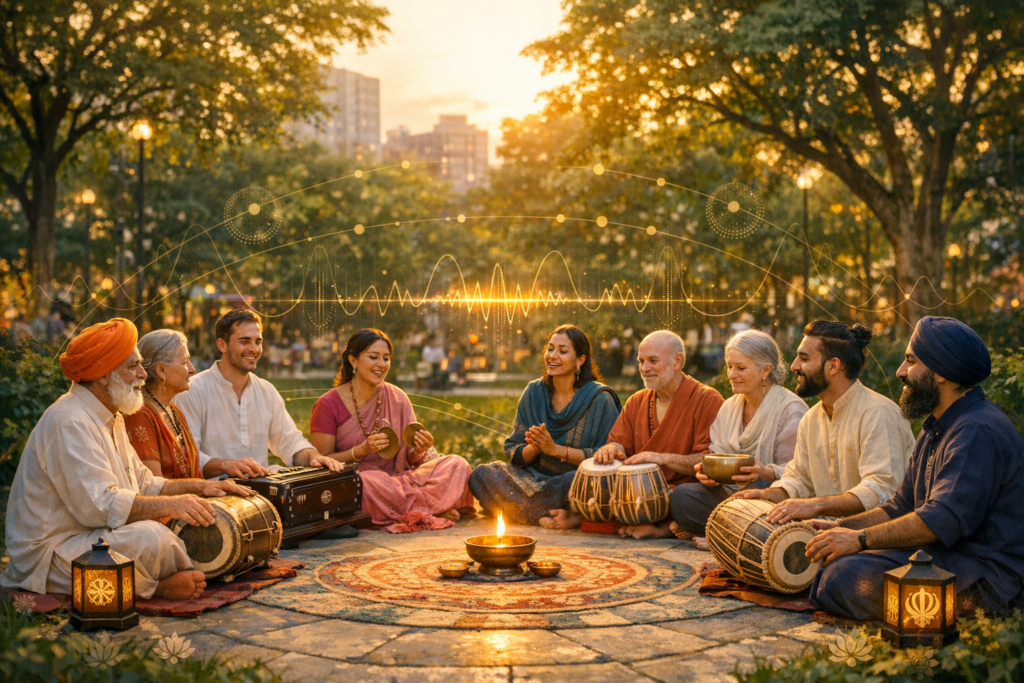
Family and community serve as primary theaters for spiritual practice. The gṛhastha phase honors responsibility to elders, children, guests, and neighbors. Practices such as anna-dāna, collective chanting, or neighborhood clean-ups enact seva as everyday citizenship, turning social cohesion into a living mandala of care.
Interreligious engagement in the dharmic sphere is grounded in mutual respect and shared ethical aspiration. Buddhism’s compassion, Jainism’s Anekantavada and ahiṃsā, Sikhism’s nām-simran and seva, and Hinduism’s acceptance of multiple yogas converge on a civilizational commitment to non-coercive spiritual growth. Such religious pluralism protects the dignity of conscience while enriching the public square with many textures of wisdom.
Within this framework, caution is warranted against any ideology—religious, political, or cultural—that seeks to impose a single, exclusive path. Swami Vivekananda’s call for acceptance (not mere tolerance) highlights an academic and ethical insight: civilizational strength arises from honoring legitimate diversity of worship and spirituality. This principle safeguards the rich tapestry of practices while enabling unity on common ethical ground.
Practical integration can be simple yet transformative. A day might begin with quiet breath awareness and a short mantra, continue with honest work undertaken in the spirit of Karma Yoga, pause for gratitude before meals, include a small act of seva, and close with reflective reading or meditation. Such sequences are adaptable to different professions, family structures, and cultural settings while maintaining a consistent dharmic orientation.
Urban life readily accommodates these principles. Mindful technology use, ethical consumption, responsible finance, and attention to sustainable housing and transport express applied dharma. When teams practice transparency, when leaders elevate fairness over expedience, and when households choose repair over waste, spirituality and policy cohere in service of the commons.
Temples remain vital centers of learning, charity, music, and community memory; yet Sanatana Dharma is not circumscribed by their walls. Its power lies in a capacious vision where the sacred accompanies the seeker into study, commerce, art, governance, and rest. The ordinary becomes luminous when seen through this lens.
In sum, Hinduism’s inclusiveness, structured by the puruṣārthas and animated by plural paths—Bhakti, Jñāna, Karma, and Rāja—demonstrates a mature religious pluralism. In concert with the allied traditions of Buddhism, Jainism, and Sikhism, it articulates a dharmic unity that nurtures inner freedom and social harmony. By honoring many gateways to the One, Sanatana Dharma turns daily life into a compassionate and intelligent choreography of the sacred.
Inspired by this post on Hindu Blog.






Leave a Reply
You must be logged in to post a comment.