
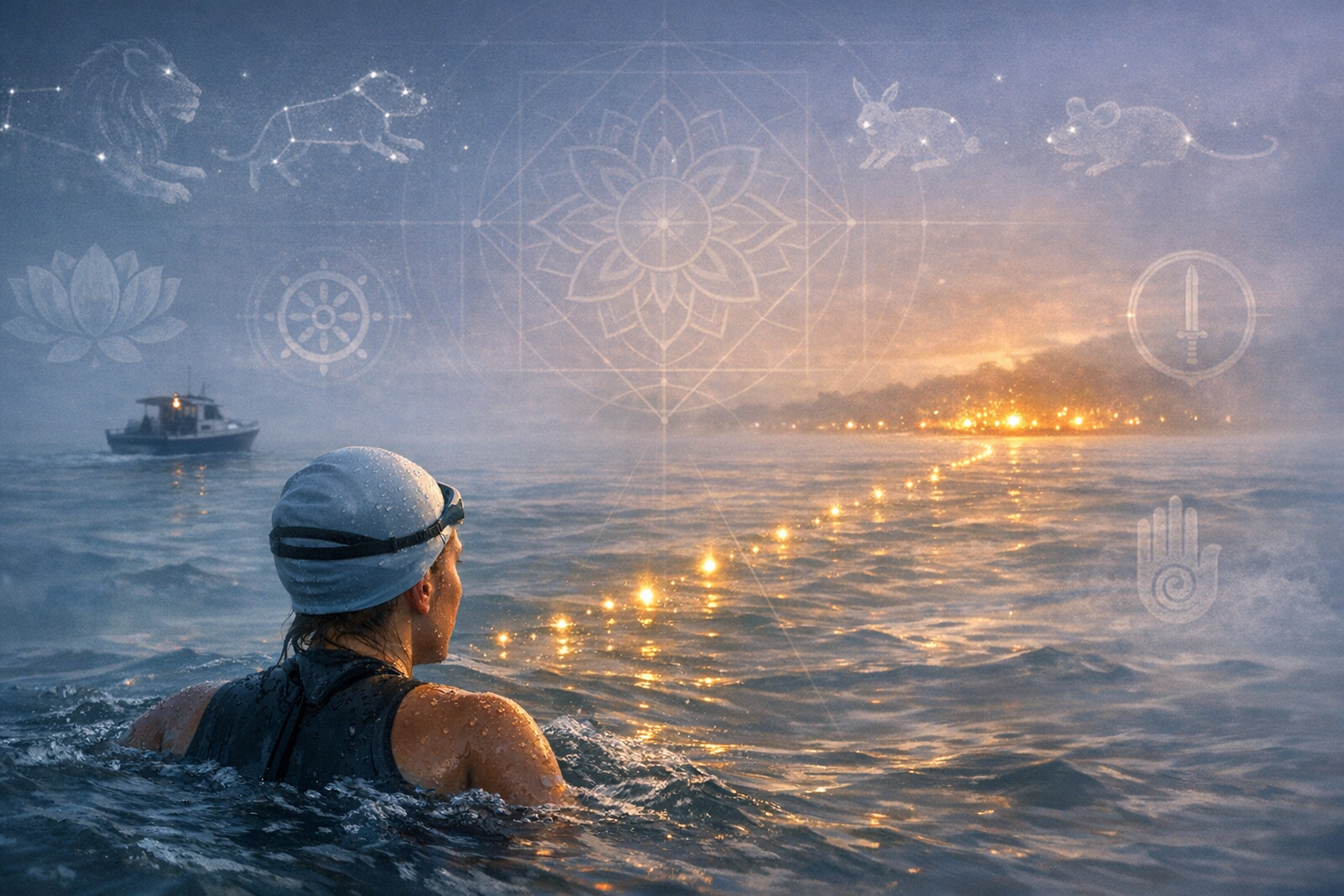
A classic parable recounts a lion launching after a stag, only to veer toward a fox that happens to cross the path, then a rabbit, and finally a mouse that disappears into a hole. The hunt ends not in triumph but in exhaustion and emptiness. This vivid tableau captures a universal hazard: without a fixed point of reference, effort fragments into futility. The same principle—focus as the determinant of meaningful progress—echoes powerfully in the documented open-water achievements and near-misses of Florence Chadwick, whose Catalina Channel attempts remain a benchmark case study in how clarity of vision sustains endurance under uncertainty.
Florence May Chadwick (1918–1995) rose to international prominence in the mid-20th century as a pioneer of marathon swimming. She trained for years in the challenging waters off La Jolla, California, and became the first woman to swim the English Channel in both directions, setting new standards for women’s long-distance open-water performance. Her reputation as a disciplined, data-driven athlete—meticulous about tides, thermoregulation, fueling, and pacing—made her Catalina Channel attempts especially instructive for understanding the intersection of physiology, psychology, and goal-directed behavior.
The Catalina Channel, spanning roughly 20–21 miles (about 32–34 km) between Santa Catalina Island and the Southern California mainland, presents a deceptively complex task environment. Sea temperatures can hover in the upper teens Celsius, currents shift with little warning, fog is common, and navigational cues are sparse. Marathon swimmers manage cold stress (via fat metabolism and external grease coatings), maintain steady stroke economies, and rely on escort boats for navigation, safety, and caloric refueling. The sensory load is paradoxical: physically overwhelming and visually impoverished. In such conditions, the mind’s ability to “see” the destination often governs whether the body can continue to deliver power.
On a fog-bound morning in 1952, Chadwick swam hour after hour toward the California coast. After more than fifteen hours in the water, with hypothermic risks rising and the shoreline concealed by impenetrable mist, she requested to be pulled out. Only then did her team confirm how close she had been to the finish—by many reports, less than a mile from shore. Her post-race reflections emphasized a single point: in the absence of visual confirmation, her belief in the endpoint faltered. The lesson was not a deficit of stamina or skill; it was a breakdown of vision under conditions of sustained uncertainty.
Months later, Chadwick returned to the Catalina Channel on another foggy day and completed the crossing in approximately thirteen hours and forty-seven minutes—an elite time in the era. The objective environment had scarcely improved; what changed was the internal map. She held the shoreline in mental focus, translating an invisible destination into a palpable, guiding image. The same sea, the same fog, and the same athlete yielded a different outcome because the cognitive anchor—the “shore”—never left her field of attention.
From a performance-science perspective, the principle is both intuitive and robust: vision anchors endurance. Clear, stable goals reduce decision fatigue, protect against attentional drift, and help the brain resolve ambiguity in favor of persistence. The technical correlation shows up across domains—from pacing strategies in endurance sports to error management in aviation and surgical teams—yet Chadwick’s case remains uniquely compelling because the variable at the crux was not muscular capacity or external resources but the sustained perception of proximity to purpose.
Dharmic traditions articulate this insight with remarkable unity. In Yoga, ekāgratā—one-pointedness of mind—stabilizes dhāraṇā and matures into dhyāna, transforming scattered effort into coherent flow. Buddhism emphasizes sati (mindfulness) and right effort to hold the object of cultivation without clinging to distractions. Jain thought elaborates samyak-dhyāna (right meditation), where disciplined attention clears karmic obscurations. In Sikh praxis, Chardi Kāla names an optimistic resilience that sustains purposeful action even when the outer horizon disappears. Each current speaks in its own idiom, yet all converge on a shared premise: when the inner shore is clearly known, outer fogs lose their power to disorient.
This shared dharmic grammar matters for more than metaphysical elegance; it offers a practical and unifying blueprint for diverse seekers across Hinduism, Buddhism, Jainism, and Sikhism. Whether the field is contemplative practice, ethical service, scholarship, or civic leadership, sustained attention to a luminous endpoint harmonizes communities and reduces friction. The unity arises organically: multiple methods, one intention; many rivers, one sea. Cultivating focus thus becomes a civic virtue as much as a spiritual one, aligning inner discipline with societal concord.
The lion’s misadventure—the serial pursuit of fox, rabbit, and mouse—maps neatly onto modern cognitive science. Novelty is intrinsically rewarding, and without a clearly represented goal, the brain privileges immediate stimuli over strategic intent. This “attentional drift” generates switching costs, degrades deep work, and fosters a false sense of progress. Chadwick’s first Catalina attempt shows that even heroic exertion cannot compensate for the absence of a stabilizing referent; conversely, her second attempt demonstrates how a fixed mental image of the goal recalibrates effort allocation and fortifies resolve.
Several mechanisms clarify why “eyes on the shore” works. First, mental imagery activates neural circuits overlapping with those engaged during task execution, priming consistent motor output under stress. Second, the “goal-gradient effect” increases motivation as perceived proximity to the target rises; vivid representation of the finish line preserves the felt sense of nearness even when sensory confirmation is missing. Third, cognitive reappraisal reframes adverse conditions—fog, cold, currents—not as threats but as expected features of the terrain, lowering anxiety and preserving stroke efficiency. The upshot is straightforward: a clear, emotionally resonant goal reduces uncertainty costs and supports resilient action.
Translating these principles into practice benefits both individual cultivation and collective endeavors. Begin by naming the shore in explicit terms: define the destination in a single, testable sentence. Next, build a daily visualization ritual—bhāvanā—brief but consistent, so the image of the goal remains available even when external cues vanish. Then, install short-horizon markers (time boxes, intermediate waypoints, or feedback loops) that preserve the experience of approach and counteract the demotivating effects of fog. In parallel, reduce cognitive noise: adequate sleep, breath-led resets (prāṇāyāma), and brief mindfulness intervals restore signal clarity. Finally, assemble a supportive saṅgha or peer network whose role mirrors the escort boat: protect, guide, and verify course without diluting the swimmer’s agency.
The moral becomes unmistakable. When vision is fragmentary, even a lion starves at the mouth of a mouse hole; when vision is whole, a swimmer traverses a near-featureless sea. Chadwick’s Catalina narrative, read through the lens of dharmic one-pointedness, affirms a universal ethic: anchor attention in a worthy objective, sustain it with disciplined practice, and let unity of purpose carry skill through uncertainty. In personal vows, professional commitments, and shared civic aspirations, keeping eyes on the shore is not merely motivational advice—it is a rigorously tested method for converting intention into arrival.
Inspired by this post on Hindu Pad.











Leave a Reply
You must be logged in to post a comment.