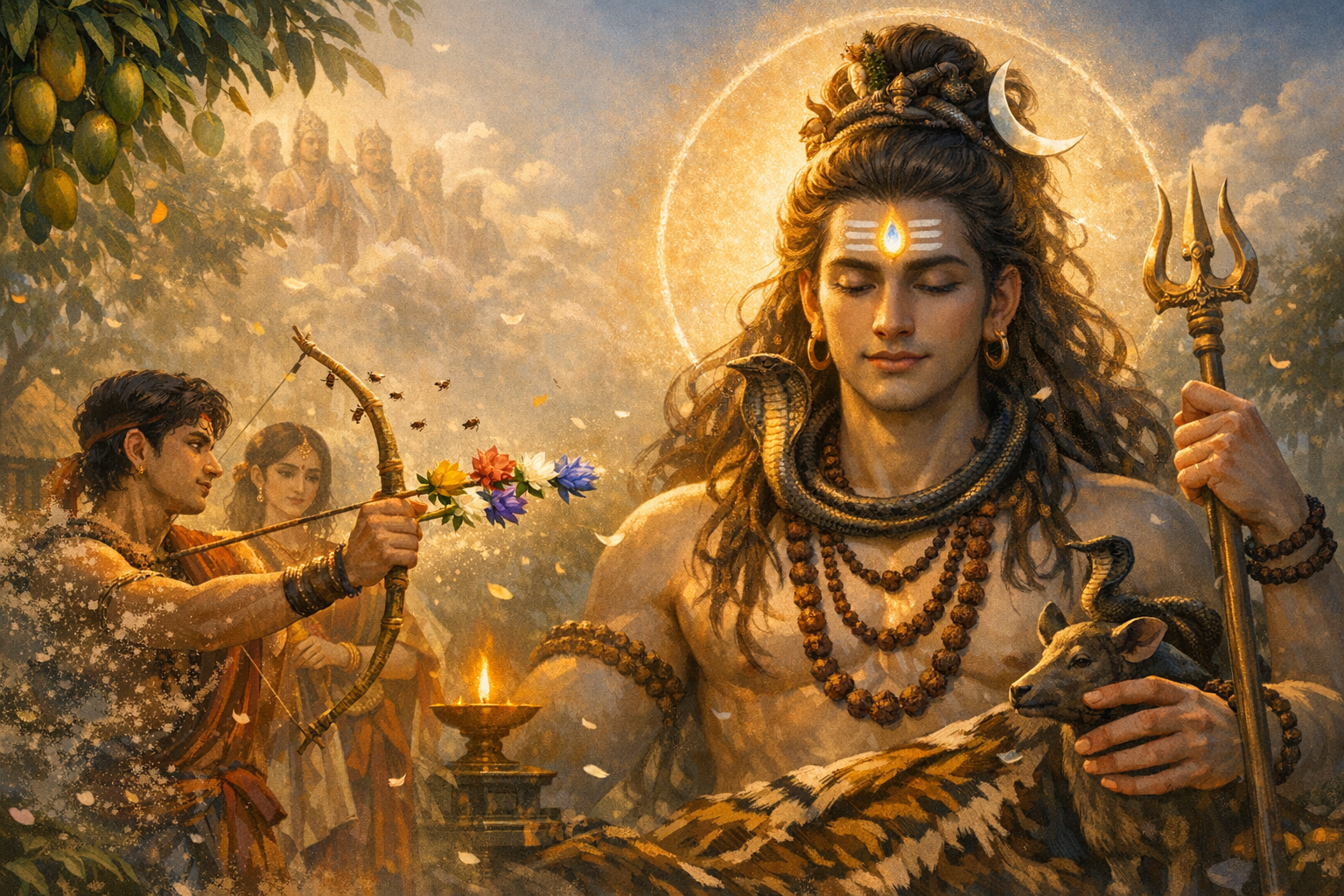
Kamantaka (also called Madana Dahana) is a compelling iconographic form of Shiva in which he appears as the destroyer of Kama, the god of desire. In this momentous scene, Shivaabsorbed in profound meditationopens the third eye, unleashing jñāna-agni, the fire of knowledge, that reduces Kama to ash. The image communicates a primary insight shared across Dharmic traditions: unmastered desire obscures discernment, while disciplined awareness transforms desire into a force aligned with wisdom and compassion.
Reading Kamantaka as a work of sacred art is both historical and contemplative. Historically, it memorializes the episode that precedes Shiva’s union with Pārvatī and the birth of Kumara/Skanda, who restores cosmic order. Contemplatively, it dramatizes an inner victory: the quelling of agitation (kṣobha) and the stabilization of attention (ekāgratā). Devotees often report that standing before the image evokes stillness and courage, a felt sense that clarity is possible even in the midst of life’s springlike enticements.
Identifying Kamantaka in temples and sculpture relies on a set of consistent markers. Kama is shown with a sugarcane bow (ikṣu-dhanuḥ), a string of buzzing bees, and five flower-arrows often associated with blossoms such as aśoka, mango, jasmine, and blue and white lotuses. His consort Rati appears in distress. Seasonal motifsmango groves, bees, and malaya-breezesignal the engineered setting of spring, staged by the gods to awaken Shiva’s desire. Against this orchestration, Shiva’s third eye is emphatically rendered, sometimes with a flame motif or sharply incised pupil, indicating the ignition of inner fire.
Shiva’s attributes in Kamantaka draw from his broader iconographic vocabulary. The matted locks (jaṭā-mukuṭa) may carry the Gaṅgā and crescent moon; serpents and a tiger-skin garment affirm his ascetic sovereignty. He can be two-, four-, or multi-armed, with familiar emblems such as the triśūla, ḍamaru, paraśu (axe), and the antelope (mṛga). Some bronzes and reliefs place a small flame in one hand to allegorize jñāna-agni, even though the burning in the narrative issues from the third eye itself. The stance may be sama-bhaṅga or tri-bhaṅga, but the affect is distinctly raudra (wrathful) yoked to serenity.
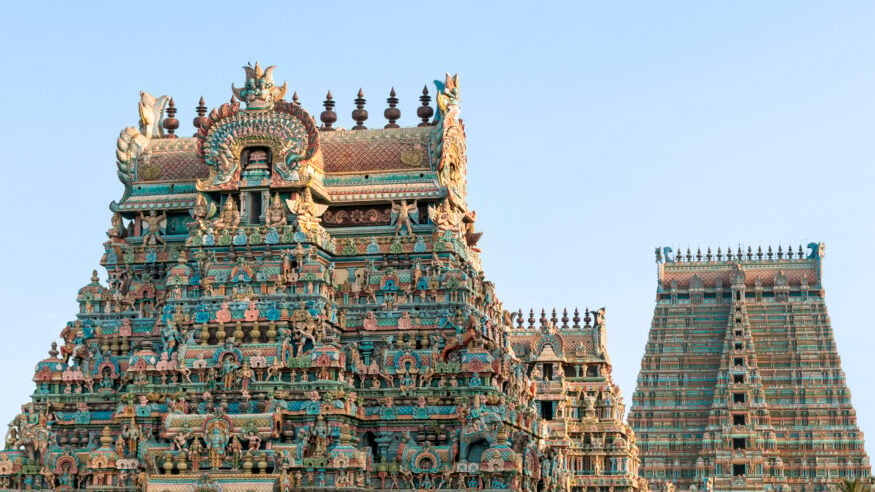
Several temples across India preserve the episode in masterful relief. Important examples include the Madana Dahana panels at the Virupaksha Temple, Pattadakal (8th century), the Kailasanatha complex at Ellora (Cave 16, 8th century), and narrative friezes across Hoysala sites such as Hoysaleswara, Halebidu (12th century). South Indian traditions also preserve the episode in festival memoryKama Dahanawhere communities ritually enact the burning of infatuation as a prelude to inner steadiness.
Textual foundations for Kamantaka are extensive. The Śiva Purāṇa (Rudra-saṃhitā, Kumāra-khaṇḍa) recounts Kama’s incineration; the Matsya and Padma Purāṇas preserve parallel tellings. Kalidasa’s Kumarasambhavam famously dramatizes the psychological and cosmic stakes: gods attempt to rouse the yogi with spring’s allure, but tapas triumphs. Agamic manuals (e.g., Kāmikāgama, Suprabhedāgama) inform murti-lakṣaṇa prescriptions, guiding sculptors in the compositional grammar of this form.
Symbolism in Kamantaka is multilayered and ultimately integrative, not negating love but refining it. Kama’s dissolution into ash (bhasma) teaches that craving unruled by viveka (discernment) must be transmuted, not indulged. In several traditions, Kama returns as Ananga“bodiless”signifying a subtle, inwardized eros that inspires but no longer tyrannizes. The sequence is telling: after the scorch of insight comes the gentle law of union, as Shiva consents to relationship with Pārvatī. Desire, chastened by knowledge, becomes devotion, creativity, and righteous action.
This imagery resonates with core philosophical teachings. In the Bhagavad Gītā (2.62–63; 3.37), desire is traced as a root of agitation and downfall when untamed; Yoga-Sūtra 1.12 prescribes abhyāsa (steady practice) and vairāgya (dispassion) as twin means to mastery. In ritual practice, vibhūti (sacred ash) on the brow memorializes what has been burned in the fire of insight. The third eye signifies an awakened axis of perception where affect, attention, and understanding align.
Regional idioms further nuance the form. Early Chalukya reliefs carve a tightly staged drama with dynamic diagonals that propel the eye from Kama’s poised bow toward Shiva’s intense gaze. Hoysala sculptors lace ornate foliage into the frame, accenting spring’s seductions and thereby heightening the triumph of interiority. South Indian bronzes prioritize palpable presence: the subtle curve of Shiva’s torso and the tension in his glance conjure a visceral moment of awakening.
How to read a Kamantaka panel in the field can follow a simple sequence. First, locate Kama’s sugarcane bow and the bee-string; next, identify Rati and spring cues such as mango clusters or floral garlands. Then attend to Shiva’s third eye and overall composure: the paradox of stillness amid provocation is the heart of the scene. Finally, look for narrative witnessesIndra and other devaswhose astonishment mirrors the viewer’s own realization that sovereignty begins within.
Across Dharmic traditions, Kamantaka’s lesson aligns with shared ethical-psychological maps. Hindu thought speaks of saṃskāras and vāsanās to be clarified through yoga and bhakti. Buddhism diagnoses taṇhā (craving) as a cause of dukkha and prescribes careful cultivation of mindfulness and wisdom. Jainism emphasizes victory over the kaṣāyas (anger, pride, deceit, greed) on the path to kevala-jñāna. Sikh teachings counsel mastery over the five thieveskāma, krodh, lobh, moh, ahankarthrough remembrance of the Divine and righteous living. Though methods vary, the telos is harmonious: freedom from compulsion and compassion in action.
Practitioners frequently describe a practical application for contemporary life. Digital stimuli and continuous novelty mimic spring’s engineered seductions; attention is scattered and restlessness grows. Kamantaka functions as a contemplative mirror: it invites a pause, a breath, and the recollection that clarity can ignite in an instant. Simple disciplinesjapa of “Om Namah Śivāya,” mindful breath, and an evening reflection on desires that served versus those that sabotagedtranslate the icon’s wisdom into daily steadiness.
Scholars and heritage enthusiasts can approach Kamantaka methodically. Iconographic checklists ensure confident identification; textual triangulation (Purāṇa, kāvya, and Āgama) provides context; stylistic comparison across dynasties reveals evolving aesthetic strategies; and ethnographic observation of festivals such as Kama Dahana secures living continuity. Such a holistic approach safeguards both historical accuracy and spiritual depth.
In sum, Kamantaka Murti is not an indictment of love; it is a pedagogy of freedom. By showing how insight burns compulsion while leaving the capacity to love more deeply, the form points to a unifying principle honored in Hinduism, Buddhism, Jainism, and Sikhism: desire becomes trustworthy when illumined by wisdom. The image endures because it teaches a perennial artmeeting the provocations of the world with a steady gaze, a clear heart, and a disciplined, compassionate will.
Inspired by this post on Hindu Blog.