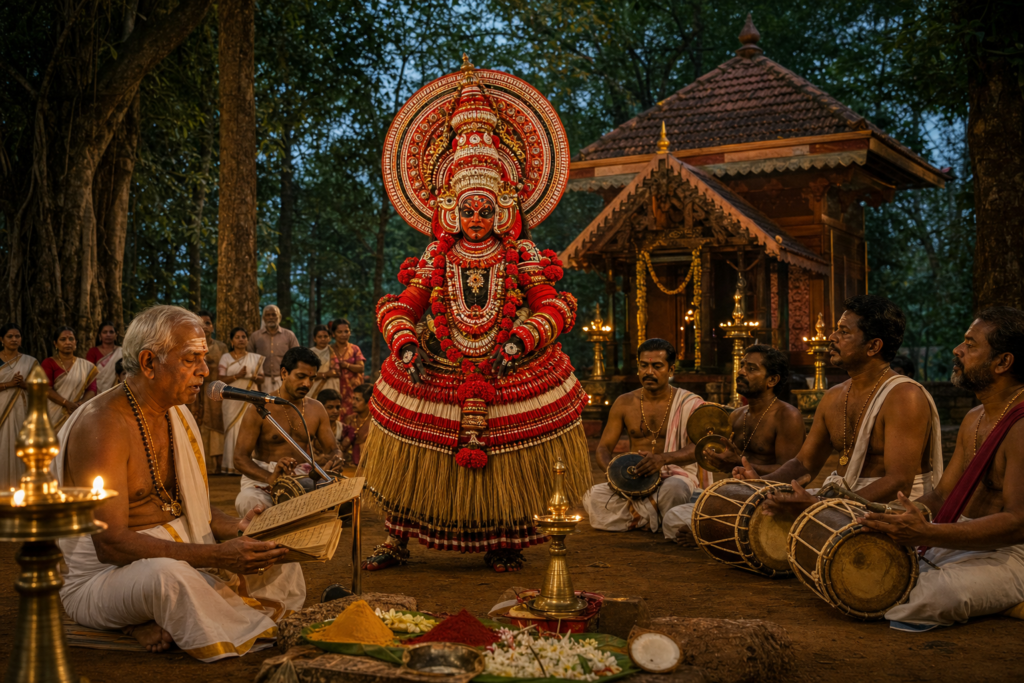
The Yamuna River, reverentially called Yamunaji and Kalindi, occupies a central place in the sacred geography of the Indian subcontinent and in the lived practice of Hindu Dharma. Its religious significance unfolds across scripture, pilgrimage, and ritual, while also embodying a unifying symbol for the wider dharmic family of Hinduism, Buddhism, Jainism, and Sikhism. From its glacial source in the Garhwal Himalaya to its confluence with the Ganga at the Triveni Sangam, Yamunaji is understood as both goddess and life-giving river, a presence that sanctifies the landscape and anchors multi-millennial traditions.
In theological terms, the river is personified as Yami, sister of Yama (the god of death) and daughter of Surya and Saranyu. Early Vedic hymns, including the Nadistuti Sukta of the Rigveda, recognize the Yamuna among the great rivers, while the well-known dialogue of Yama and Yami (Rigveda 10.10) attests to the antiquity of her cultic memory. Puranic literature expands this identity: the Skanda Purana and other compendia repeatedly extol the purificatory power of bathing in the Yamuna, emphasizing its capacity to grant inner and outer sanctity. The epithet Kalindi evokes both the dark, life-infusing waters and the river’s connection to the Kalinda range of the Himalaya.
Geographically, the Yamuna rises at Saptarishi Kund near Yamunotri (Uttarkashi district, Uttarakhand), fed by high-altitude snowfields of the Bandarpunch massif. It is a perennial, snow-fed Himalayan river whose hydrology is seasonally augmented by the Indian monsoon. Flowing roughly 1,376 km, the Yamuna traverses or demarcates the modern states of Uttarakhand, Himachal Pradesh, Haryana, Delhi, and Uttar Pradesh before its sacred confluence with the Ganga at Prayagraj. Major tributaries include the Tons and Asan in the upper catchment, and the Chambal, Sindh, Betwa, Ken, and Hindon downstream; together, they drain an expansive basin of approximately 366,000 square kilometers. This hydrological web sustains the famed Ganga–Yamuna Doab, one of the most fertile and culturally resonant regions in South Asia.
As sacred geography, the Yamuna binds a sequence of tirthas whose collective aura is central to Hindu pilgrimage. In the high Himalaya, Yamunotri is approached through arduous treks whose very difficulty is framed as tapas (austerity). Downstream, Paonta Sahib by the river in present-day Himachal signifies the Sikh tradition’s historic roots in the valley. Entering the plains, Indraprastha (linked to the Mahabharata’s Khandavaprastha) marks the Yamuna’s early urban sacredness, later mirrored by Mathura, Vrindavan, and Gokulthe Braj region where the river becomes inseparable from Krishna-lila. Further south, Agra’s riverfront ghats evoke both civilizational artistry and ritual life. The journey culminates at Prayagraj’s Triveni Sangam, where the Yamuna, Ganga, and the subterranean Sarasvati are believed to unite, forming one of the holiest confluences in Hindu Dharma.
Scriptural narratives provide the deepest texture to Yamunaji’s religious significance. In the Bhagavata Purana (notably the Tenth Canto), episodes such as Vasudeva’s midnight crossing with the infant Sri Krishna, the subjugation of Kaliya (Kaliya Mardana), and the rasa-lila along the riverbanks in Vraja consecrate the Yamuna as a theater of divine play (lila). The Mahabharata situates crucial scenes of Kuru polity near the Yamuna, with Indraprastha’s rise signaling the river’s role in the dharmic imagination of statecraft, hospitality, and righteous conduct. Collectively, these accounts portray Yamunaji as a compassionate force mediating between mortal vulnerability and divine grace.
Ritual life along the Yamuna is both intimate and grand. Daily aarti at ghats such as Keshi Ghat (Vrindavan) and Vishram Ghat (Mathura) reflects localized devotion, while seasonal and pan-Indic observances elevate the river’s role nation-wide. Yamuna Jayanti is observed in several regions in spring, celebrating the goddess’s manifestation. The bond between Yama and Yami animates Yama Dwitiya (Bhai Dooj), when siblings frequently bathe in or honor the Yamuna’s waters as a prayer for longevity and mutual well-being. At the Triveni Sangam, the Kumbh Mela and Magh Mela underscore the Yamuna’s participation in the great cyclical assemblies that articulate sacred time and collective purification through snana (ritual bathing).
Liturgical and musical traditions further consolidate Yamunaji’s place in bhakti practice. Pushtimarg venerates the Yamuna through Vallabhacharya’s celebrated Yamunashtakam, daily recited in temples and homes to honor the river as the granter of bhakti-rasa. Gaudiya Vaishnava traditions, shaped by the Braj landscape, embed Yamuna imagery in kirtan and stotra, cultivating a refined aesthetic theology where the river symbolizes the cooling mercy that tempers the heat of samsara. These textual and performative canons ensure the Yamuna’s presence in both communal temple worship and domestic devotional routines.
From the standpoint of vrata and samskara, the Yamuna plays a practical and symbolic role. The river’s water is carried as tirtha-jala to domestic shrines, used in abhisheka (ritual bathing of deities), and sprinkled in samskaras to sanctify space and participants. Sunrise offerings (arghya) to Surya by the river honor the mythic kinship of Surya, Yama, and Yami, reaffirming cosmological order (rita) and ethical duty (dharma). Observant pilgrims often plan snana on tithi-s considered especially auspicioussuch as Kartik Purnima, Magh Purnima, or Amavasyasynchronizing personal discipline with sacred lunar rhythms.
The Yamuna also exemplifies unity across dharmic traditions. The Mathura region, nourished by the river, fostered the Mathura School of Art, pivotal to early Buddhist iconography and sacred architecture. Jain heritage at Kankali Tila (Mathura) has yielded inscriptions and icons attesting to sustained Jain monastic and lay practices near the Yamuna’s course. Along the upper reaches, Gurudwara Paonta Sahib by the Yamuna memorializes the Sikh tradition’s formative era under Guru Gobind Singh, with seva (selfless service) and sangat (community) flourishing beside the river. Across these traditions, rivers are honored as living presences; the Yamuna becomes a shared locus for ethical action, meditation, learning, and servicean emblem of dharmic pluralism in practice.
Historically, the Yamuna–Ganga Doab facilitated trade networks, agricultural wealth, and urban formations that sustained temple complexes, monasteries, gurudwaras, and learning centers. Indraprastha–Delhi’s long urban history, Agra’s riverfront, and the Braj mandala’s sacred ecology illustrate how civic life and sanctity co-evolved around the river. Archaeological, epigraphic, and literary records collectively affirm that the Yamuna valley has been a crucible of civilizational synthesis where sacred ritual, aesthetic expression, and pragmatic statecraft converged.
Dharmic ecology frames care for the Yamuna as a spiritual imperative. Traditional ethics, expressed through the Panchamaha-yajnas, include Bhuta-yajnacare for living beings and the elementsencouraging communities to protect rivers as embodiments of the five great elements (pancha-mahabhuta). Contemporary environmental science converges with this worldview by emphasizing ecological flows, pollution control, floodplain restoration, and watershed stewardship. When communities reduce plastic use at ghats, support clean-flow initiatives, and honor local conservation norms, they operationalize a timeless teaching: reverence is incomplete without responsibility.
For pilgrims and visitors, respectful engagement enhances both sanctity and sustainability. Best practices include: choosing designated bathing points; participating in aarti and seva with humility; avoiding ritual offerings wrapped in plastic; supporting conservation-minded temple and community initiatives; and learning local histories to deepen appreciation of place. Approached this way, a yatra along the Yamuna becomes more than movement through space; it becomes a disciplined journey through meanings that link scripture, ritual, art, and ecology.
In synthesis, the religious significance of the Yamuna River arises from the confluence of theology (as Yami and Kalindi), sacred narrative (Krishna-lila and Kuru polity), pilgrimage (from Yamunotri to Triveni Sangam), and dharmic ecology (reverence expressed as practical stewardship). Its banks have sheltered rishis, sages, saints, artists, and seekers across Hindu, Buddhist, Jain, and Sikh lineages, showing how a river can bind multiple paths into a shared civilizational current. To honor Yamunaji today is to recite her stotra, to remember her stories, to bathe with mindfulnessand to ensure the river flows clear for future generations who will continue to see, in her waters, a reflection of the sacred.
Inspired by this post on Hindu Pad.