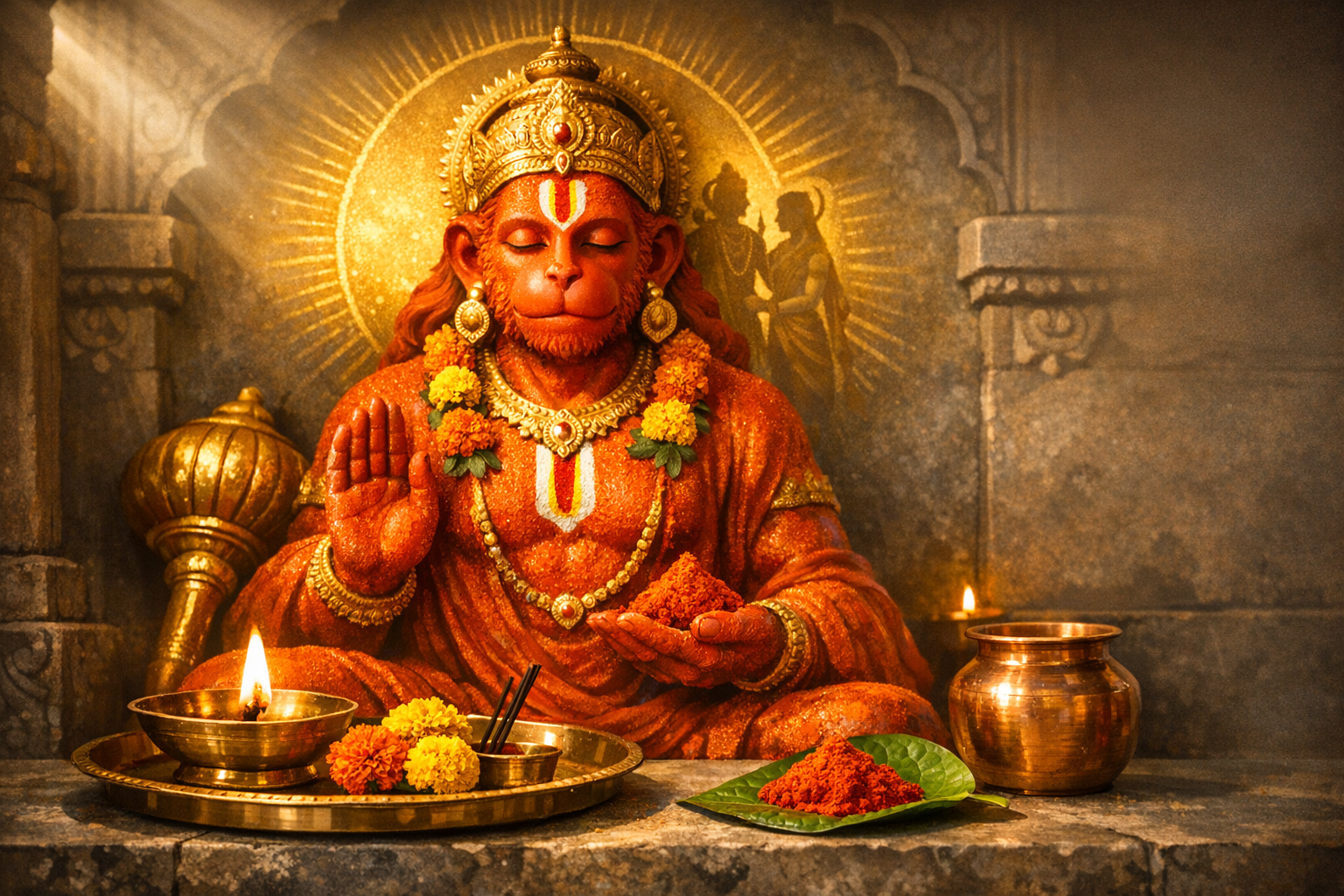
Across India, the striking orange glow of Hanuman murtis immediately invites the question many devotees and visitors ask: why is Lord Hanuman covered with sindoor, and what is the significance of sindoor in Hanuman puja? Exploring this question illuminates a living nexus of legend, ritual practice, iconography, and shared values across dharmic traditions.
A widely cherished North Indian devotional legend recounts that Hanuman once observed Sita mata applying sindoor in the parting of her hair. On asking its purpose, Sita explained that she wore sindoor for the long life and well-being of Sri Rama. In response, Hanuman smeared his entire body with sindoor, reasoning that a small amount benefits Rama, so a full-body application must please Rama even more. Pleased with this boundless bhakti, Rama is said to have blessed that worshippers who offer sindoor to Hanuman with sincerity would receive protection and fulfillment of righteous wishes.
From a historical and textual standpoint, this account circulates primarily through late-medieval oral and regional traditions closely associated with Ram bhakti literature. While the earliest strata of the Ramayana tradition do not record this episode verbatim, the legend’s popularity across North and West India demonstrates how living traditions often canonize devotion through practice. In temple worship, this has taken material form as shendur (Marathi) or sindooram, which devotees recognize as both ritual adornment and symbolic theology in action.
Iconographically, the red–orange coating is read through multiple lenses. First, it is a visual proclamation of Hanuman’s unqualified devotion to Sri Rama, the very heart of the bhakti tradition. Second, the color corresponds to energy, courage, and tapas; its fiery hue aligns with Agni while simultaneously evoking Hanuman’s Vayu-tattva as a dynamic, protective force. Third, in many regions, the oil-based shendur layer historically served as a protective coating for metal or stone images against humidity and wear, linking practical conservation with ritual aesthetics.
The materials used for the offering vary. Traditional preparations include natural red ochre (gairika), turmeric-lime kumkum that acquires a red tint, and regionally prepared shendur mixed with til (sesame) oil for application. In contemporary practice, many temples emphasize safe, non-toxic formulations and discourage chemical vermilion containing heavy metals. This shift reflects a broader commitment to dharma that embraces care for health, the environment, and sacred art.
Symbolically, the red–orange palette communicates more than color. In classical Indian aesthetics and ritual theory, pigment application (alankara) expresses the deity’s qualities: bravery, prana-shakti, steadfast service (seva), and protective benevolence. For many households, offering sindoor to Hanuman is therefore a daily or weekly enactment of the larger spiritual aspiration to align one’s energy with seva and courage. This is why the question “why we apply sindoor to Lord Hanuman” is inseparable from the answer that it signifies a vow to embody Hanuman’s virtues.
Hanuman worship is also associated in popular belief with relief from planetary afflictions, especially those of Shani. In this devotional frame, the vivid sindoor acts as a reminder of Hanuman’s fearless presence and his capacity to stabilize the mind during periods of strain. Although the efficacy of upaya must ultimately be understood as resting in sincere bhakti and ethical living, the ritual’s consistency helps cultivate discipline, focus, and a protective mental posture.
Importantly, the color and its meanings resonate across dharmic traditions. Saffron and deep orange, emblematic of renunciation and inner fire, are honored in Hinduism, Buddhism, Jainism, and Sikhism as symbols of restraint, service, and truth-seeking. Seen in this light, Hanuman’s sindoor becomes a bridge: it honors a specifically Vaishnava bhakti narrative while reflecting a wider dharmic palette that celebrates courage, compassion, and dedication to the common good.
The importance of Hanuman puja with sindoor can be approached in three integrated ways. Theologically, it honors the Hanuman–Sri Rama–Sita mata relationship and models perfect bhakti. Psychologically, it offers a ritual container for resilience, clarity, and one-pointedness. Culturally, it safeguards an intergenerational memory practice that unites households and communities around seva and moral courage.
For those seeking how to do Hanuman puja at home with sindoor, the following step-by-step outline reflects common, widely accepted practice. Regional sampradaya guidance should be respected where applicable, as local customs add meaningful nuance.
1) Preparation: Clean the space and the murti or picture of Hanuman. Assemble a small lamp (deepa), water, flowers (especially marigold), betel leaves if available, fruits or jaggery-based naivedya, incense, natural kumkum or shendur, and a clean cloth. Devotees commonly choose Tuesday or Saturday at sunrise or twilight, but daily worship is equally auspicious.
2) Sankalpa: With hands folded, mentally state the intention to perform Hanuman puja for inner strength, clarity, and the welfare of all beings. This aligns the ritual with dharma and the spirit of universal goodwill cherished across dharmic paths.
3) Dhyana and Invocation: Light the lamp and incense. Focus on Hanuman’s formhumble, powerful, and eternally devoted to Sri Rama. A simple dhyana mantra such as “Om Hanumate Namah” may be chanted 11, 21, or 108 times. Some recite “Shri Ram Jai Ram Jai Jai Ram” to anchor the mind in Rama-bhakti before offerings.
4) Alankara and Sindoor Offering: Offer water, flowers, and akshata (unbroken rice, if used in the tradition). Apply a small tilak of sindoor or shendur to the imagetraditionally at the chest or feet of the murti or on the frame of a photo. If the temple or home murti is sensitive to pigmentation, place the sindoor on a betel leaf or a designated plate before the deity to symbolize the offering.
5) Stotra and Parayana: Recite Hanuman Chalisa, Bajrang Baan, or selected verses from Sundara Kanda as per regional practice. Even a short, focused recitation daily often proves more stabilizing than longer readings performed irregularly. The devotional literature itself continually answers the question of the significance of sindoor in Hanuman puja by praising Hanuman’s fearless seva and unwavering remembrance of Sri Rama.
6) Naivedya and Aarti: Offer fruits, jaggery, or other satvic naivedya. Perform aarti (for example, “Aarti Kije Hanuman Lala Ki”), rotating the lamp clockwise with measured attention. Conclude with pranam and distribute prasada reverentially.
7) Japa and Shanti-Prarthana: Conclude with brief japa or a universal peace prayer, dedicating merits to family, community, and all beings. This gesture embeds Hanuman puja in the larger ethos of interdependence central to Hinduism, Buddhism, Jainism, and Sikhism.
Temple etiquette and conservation considerations are increasingly emphasized. Many temples guide devotees to avoid smearing thick layers of chemical sindoor directly on ancient images to prevent surface degradation. Offering natural, non-toxic sindoor in moderationor symbolically on a leafbalances devotion with stewardship of sacred heritage.
Common questions arise in practice. Is sindoor compulsory for Hanuman puja? No. The heart of the ritual is devotion; flowers, chandan, vibhuti, or simple pranam offered with sincerity are fully acceptable. Can women offer sindoor to Hanuman? Yes; in contemporary practice, all devoteesirrespective of genderparticipate in this seva, subject to local customs and temple guidelines. Does the color have to be bright orange? Not necessarily; regional traditions use varying shades of red and orange grounded in available natural materials and local aesthetics.
From a broader dharmic perspective, the sindoor offering foregrounds values rather than exclusivity. Its vivid hue honors tapas, seva, fearlessness, and compassionvirtues that resonate across the dharmic family. When communities gather on Tuesdays, Saturdays, or Hanuman Jayanti, the visual tapestry of sindoor becomes a shared reminder that personal strength is inseparable from collective well-being.
Ultimately, the importance of Hanuman puja with sindoor rests in alignment. The legend of Sita mata and Hanuman articulates an ethos of boundless devotion; iconography renders that ethos visible; ritual practice trains the mind in steadiness and service. When approached with knowledge, care for health and heritage, and a spirit of unity, this seemingly simple act answers the original questionwhy we apply sindoor to Lord Hanumanby guiding practitioners toward inner courage, compassionate action, and unwavering remembrance of Sri Rama.
Inspired by this post on Hindu Pad.