
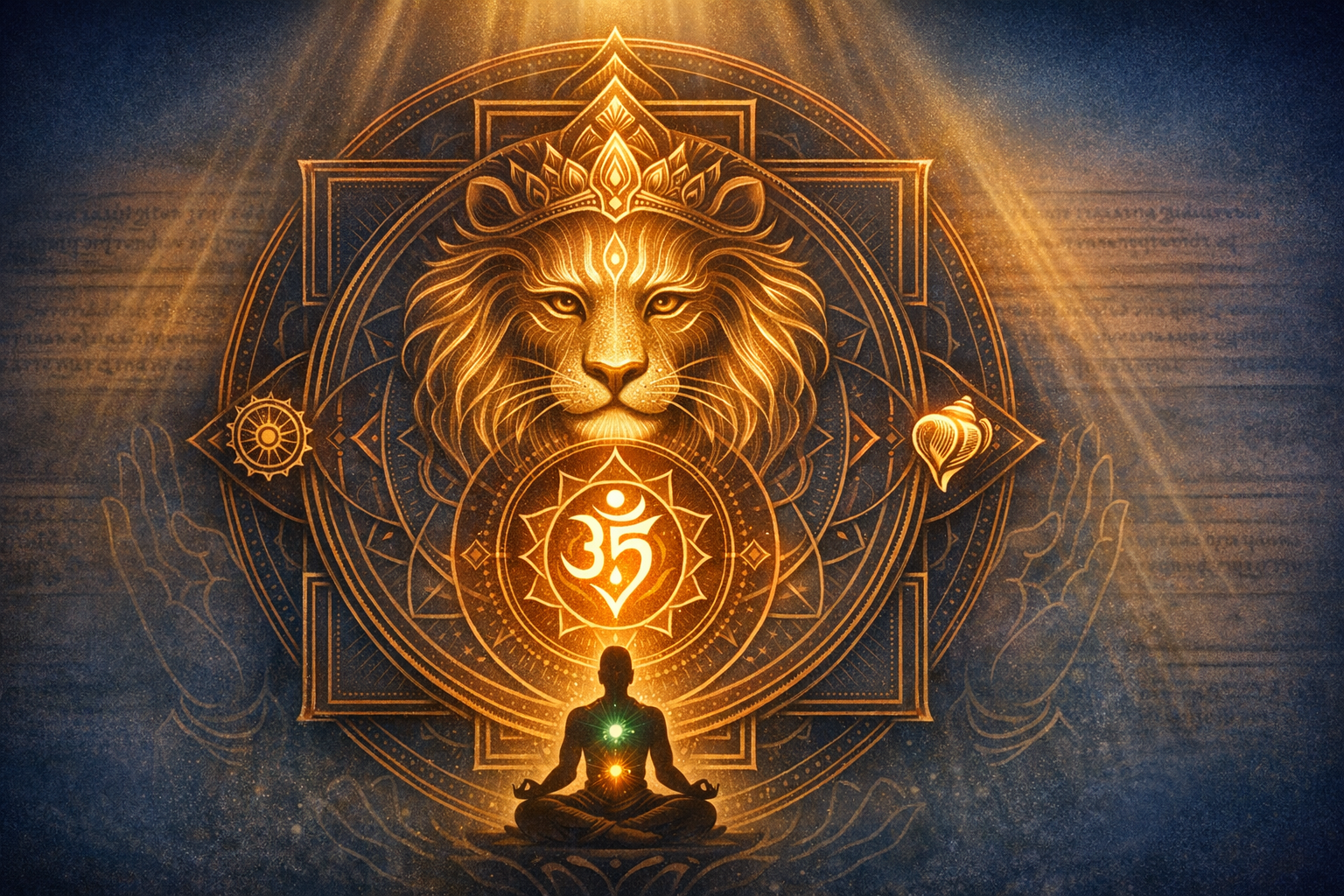
The Nrisimha Tapaniya Upanishad occupies a distinctive place within the corpus of Vaishnava Upanishads, especially where Tantric Vaishnavism and mantra-shastra intersect. Traditionally associated with the Atharvaveda and transmitted across several medieval recensions, it presents Lord Nrisimha (Narasimha)the man-lion manifestation of Vishnuas a principle of protective wisdom and fierce compassion. The Purva (earlier) section is commonly divided into five khandas (chapters), and the second khanda is renowned for its concentrated exposition of mantra potency, ritual mapping, and contemplative praxis centered on Nrisimha.
Scholarly consensus generally situates the composition and consolidation of the Nrisimha Tapaniya Upanishad in the late classical to medieval period, when regional devotional communities and Tantric exegetes systematized mantra theology alongside bhakti. While dating remains debated, philological features, the Upanishad’s alignment with Pancharatra idioms, and its emphasis on bija (seed syllables), nyasa (ritual installation), and dhyana (contemplation) support a milieu in which ritual technology and philosophical inquiry matured together. The text’s leitmotif is “tāpanīya”what is annealed, tested, and refinedinvoking tapas (ascetic heat) as an interpretive key to spiritual transformation.
Within this framework, the second khanda advances a technical theology of the Nrisimha mantra as both revelation and instrument. It treats mantra not merely as sound, but as encoded metaphysics: phonemes, meters, and intonations correspond to cosmological categories, deific powers, and psychological states. Nrisimha is articulated as the immovable axis of fearlessness, and the mantra as a disciplined approach to make that axis experientially present. The khanda’s intent is soteriologicalclarifying how right knowledge (jnana), devotion (bhakti), and practice (abhyasa) converge through properly received mantra-vidya.
A hallmark of the Nrisimha cycle is the prominence of the bija kṣrauṁ (often transliterated kshraum). In Tantric hermeneutics, seed syllables are read through layered associations: consonantal power, vowel expansion, and bindu closure. Without committing to any single school’s exclusive etymology, traditional exegesis commonly identifies kṣ as a principle that “cuts” through decay and duality, r as fiery transformation, au as plenary expansion, and ṃ (bindu) as integrative stillness. The second khanda’s focus on potency coheres with such interpretive grammars: the bija is not an ornament to the mantra but its concentrated heart, the point from which protection, clarity, and fearlessness radiate.
Closely aligned with the khanda’s intent are mantra forms transmitted in Vaishnava and Tantric practice lineages that many exegetes read in light of the Upanishad’s teaching. Two widely known forms are: Om Namo Bhagavate Narasimhāya and the Nrisimha Gayatri, Om Nṛsiṁhāya Vidmahe Vajranakhāya Dhīmahi Tanno Nṛsiṁhaḥ Prachodayāt. Textual families differ on precise attributions, but practitioners consistently treat these as compatible with the second khanda’s program: to instill a non-dual courage that protects dharma externally and dissolves inner turbulence. The prayer Ugram Vīram Mahāviṣṇum Jvalantam Sarvato-Mukham Nṛsiṁham Bhīṣaṇam Bhadram Mṛtyor Mṛtyum Namāmy Aham is also revered in devotional circles; it functions as a doxology whose semantics echo the Upanishadic portrayal of a radiant, all-facing presence that conquers mortality.
Mantra architecture in the second khanda is best understood through the classical triad of ṛṣi (seer), chandas (meter), and devatā (deity), together with anga-nyasa (installation on the limbs) and kara-nyasa (installation on the hands). Vaishnava Tantric handbooks often assign rishi, meter, and deity in a way that integrates Prahlada’s insight, the Gayatri chandas for contemplative steadiness, and Nrisimha as the devata of protective gnosis. Although particular assignments differ across traditions, the shared method is consistent: prepare the body as a sanctum (deha-mandira), align breath and attention, and “install” the mantra so that recitation transforms from external speech into interiorized awareness.
The khanda’s ritual grammar typically unfolds as dhyana (iconographic contemplation), nyasa (somatic sanctification), japa (repetition), and, in some lineages, kavacha (protective encirclement) and yantra (geometric support). The dhyana portrays Nrisimha as simultaneously fierce and auspicious, signaling a hermeneutic of “terrible grace”: the very force that dissolves adharma serves as compassionate refuge. Nyasa maps mantra syllables onto the head, heart, shoulders, and vital centers; in contemporary language, this can be correlated with yogic anatomy to cultivate presence in the anahata (heart) and manipura (solar) regions, tempering fear with lucid resolve.
Read philosophically, the second khanda invites a double movement: outwardly, a commitment to dharmic protection and ethical clarity; inwardly, a dismantling of asuric (discordant) tendenciesanger, fear, forgetfulness of the Self. Practitioners often report that steady japa, framed by dhyana and nyasa, yields experiential shifts in attention: from agitation to one-pointedness, from reactivity to discernment. Such testimony is congruent with the Upanishadic arc in which mantra ripens into knowledgesound consumed in meaning, and meaning resolved in silence.
Comparative perspectives across the dharmic spectrum underscore the Upanishad’s enduring relevance and the unity of purpose among Hinduism, Buddhism, Jainism, and Sikhism. Vajrayana Buddhism’s dhāraṇī tradition likewise encodes compassion and wisdom into sonic forms for protection and awakening. Jain mantra discipline, including the Namokar Mantra and beejakshara exegesis, emphasizes purification and equanimity through measured repetition. Sikh nāma-simran centers the heart on the Divine Name as living presence. These parallel commitmentsto ethical clarity, contemplative discipline, and compassionate actionexemplify a shared civilizational grammar, even as ritual languages and symbols vary.
Because the second khanda operates at the confluence of theology and technique, responsible practice emphasizes guidance, context, and intention. Tantric Vaishnava lineages recommend receiving specific mantra-vidya under a qualified acharya to ensure correct pronunciation, meter, and nyasa. Simultaneously, widely venerated formulae such as Om Namo Bhagavate Narasimhāya are accessible to the broader community and are often adopted for daily remembrance (smarana) with a spirit of humility and non-harm. The Upanishad’s aim is not sectarian exclusivity but inner refinement and fearless compassion, outcomes that resonate across the dharmic traditions.
Historically, the Nrisimha Tapaniya Upanishad stands at an exegetical crossroads where bhakti intensifies rather than eclipses inquiry. Its second khanda frames mantra as a precise epistemic tool: a way of knowing that reshapes the knower. The khanda’s language of heat, annealing, and protective radiance speaks to practitioners navigating uncertaintycalling forth steadiness without aggression and courage without contempt. In a contemporary setting, this resonates as an ethic of protection wedded to insight, aligning personal transformation with social responsibility.
In summary, the second khanda of the Nrisimha Tapaniya Upanishad articulates a rigorous, compassionate science of mantra. It situates the Nrisimha bija and related formulations within a complete soteriological arc: dhyana for vision, nyasa for embodiment, japa for interiorization, and knowledge for liberation. Its Tantric Vaishnava idiom, read alongside allied practices in Buddhism, Jainism, and Sikhism, reveals not opposition but a deep consonance of aimsawakening fearlessness, safeguarding dharma, and cultivating wisdom that protects all beings.
Inspired by this post on Hindu Blog.
