Hudum Puja is a rare, rain-invoking folk ritual observed among the Koch Rajbongshi community in western Assam and adjoining North Bengal. Dedicated to Hudum Deo, a local rain and fertility deity, the rite is performed during periods of acute water stress when timely monsoon showers become critical for paddy transplantation and village livelihoods. In its symbolism, social choreography, and agrarian timing, Hudum Puja encapsulates a living archive of ecological wisdom that binds community, agriculture, and the sacred landscape of the Brahmaputra valley.
The Koch Rajbongshi, historically settled across present-day Assam (notably Goalpara, Dhubri, Kokrajhar) and North Bengal (Cooch Behar, Jalpaiguri), maintain a layered ritual repertoire that integrates pan-Indian dharmic motifs with distinct local cults. Hudum Deo belongs to this vernacular pantheon of protective forces linked to rainfall, soil fecundity, and the health of seed, grain, and livestock. The ritual is not a fixed calendar festival; it emerges as a community response to delayed monsoon or persistent drought, making it an adaptive practice within the agrarian risk-management cycle.
Theologically, Hudum Deo is understood as the animating principle of rain clouds, a guardian of crops, and a moral agent responsive to collective sincerity. In some oral accounts, Hudum is associated with attributes familiar to pan-dharmic rain archetypesechoing the benevolence of Varuna and the seasonal vigor linked with Indrayet remains emphatically place-bound and relational, responding to the village’s conduct, cohesion, and ritual propriety. This local cosmology preserves an ethic of reciprocity: when humans honor natural limits and social harmony, the sky returns its blessing as rain.
The agronomic context is essential. In the floodplains of Assam, rice cultivation follows a tight monsoonal cadence. A delayed onset of southwest monsoon, diminished pre-monsoon showers, or erratic intra-seasonal rainfall can jeopardize nursery preparation, transplanting windows, and vegetative growth. Hudum Puja is mobilized precisely at such inflection points, reinforcing a collective sense of timing: the moment to appeal, to repair field embankments, to ready seedbeds, and to rededicate village effort to the stewardship of water and soil.
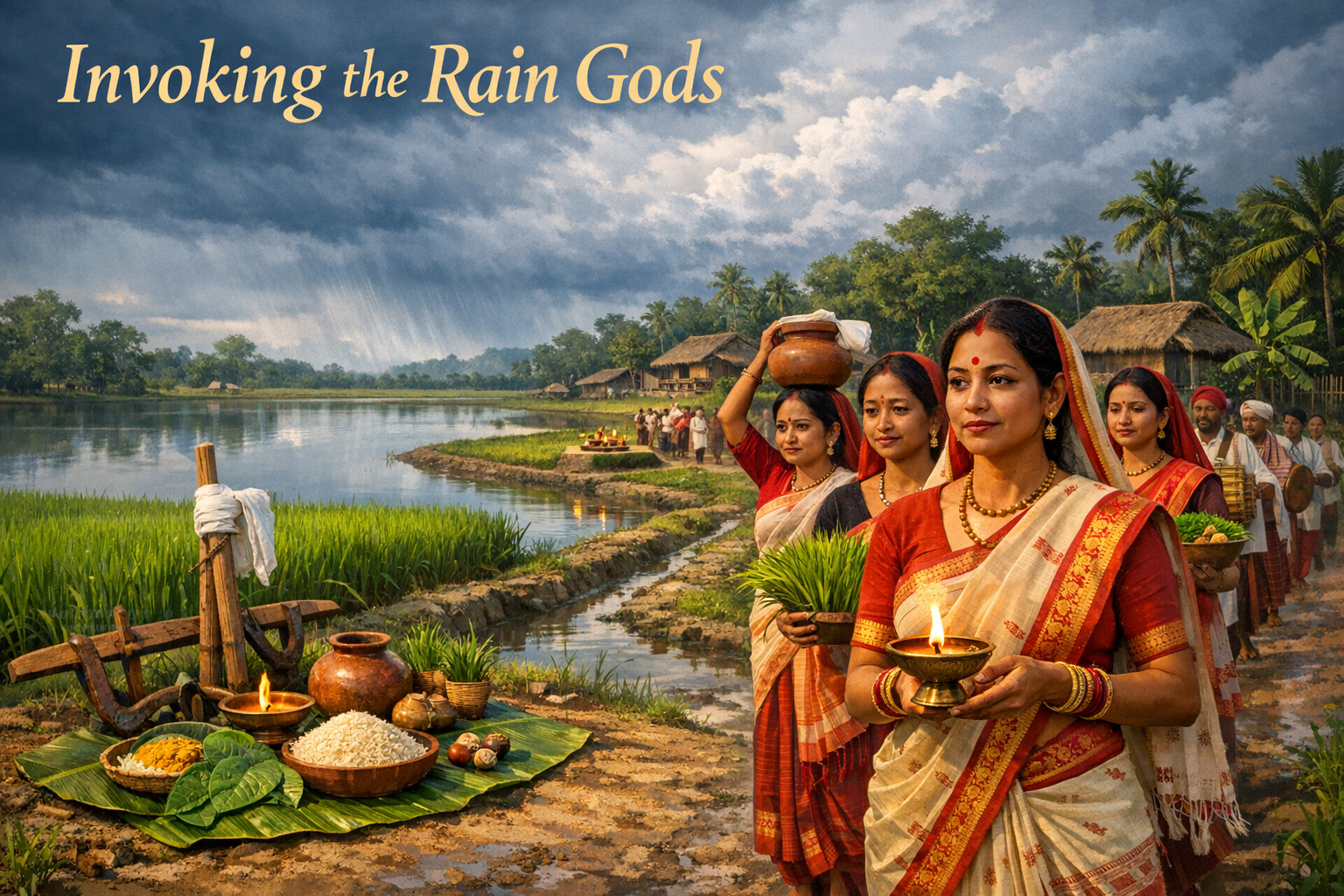
While variations exist across localities, the ritual sequence tends to converge on several elements. Womenoften married women from cultivator householdsplay primary roles as leaders, singers, and processional carriers of ritual objects such as earthen pots of water, rice, turmeric, oil lamps, and tender paddy seedlings. The procession traditionally moves from household courtyards to the margins of fields or communal water bodies, where invocations to Hudum Deo are offered. In many villages, men observe taboos during the core rite, maintaining distance to protect the ritual’s sanctity and the women’s ritual agency.
A hallmark of Hudum Puja is the performance of Hudum geetimprovised or inherited folk songs notable for their robust humor, social satire, and the frankness with which they name desires, anxieties, and failings. In certain sub-regional forms, the ritual is conducted at night and may involve deliberate norm-reversal through provocative lyrics or gestures. Ethnographers read this inversion as an old agrarian technology of the sacred: by temporarily suspending everyday decorum under ritual license, the community symbolically “shocks” a stalled cosmos into movement, coaxing clouds to gather and release rain.
Accounts also describe a carefully maintained system of privacy and consent around the rite. Where elements of partial or symbolic disrobing occurchiefly among older married women in some localesthese are conducted away from male gaze, anchored in long-standing taboos that require men to absent themselves. Such practices are never staged for spectatorship; they are guarded as community sacra. Crucially, many villages observe Hudum Puja without any form of disrobing, using songs, water offerings, and field-edge invocations to signal the appeal to Hudum Deo.
Offerings are austere and agrarian: uncooked rice, seasonal fruits, betel leaves and areca nut, turmeric, oil lamps, and pure water. The choice is environmentally consonantbiodegradable, locally sourced, and resonant with the life of the field. In some variants, a bamboo staff or plough implement is carried to the ritual site, sanctifying tools of cultivation that bind human labor to soil moisture, root growth, and the life cycle of paddy. The return procession often includes collective sprinkling of water and the blessing of seed trays, granaries, and field boundaries.
From the perspective of symbolism, Hudum Puja fuses three layers: the supplicatory (prayer for rain), the corrective (public satire that names social disharmony), and the regenerative (ritual potency to reset ecological balance). By acknowledging tensionsacross gender roles, kinship obligations, or work ethicsthe songs discharge communal strain and restore cohesion, which traditional cosmology reads as a precondition for rain. The experiential arc leads participants from worry to catharsis to renewed resolve, mirroring agrarian time in which anxiety peaks just before the monsoon breaks.
The central placement of women is neither incidental nor merely performative. In village moral economies, women preserve household ritual, seed selection wisdom, and rhythms of fasting-feasting that calibrate work and rest. Hudum Puja extends this custodianship to the public realm, inviting women to voice communal truth through Hudum geet. The inversion of everyday modestywhere it occursconstitutes a ritually delimited, consent-driven space that asserts female agency as a conduit for ecological renewal and the fertility of land and community.
Regional texture is significant. In western Assam, reports emphasize the drought-triggered, non-calendar character of the rite, its nocturnal performance, and strictures around male seclusion. In North Bengal, folk memories similarly locate Hudum Deo as a rain granter, with variations in song repertory and processional objects. These are not contradictions but microecological adaptations within a shared ritual grammar. Across sites, the litmus test remains practical: does the rite build solidarity, prepare fields and canals, and focus collective attention on impending agricultural operations?
Seen through an ecological lens, Hudum Puja works because it aligns social energy with seasonal thresholds. Before or immediately after the rite, villages often mobilize to repair bunds, unclog field channels, desilt ponds, and redistribute labor for transplanting. The ritual thus becomes a trigger for water stewardship. Even when rainfall follows as part of a broader synoptic pattern, Hudum Puja ensures the village is prepared to receive itseedbeds ready, soils moist, boundaries sealedminimizing field losses from the first monsoon pulses.
Comparative dharmic perspectives amplify this insight. In Vedic-Hindu practice, Varuna yajnas and Indra-invocations similarly entwine cosmic order (ṛta) with moral-social order (dharma). In Buddhist communities, paritta recitationssuch as Ratana Suttaare historically mobilized against communal peril, including drought, with an emphasis on truth-speaking and collective virtue. Jain ethical disciplines of aparigraha (non-possessiveness) and careful stewardship of life support mindful resource use, while Sikh Ardas and seva center communal welfare (sarbat da bhala), including the nurturing of shared water bodies (sarovars). Hudum Puja belongs within this wider dharmic ecology of interdependence, where prayer, ethics, and practical care for the commons are mutually reinforcing.
In agricultural science terms, rituals that synchronize community action with monsoon signals can improve yields simply by reducing coordination failures. Timely transplanting, evenness of seedling age, and field-level water management are all sensitive to collective timing. Hudum Puja’s affective powerits songs, satire, and catharsisturns anxiety into coordinated work, a well-documented mechanism for resilience in smallholder systems. Under climate volatility, such social technologies complement meteorology, irrigation schemes, and agronomic advisories.
Contemporary challenges, however, demand careful documentation and ethical framing. Media sensationalism can misrepresent Hudum Puja by isolating its most unusual elements from context, erasing consent protocols and agrarian purpose. Communities respond by reiterating long-standing taboos on voyeurism, insisting on privacy, and emphasizing that the rite is not entertainment but a supplicatory practice embedded in agricultural time. Responsible cultural heritage work should foreground women’s voices, village norms, and the ecology-first logic of the rite.
Safeguarding Hudum Puja as intangible cultural heritage does not require fossilizing it. Communities themselves have evolved formatseschewing elements that no longer resonate, strengthening the musical-liturgical core, and linking the rite to tree-planting, canal desilting, and soil-moisture conservation drives. Such adaptive continuity mirrors the dharmic ethos of unity in diversity: practices endure by aligning enduring principlesreverence for life, truth-speaking, communal welfarewith contemporary needs and sensitivities.
Several misconceptions merit clarification. First, Hudum Puja is not a routine festival; it is typically reserved for drought or significant delay in rainfall. Second, elements of norm-inversion, including provocative lyrics or forms of disrobing, are neither universal nor public-facing; where present, they are bounded by consent, privacy, and strict taboos on spectatorship. Third, its efficacy is not measured solely by immediate rainfall but by how effectively it catalyzes community preparedness, water stewardship, and moral renewal at decisive agrarian junctures.
For scholars and practitioners, Hudum Puja offers a layered case study: an indigenous rain rite whose ritual poetics (Hudum geet) and social choreography transform fear into solidarity; a gendered space that confers ritual leadership on women; and an ecological ethic that turns prayer into stewardship. Documenting song corpora, mapping regional variants, and studying linkages with field operations can deepen understanding of how culture serves as infrastructure for resilience.
Bridging communities across the dharmic family, Hudum Puja resonates with shared commitments to ahimsa, truthful speech, mutual care, and reverence for the natural world. When framed within this ecumenical horizon, the rite stands not as an isolated curiosity of Assam but as part of a pan-dharmic grammar of living with monsoon rhythms. In affirming that human harmony and ecological balance are inseparable, Hudum Puja speaks a language understood across Hindu, Buddhist, Jain, and Sikh traditions: the Earth responds to communities that honor her with humility, restraint, and collective action.
As climate change intensifies rainfall variability in South Asia, the wisdom embedded in Hudum Pujatimeliness, social cohesion, practical stewardshipgains renewed relevance. Strengthening local water bodies, restoring traditional field channels, diversifying seed systems, and honoring women’s ecological leadership are all pragmatic corollaries of the rite’s spirit. In this synthesis of prayer and practice, the Koch Rajbongshi offer a living testament to sacred ecology: a reminder that when people stand together for land and life, the clouds, too, may consent to gather.
Inspired by this post on Hindu Blog.