The question of why Sri Rama sent Devi Sita to exile even while fully aware of her purity has animated centuries of reflection in the Ramayana tradition. To engage this question faithfully, it is essential to distinguish two pivotal episodes that are often conflated in popular discourse: Sita’s Agni Pravesha (Agni Pariksha) in the Yuddha Kanda after the defeat of Ravana, and the subsequent exile described in the Uttara Kanda. Read together through the lens of dharma, these episodes illuminate Sri Rama’s role as Maryada Purushottamaupholder of righteous conductand Sita’s unwavering radiance as the embodiment of satya, shakti, and dignity.
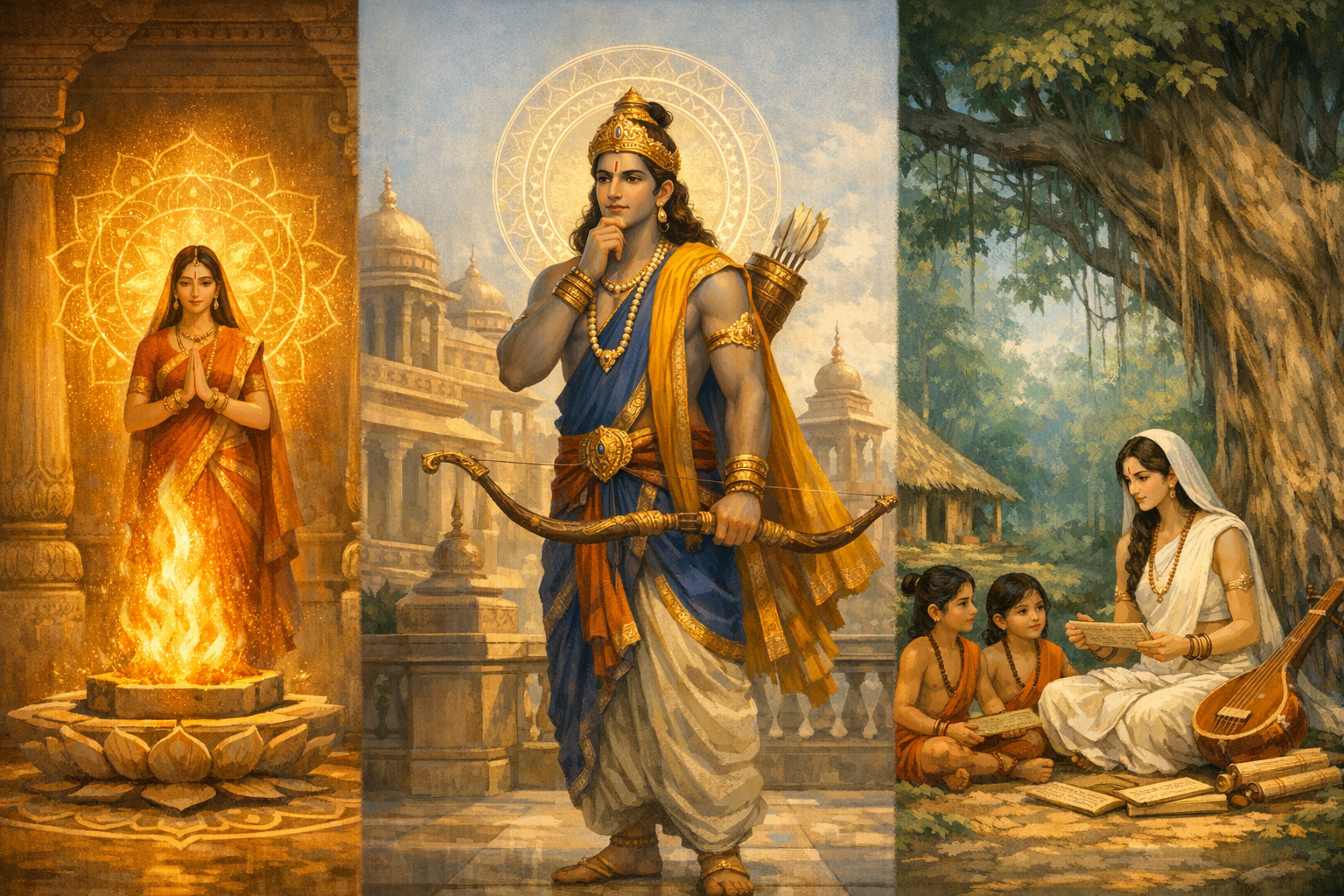
In the Valmiki Ramayana’s Yuddha Kanda, Sita’s Agni Pravesha is not a spectacle of cruelty but a theologically framed act where Agni Deva returns Sita to Sri Rama, publicly affirming that her tapas-like purity remained unsullied in Lanka. Cosmic witnesses and devas endorse her unblemished state, restoring social confidence after a war that left the polity fragile. The episode functions within a Vedic-ritual idiom wherein Agni serves as sakshi (witness) and purifier, central to sacramental rites such as vivaha; it serves less as a punitive trial and more as a juridical-theological attestation before the realm.
Later, in the Uttara Kanda, the challenge shifts from metaphysical attestation to the politics of public trust. A washerman’s (dhobi’s) insinuation becomes emblematic of a deeper concern: how should a king negotiate personal knowledge and public confidence when even a shadow of suspicion threatens institutional stability? Sri Rama’s anguish is acute; tradition consistently affirms that he never doubted Sita’s character. Yet, bound by rajadharmaarticulated in the Mahabharata’s Shanti Parva and the classical codes on kingshiphe chooses a course that preserves the crown’s credibility while ensuring Sita’s safety in Valmiki’s ashrama. The pain of that decision defines his moral dilemma.
Multiple authoritative retellings elaborate the Agni Pravesha to protect Sita’s sanctity and clarify Rama’s intent. In the Adhyatma Ramayana and in Purānic narratives such as the Brahma Vaivarta Purana (and strands noted in the Padma Purana), the “Maya Sita” doctrine asserts that the true Sita, entrusted to Agni before the abduction, was never in Ravana’s grasp; the illusory Sita alone experienced captivity. After the war, Agni returns the original Sita in the Agni Pravesha. This symbolism reframes the episode as a theological necessity rather than a human-imposed ordeal, signifying the reunion of Purusha and Shakti under divine witness.
The ritual logic of Agni as witness contextualizes why the tradition uses fire to resolve an unprecedented public doubt. In Vedic culture, sacred fire embodies truth, discernment, and purification. To present Sita before Agni is therefore to appeal to the highest liturgical arbiter available to that worldan act comprehensible within the religious-legal grammar of the time, even as contemporary ethics rightly rejects ordeals as jurisprudence. The Ramayana does not prescribe such acts as social norms; rather, it dramatizes a singular, liminal moment where cosmology, polity, and ethics intersect.
The exile in the Uttara Kanda shifts the ethical terrain from metaphysical proof to statecraft. The dhobi’s remarkwhile falsesignals perceived vulnerability in the social compact. In classical rajadharma, a ruler must be seen as impeccably aligned with dharma, for the people’s confidence is a precondition for justice, security, and prosperity. Sri Rama’s decision thus prioritizes the polity’s peace over his personal happiness, a tragic but deliberate choice that seeks to prevent a contagion of rumor from undermining the throne. The narrative repeatedly intimates that Sri Rama’s heart breaks as he orders Lakshmana to escort Sita to Valmiki’s hermitage, a sanctuary of protection and honornot a punitive exile in the wilderness.
Read as ethical biography rather than mere chronicle, the Ramayana renders Sri Rama’s choice as a case study in governance under uncertaintybalancing private certainty (Sita’s purity) against public signaling (the need for unimpeachable standards). One may analogize this, cautiously, to the principle that a ruler’s household must be beyond suspicion to forestall factionalism and instability. The decision is not a moral endorsement of gossip, but a sacrifice that refracts personal sorrow into public duty, with Sita’s welfare simultaneously secured in the most venerable of ashramas.
Devi Sita’s agency and voice remain central throughout. The tradition underscores her fortitude in embracing ashrama life, her fearless truth in the royal assembly when she later demands that Bhūmi Devī receive her if she has never swerved from dharma, and her role as mother and teacher to Lava and Kusha. In the Ramayana’s climactic movement, her return to the Earth is not defeat but vindication: a solemn covenantal act through which the Earth-goddess proclaims her innocence to all time.
The upbringing of Lava and Kusha in Valmiki’s hermitage reframes the exile as a crucible of cultural regeneration. The twins learn the Ramayana (Rama Katha), appear in Ayodhya to recite it, and catalyze social remembrance, repentance, and reconciliation. In this dramaturgy, truth triumphs not by decree but by narrative revelation; the polity heals when it hears its own deepest story, sung by those born of the very injustice it must now confront.
Bhakti-era and regional Ramayanas echo these themes in distinct idioms. Kamba Ramayanam captures the pathos and majesty of dharma, while Tulsidas’s Ramcharitmanas emphasizes Rama’s compassion, Sita’s spotless honor, and the cosmic lila behind worldly sorrow. These retellings, while varied in detail, converge on a shared verdict: Sita is pure; Sri Rama is duty-bound; their separation is a dharmic crucible, not a moral indictment of Sita.
Purānic expansions further protect Sita’s dignity through the Maya Sita doctrine, implicitly addressing modern readers’ moral discomfort with any notion of trial by ordeal. The puranic lens safeguards both theological coherence and ethical intuition: the real Sita is untouched; Agni is the guarantor of truth; Sri Rama acts within the horizons of maryada and rajadharma, not patriarchal caprice.
Across dharmic traditions, the narrative’s ethical core remains resonant. The Buddhist Dasaratha Jataka adapts the Rama story to stress renunciation, truthfulness, and the obligations of a righteous ruler. Jain Ramayana traditions (such as Vimalasuri’s Paumacariya) reconfigure characters and episodes to uphold ahiṁsā and vows, yet sustain the teaching function of the story: virtue requires discipline, leadership demands sacrifice, and truth must be vindicated through compassionate means. Sikh teachings, while invoking “Ram” primarily as a divine Name beyond any single historical figure, consistently commend maryada (righteous discipline) and just rule; these values harmonize with the Ramayana’s vision of ethical governance.
By reading Sita’s Agni Pravesha and exile with this dharmic ecumenism in mind, one sees a unifying tapestry rather than sectarian difference. Hindu, Buddhist, Jain, and Sikh wisdom streams align on core principlestruth, restraint, compassion, accountabilityguiding the seeker to integrate personal virtue with social responsibility. This unity of insight across traditions advances a shared cultural heritage that venerates Sita’s dignity and acknowledges Sri Rama’s burdened kingship.
Modern readers rightly recoil at the idea of subjecting anyone to an ordeal. The Ramayana’s own evolutionespecially through the Maya Sita doctrineanticipates this moral horizon, transporting the episode from punitive register to symbolic revelation under Agni’s witness. The text invites readers to extract ethical essence, not to replicate archaic forms; the moral that endures is the vindication of Sita’s honor and the solemn accountability of power.
Ethically, the exile is best understood as a painful statecraft decision rather than credence given to slander. Sri Rama knows Sita’s satitva; the polity must also know it, but through a process that sustains institutional legitimacy. The ashrama provides Sita safety, honor, and the space from which the truth of her life will returnsung by Lava and Kushainto the very heart of Ayodhya’s collective conscience.
On a symbolic plane, Sita (as Bhūmi’s daughter) represents the moral ground of existence; Rama represents dharma’s sovereign call; and Agni represents the luminous consciousness that discloses truth. Their separations and reunions enact the cycle through which societies forget, test, and remember the truths that sustain them. When Sita finally returns to the Earth, the narrative’s ethical equilibrium is restored in a cosmic register, and Rama’s own lila on Earth approaches completion.
For contemporary leadership, the episodes offer a rigorously challenging lesson. Private conviction does not alone secure public trust; rulers must often shoulder suffering to protect institutional integrity. Yet, the manner in which truth resurfacesthrough narrative testimony, transparent process, and the education of the next generationremains the text’s lasting instruction. The Ramayana thereby articulates an ethics of leadership marked by sacrifice, strategic restraint, and reverence for truth.
Ultimately, Sita’s Agni Pravesha and exile do not diminish Devi Sita; they magnify her. Her purity is not merely asserted; it is cosmically disclosed and socially memorialized. Sri Rama’s stature as Maryada Purushottama lies not in infallibility as a private person, but in his tireless submission of personal desire to dharma and rajadharma. Their intertwined journeys define a civilizational grammar for reconciling love with law, compassion with duty, and personal truth with public responsibility.
Read with this integrative understanding, the Ramayana supports unity among dharmic traditions by directing attention away from polemics and toward shared ethical aspirations. Sita stands as an eternal icon of integrity; Sri Rama stands as an exemplar of accountable power. Together they proclaim a message every age requires: dharma is luminous, truth is invincible, and society endures where compassion and responsibility meet.
Inspired by this post on Hindu Pad.