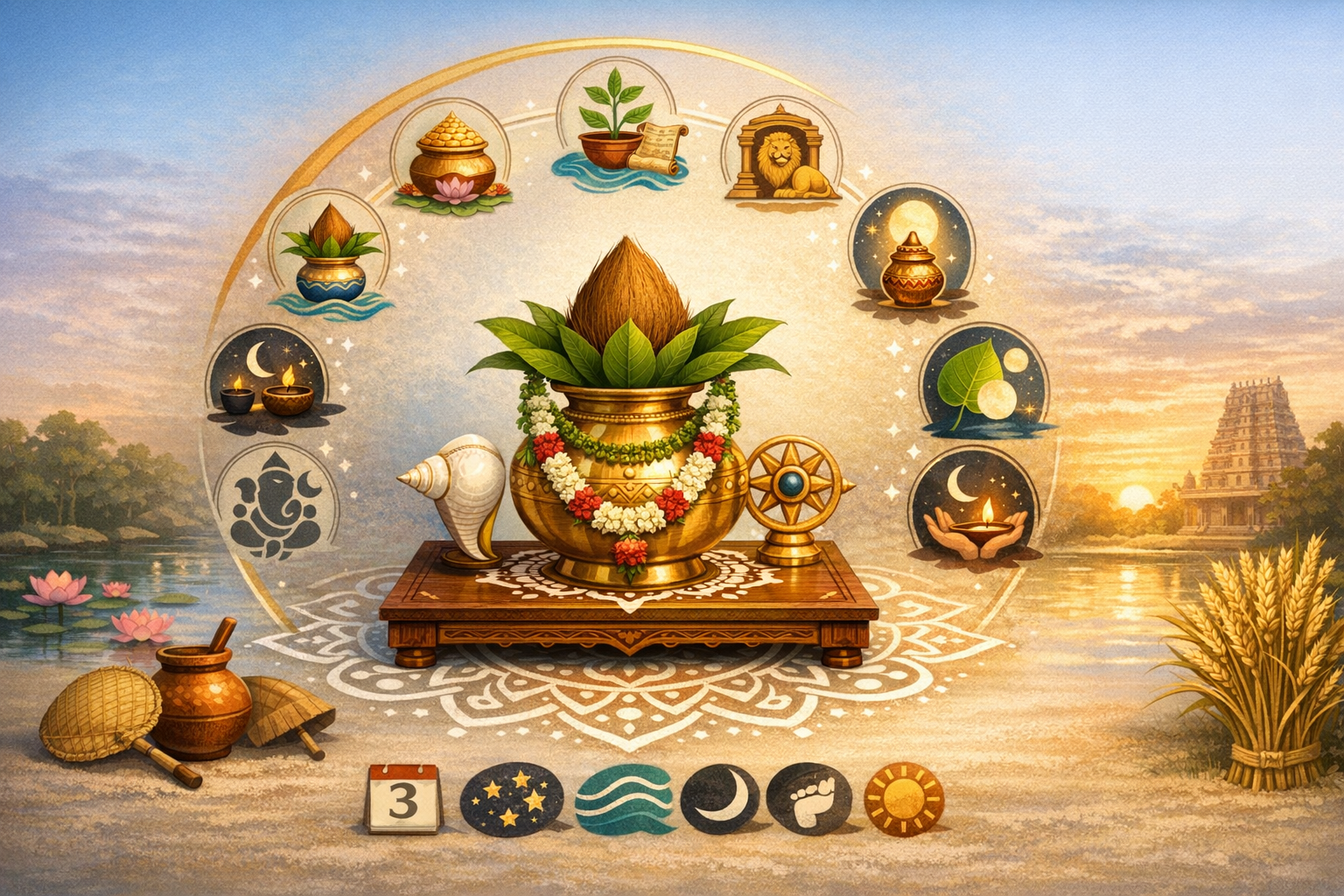
Vaishakha Masam (also written Vaisakha masam or Vaishakh month) is the second lunar month in the traditional Hindu Telugu calendar observed widely in Andhra Pradesh. In 2026, Vaishakha Masam begins on 18 April and concludes on 16 May according to the Amanta lunisolar system followed in the Telugu Panchangam. The same Amanta reckoning is customary in Maharashtra, Karnataka, and Gujarat, ensuring broad regional alignment. This sacred period is dedicated to Lord Vishnu and is reverentially known as Madhava Masam.
The technical framework of the Telugu calendar is lunisolar: months (masam) are defined by lunar cycles while seasons track the solar year. In the Amanta system, a lunar month commences the day after Amavasya (new moon) and ends on the next Amavasya. Consequently, Vaishakha Masam 2026 spans the fortnight of Shukla Paksha (waxing phase) followed by Krishna Paksha (waning phase), fully contained between 18 April and 16 May.
Panchang computations rest on five limbs: Tithi (lunar day), Nakshatra (lunar mansion), Yoga, Karana, and Vara (weekday), all referenced to local sunrise. Because tithi boundaries do not align neatly with the civil clock and vary by longitude and latitude, local sunrise-based Panchangam values can shift festival observances by a day across cities. For precise ritual timing, verified city-specific Telugu Panchangam data should be consulted, especially for vrata, sankalpa, and temple observances.
Madhava Masam is classically considered auspicious for Vishnu upasana. Dharma texts and Puranic sources extol Vaishakha as a month of intensified punya through snana (sacred bathing, ideally at sunrise), dana (charity), japa (mantra recitation), homa, and vrata. Traditional guidance emphasizes offering coolants (such as water, buttermilk, sharbat, hand-fans, and umbrellas) and performing annadanam, reflecting both seasonal compassion and spiritual merit. Vishnu Sahasranama, Gita parayana, and Satyanarayana puja during Purnima are particularly recommended.
Convergence across dharmic traditions is especially visible in this month. Vaishakha Purnima is observed as Buddha Purnima (Vesak) by Buddhists worldwide, commemorating the birth, enlightenment, and parinirvana of the Buddha in many traditions. Jains mark Akshaya Tritiya within Vaishakha Shukla Paksha as the day of Varshi Tapa Parana associated with Bhagavan Rishabhanatha, highlighting ideals of tapas and ahiṃsa. Sikh communities celebrate Vaisakhi around mid-April, aligning with the solar entry into Mesha (Aries) and the establishment of the Khalsa, thereby resonating closely with the onset of the Vaishakh season. These interconnected observances underscore a shared ethical and spiritual ethos among Hinduism, Buddhism, Jainism, and Sikhism, strengthening unity in the broader dharmic family.
The overarching structure of Vaishakha Masam 2026 comprises Shukla Paksha from 18 April onwards, culminating in Vaishakha Purnima in early to mid-May, and Krishna Paksha thereafter, concluding at Amavasya on 16 May (local variations apply). Within this framework fall several major observances that shape household rituals, temple utsavams, and community life in Telugu-speaking regions and beyond.
Akshaya Tritiya (Vaishakha Shukla Tritiya) is a pan-Indian holy day of enduring merit, celebrated as an auspicious muhurta when works begun are believed to attain sustainable success. In Telugu tradition, it is ideal for Lakshmi-Narayana puja, commencement of noble ventures, griha-pravesha subject to muhurta validation, and acts of dana. Parashurama Jayanti is also observed on this day in many sampradayas, foregrounding dharma, courage, and restraint. In the Jagannath tradition, Chandan Yatra begins on Akshaya Tritiya, a practice mirrored in numerous Vaishnava temples across South India.
Ganga Saptami (Vaishakha Shukla Saptami) venerates the re-manifestation of the sacred Ganga narrated through the Jahnu rishi tradition. Even where the Ganga is geographically distant, the vrata is observed through ritual snana, arghya, and stotra recitation, with the spirit of the rite harmonized to local tirthas and temple tanks.
Sita Navami (Vaishakha Shukla Navami) honors Devi Sita as the embodiment of steadfast virtue, ecological harmony, and patient strength. Families in Andhra Pradesh often perform simple household pujas reading passages from Ramayana, accompanied by satvik offerings and a sankalpa for balance and resilience in family life.
Mohini Ekadashi (Vaishakha Shukla Ekadashi) is observed with fasting and Vishnu worship, recalling the Mohini avatara as the principle of protective discernment that safeguards dharma. The vrata encourages measured speech, mindful consumption, and the cultivation of sattva guna.
Narasimha Jayanti (Vaishakha Shukla Chaturdashi) commemorates the avatara that restored cosmic order by dissolving adharma. In the Telugu sacred geography, Ahobilam and numerous Sri Narasimha temples conduct elaborate alankarams and special sevas, while households observe fasts, recite Sri Lakshmi-Narasimha stotras, and reflect on courage, compassion, and righteous protection.
Vaishakha Purnima aligns with multiple observances: Sri Satyanarayana Vratam in many Telugu homes and temples, Kurma Jayanti in Vaishnava traditions, and Buddha Purnima (Vesak) across Buddhist communities. The day is also esteemed for Pitru tarpanam, Vishnu Sahasranama parayana, and meditative charity. Its shared sanctity across dharmic streams is emblematic of the month’s integrative spiritual spirit.
Apara Ekadashi (Vaishakha Krishna Ekadashi) emphasizes pratyahara, inner restraint, and charitable support for those in need, leading practitioners toward ethical clarity. As with all Ekadashis, local Panchang timings for fasting, parana, and sunrise alignment should be followed carefully.
Pradosha Vrata occurs twice during the monthonce in Shukla Paksha and once in Krishna Pakshaspotlighting soma-kala prayers to Shiva in the evening twilight. Many families integrate this observance alongside regular Vishnu puja during Madhava Masam, embodying harmony across Shaiva and Vaishnava practices.
Sankashti Chaturthi in Krishna Paksha brings Ganesha worship focused on obstacle removal through mantra, vrata, and moonrise-based darshan of Chandrodaya timings. The observance complements the month’s overarching thrust on sustained, obstacle-free progress initiated at Akshaya Tritiya.
Vaishakha Amavasya, concluding the month, is observed with Pitru tarpanam and prayers for ancestral peace. Acts of quiet dana, feeding birds and animals, and restraint in speech and consumption are commonly incorporated as simple, accessible dharmic practices.
In regional nomenclature, Vaishakha Masam corresponds to Vaishakh Mahina (Marathi), Vaishakha Maasa (Kannada), and Vaishakh month (Gujarati). North Indian almanacs often use the Purnimanta scheme wherein month names shift at Purnima; however, in practical observance, major Vaishakha festivals align closely across Bharat due to tithi-centric calculations. Around mid-April, the solar month of Vaisakh begins with Mesha Sankranti (solar Aries), coinciding with Vaisakhi in Sikh tradition and the onset of the agrarian cycle in many regions.
In years with intercalation (Adhika Masa), a duplicate lunar month may occur; the standard cycle is then distinguished as Nija Vaisakh Month. The 2026 Telugu Panchangam indicates a regular Vaishakha sequence from 18 April to 16 May; nevertheless, practitioners are advised to verify local sunrise-based tithi timings for all sankalpas and vratas.
Home practice during Madhava Masam often includes a morning snana, lighting a deepa, Sri Vishnu Sahasranama parayana, and offering tulasi leaves, flowers, and satvik naivedyam. Weekly routines may incorporate Thursday or Ekadashi-focused sadhana, with special emphasis on Akshaya Tritiya, Narasimha Jayanti, and Vaishakha Purnima. Charity oriented to heat reliefclean drinking water, sharbat distribution, hand-fans, and shaded rest pointsembeds ecological empathy into religious duty.
For life events, Vaishakha offers several auspicious windows, notably Akshaya Tritiya, traditionally considered a universal shubha muhurta for initiating constructive endeavors, sanctified purchases, and spiritual resolutions. Nonetheless, comprehensive muhurta selection should heed Panchang factors (Tithi, Nakshatra, Yoga, Karana, and Lagna) and local sunrise, ensuring alignment with both scriptural principles and practical circumstances.
In summary, Vaishakha Masam 2026 in the Telugu calendarspanning 18 April to 16 Mayis a spiritually fertile month honoring Lord Vishnu as Madhava, structured by careful Panchang computations and animated by vrata, dana, and parayana. Its calendar of observances, from Akshaya Tritiya and Narasimha Jayanti to Vaishakha Purnima, resonates across Hindu sampradayas while also embracing Vesak in Buddhism and seasonal consonances with Jain and Sikh traditions. In both household and temple life, Vaishakha’s enduring message is one of unity, compassion, ethical clarity, and sustained, meritorious action.
Inspired by this post on Hindu Pad.