Thirunangur, near Sirkazhi in Tamil Nadu, occupies a singular place in the sacred geography of Bharatavarsha: within a compact rural landscape lie eleven Divya Desams, each dedicated to Lord Vishnu, yet all bound by a shared mythic moment centered on Lord Shiva’s grace. This rare confluence of Shaivism and Vaishnavism is not a rhetorical ideal but a lived reality, audible in the recitation of the Nalayira Divya Prabandham and visible in the annual Garuda Sevai when the processional icons from the eleven shrines assemble in one village square. As a result, Thirunangur exemplifies a dharmic vision of unity-in-diversity that resonates across Hinduism, and by extension, with the broader ethos shared by Buddhism, Jainism, and Sikhisman ethos that honors multiple paths while upholding shared values such as dharma, ahiṃsā, and seva.
Geographically, Thirunangur sits in the fertile Kaveri delta, a short drive from Sirkazhi, amid paddy fields, sacred groves, and small irrigation channels that have sustained agrarian life for centuries. The eleven shrines lie within a few kilometers of one another, making it possible to traverse the circuit within half a day. The intimacy of the terrain stands in contrast to the vastness of the theological narrative it shelters: here, cosmic motifs of creation, preservation, and transformation are localized into village-scale liturgy, daily puja, and seasonal festivals.
According to the sthala-purāṇas (temple legends) cherished in the region, the origin of the eleven Divya Desams is linked to Shiva’s Rudra Tāṇḍava after the immolation of Satī. Tradition holds that from each fierce lock of Shiva’s matted hair manifested an aspect of the Ekādaśa Rudras. To pacify the cosmic dance and re-establish harmony, Lord Vishnu appeared, and in response to Shiva’s plea, manifested in eleven forms across the Thirunangur landscape. Thus, a single sacred event unfolded as a lattice of shrines where Vishnu (as Nārāyaṇa, Purushottama, Krishna, and other mūrti forms) and Shiva (as the initiating principle of the narrative) are jointly revered.
This narrative is not framed as sectarian competition; it is received locally as theological complementarity. Puranic literature such as the Skanda Purana and Padma Purana, along with the living commentaries of ritual and song, reinforce a hermeneutic in which Nārāyaṇa and Rudra are honored as cooperating manifestations aligned with dharma. In the Thirunangur field of temples, that hermeneutic becomes an everyday social ethic: families crossing boundaries of sect and lineage for shared service, artisans preparing vahanas, and archakas coordinating prasad offerings across shrines.
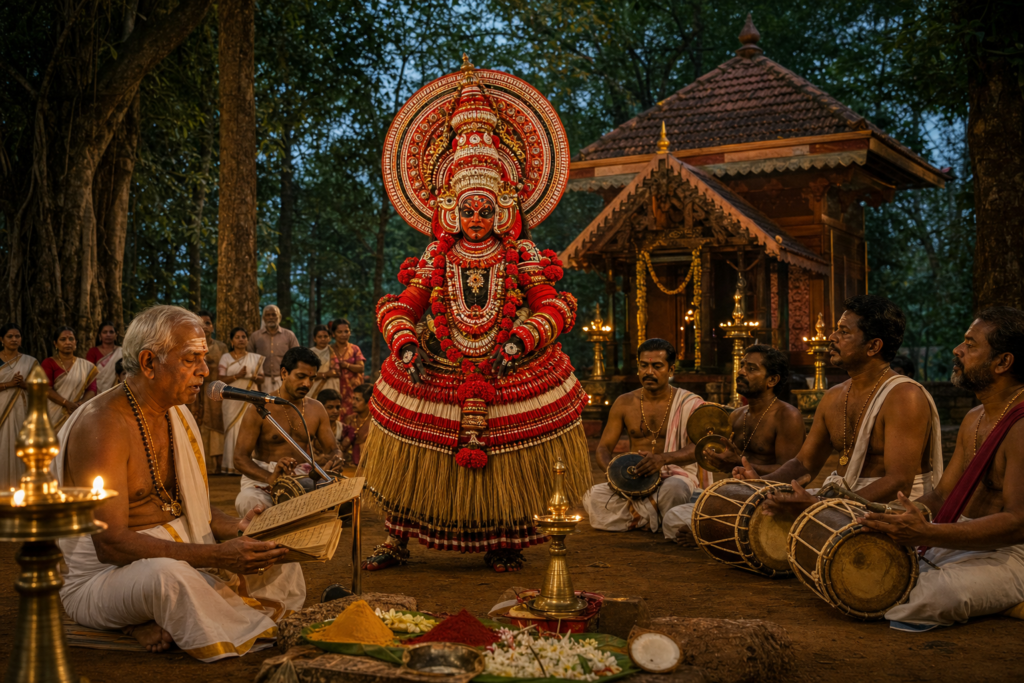
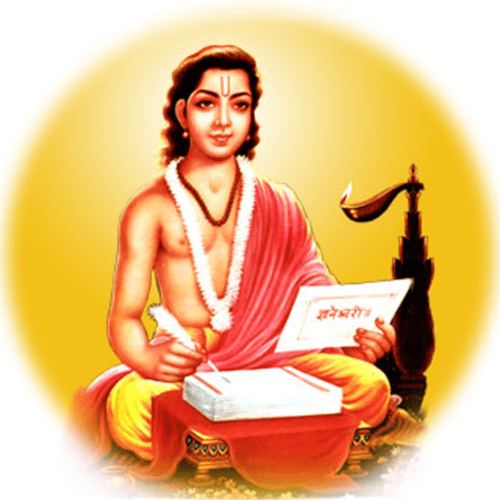
The liturgical identity of the eleven shrines is anchored in the Nalayira Divya Prabandham. Tirumangai Āḻvārclosely associated with the Sirkazhi regionsang several of these sites into the sacred canon, giving Thirunangur its distinctive place in the Vaishnava sacred map. The daily recitation of the Prabandham, alongside Vedic mantras, continues to shape ritual rhythms: morning awakenings, alankara, naivedya, and evening dīpārādhana that conclude with blessings for the welfare of all beings.
The most celebrated public expression of this unity is the Thirunangur Garuda Sevai, held in the Tamil month of Thai (January–February), typically around the new moon. On this day, the utsava-mūrtis of all eleven Divya Desams, each enthroned upon Garuda vahanas, are brought in procession to a single venue. The presiding presence of Tirumangai Āḻvār’s imageborne from nearby Thirunagarities the whole assembly together through the chanting of his pāsurams, sung before each deity in turn. Pilgrims and residents often describe a palpable stillness amid the pageantry: a moment in which the orchestration of conches, nagaswaram, and cymbals yields to a shared silence that feels both intimate and cosmic.
Several of the eleven shrines are renowned by distinctive names and mūrti forms celebrated in local memory and Āḻvār poetry: Arimeya Vinnagaram (Kudamadukkoothan), Thiru Vaikunda Vinnagaram (Vaikundanāthan), Thiru Semponsei Kovil (Perarulālan), Thiru Manimadakkovil (a Varadarāja form), Thiru Kavalambadi (Gopāla Krishna), Thiru Vellakulam/Annan Koil (Tāmarai Kannan), Thiruvanpurushottamam (Purushottaman), and Parthanpalli (Parthasārathy). Each sanctuary preserves a unique iconographic and narrative profile while being interlinked to the others by the overarching Shiva–Vishnu harmony.
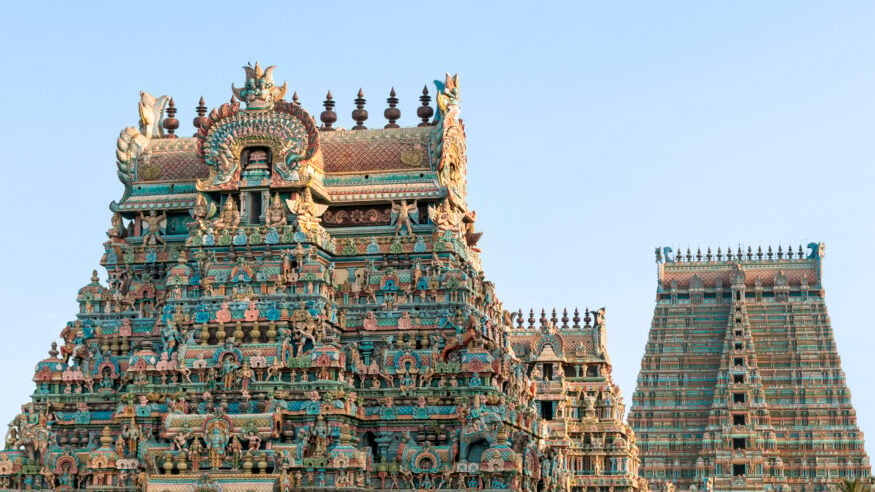
Architecturally, the temples are intimate Drāviḍa shrinestypically a garbhagriha and ardha-maṇḍapa aligned to the east, an ambulatory path within a single prākāra, and vimānas in modest tiers with lime stucco ornamentation. Inscriptions and stylistic elements suggest significant patronage during the Chola and later Nāyaka periods, with periodic renovations in the last two centuries. While none rivals the monumental scale of the great Chola temples, their proportion, light, and acoustic quality are finely tuned to the recitation of the Prabandham and the cadence of daily worship.
The ritual system in many of the shrines follows the Pāñcharātra Āgama, harmonized with regional customs. Devotees encounter a rhythm of abhisheka, alankāra, arcanā with 108 or 1008 nāmāvalis, and offerings of tulasi, butter, and chakkarai pongal. Thāyār (Lakshmi) sanctums under local epithetsoften honored as Nachiyārreinforce the theological pairing of compassion and sovereignty that defines Sri Vaishnava worship.
In historical terms, Thirunangur illustrates how living pilgrimage circuits emerge from the braiding together of puranic myth, Āḻvār poetry, and agrarian society. Donative inscriptions in and around the Kaveri deltaendowments for lamps, lands, and food offeringspoint to the participation of cultivators, artisans, and local chieftains. Even today, the Garuda Sevai depends on the cooperative labor of multiple villages, reaffirming that sacred heritage is sustained not only by theology but by community practice.
The proximity of Sirkazhia premier Shaiva kṣetra with the famed Brahmapureeswarar (Sattainathar) templeadds another layer of significance. Many pilgrims to the Thirunangur Divya Desams also pay respects at Sirkazhi, intuiting that the grace of Shiva which frames the origin story of the eleven Vishnu shrines is best acknowledged in both traditions. In this way, the local itinerary becomes a microcosm of civilizational pluralism: devotion flows from shrine to shrine without anxiety, guided by the understanding that truth is honored through many venerable forms.
From a broader dharmic perspective, the Thirunangur model of harmony echoes values found across sister traditionsBuddhism’s emphasis on compassion and wisdom, Jainism’s anekāntavāda and ahiṃsā, and Sikhism’s seva and remembrance of the One. The shared civilizational insight here is not doctrinal uniformity but ethical alignment: multiple legitimate means (upāya) for realizing the Real. Thirunangur’s sacred geography thus serves as a classroom for unity without erasure, where respect for distinct paths is not a concession but an ideal.
For pilgrims, practical planning enhances the experience. The eleven temples can be covered in a circuit of 4–6 hours by car or, for those seeking immersion, by bicycle and short walks between clusters. Typical visiting windows align with morning and evening puja; mid-day closures are common. Modest dress, mindful photography, and quiet participation in ārati help conserve the sanctity of small sanctums. The cool, clear light of December to February is ideal, with the Thai Garuda Sevai offering the most vivid immersion in the collective life of the shrines.
Environmental sensitivity is integral to sustaining the circuit. Temple tanks (pushkariṇi)often linked in narrative to Lakshmi or to episodes from Krishna’s lifeserve as ritual and ecological anchors. Respect for water bodies, careful disposal of offerings, and support for local greening efforts express an applied dharma that binds worship to stewardship of the Kaveri delta’s fragile ecosystems.
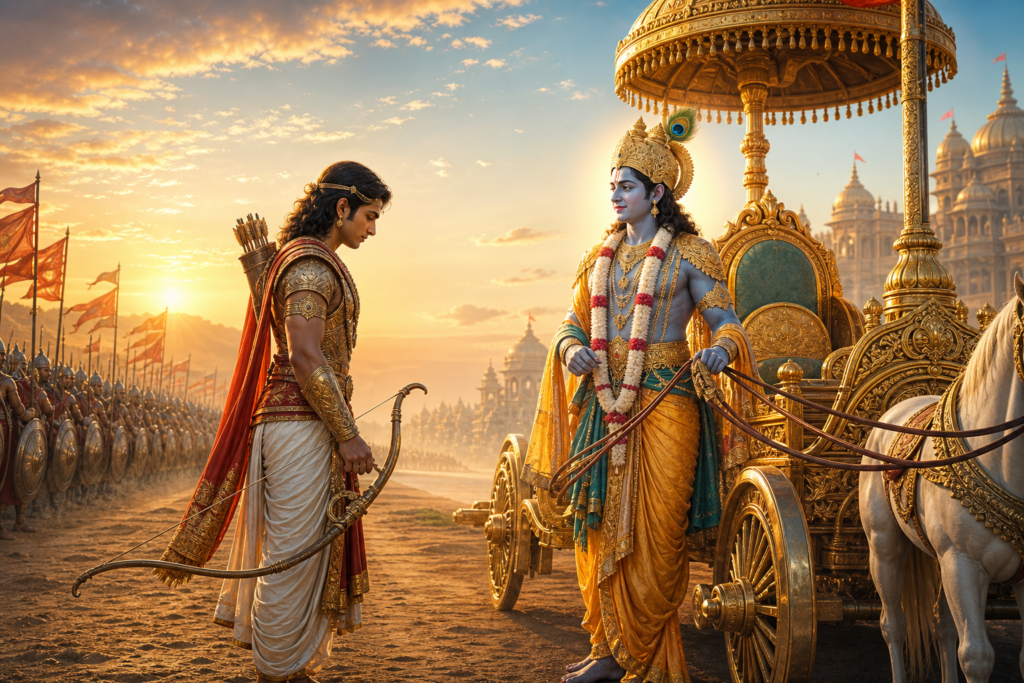
Iconographically, the Thirunangur shrines present a striking range of Vishnu forms: Krishna as Parthasārathy at Parthanpalli, Gopālan at Kavalambadi, Kudamadukkoothan at Arimeya Vinnagaram; Purushottaman at Thiruvanpurushottamam; Vaikundanāthan at Vaikunda Vinnagaram; and Tāmarai Kannan at Thiru Vellakulam/Annan Koil. Each form carries specific theological inflectionsguidance, pastoral sweetness, cosmic dance, supreme personhoodthat collectively sketch a comprehensive vision of the Divine’s accessibility to devotees of varied temperaments.
The social economy around the circuit reinforces intangible heritage: prasāda kitchens transmit culinary memory; nagaswaram and tavil ensembles sustain musical lineages; and festival craftsmen maintain knowledge of wood, cloth, and metalwork for vahanas and umbrella canopies. In an era of rapid change, these living arts tie devotion to livelihoods, ensuring that sacred and social wellbeing advance together.
Conservation remains a practical challenge for relatively small shrines. Community-led initiativescoordinated festival logistics, volunteer clean-ups, and documentation of oral historieshave proved effective. Responsible heritage visitationarriving with time, patience, and an ethos of servicecan strengthen local capacity without commodifying the sacred.
Ultimately, the Thirunangur Divya Desams articulate a profound civilizational teaching: Shiva and Vishnu, invoked together at the inception of these eleven shrines, invite devotees to see beyond polarization into a luminous complementarity. This teaching, restated yearly in the Garuda Sevai and daily in quiet archana, mirrors the wider dharmic affirmation that unity is best realized not by eliminating difference but by honoring it within a larger horizon of truth, compassion, and shared duty.
Notes on sources and variations: Local sthala-purāṇas, Āḻvār hymns from the Nalayira Divya Prabandham, and puranic references (notably in the Skanda Purana and Padma Purana) inform the narratives presented here. As with many living traditions, details of festival timing and temple-specific epithets can vary across communities; consulting each shrine’s noticeboard or local archaka ensures the most accurate, up-to-date guidance.
Inspired by this post on Hindu Blog.