
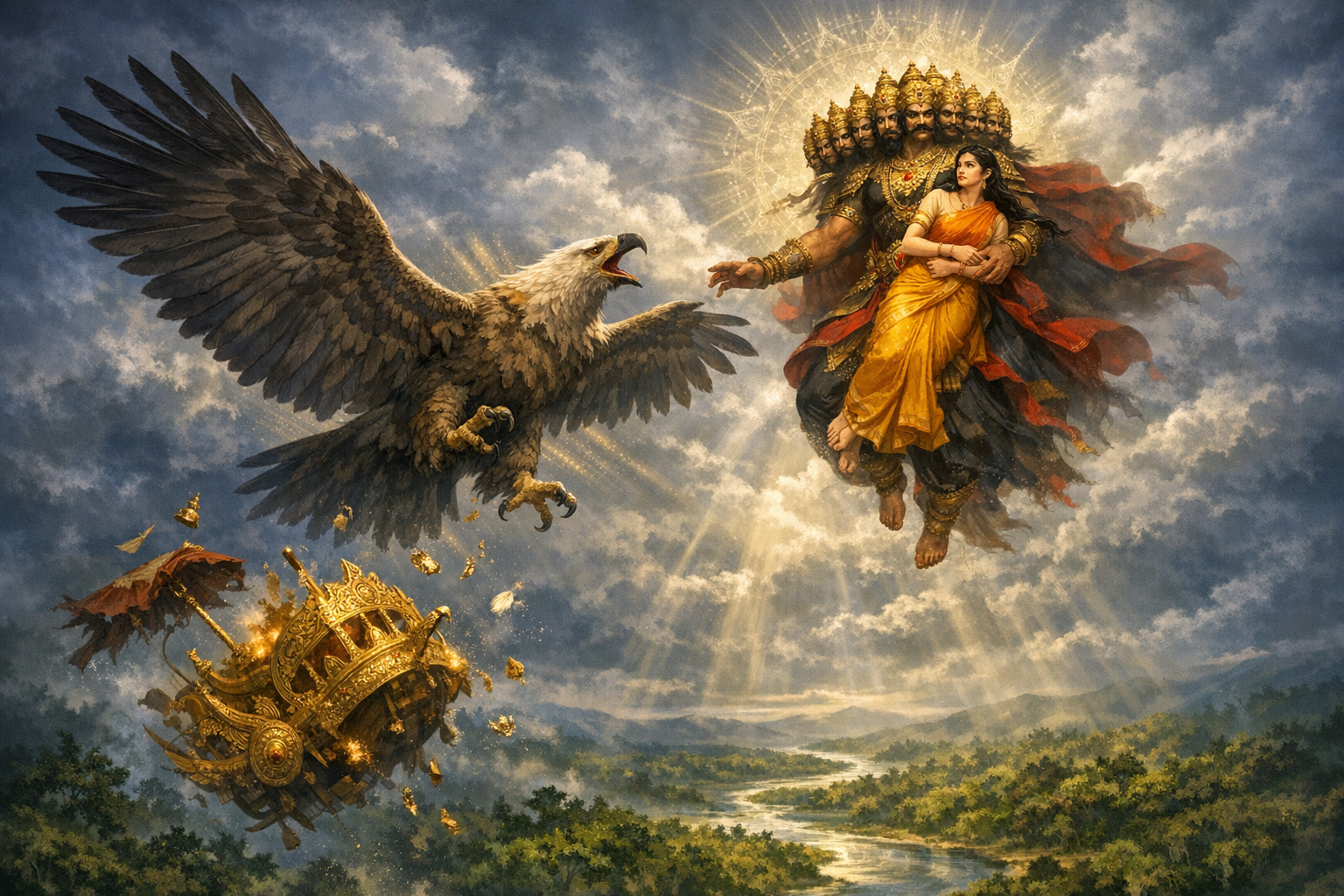
The confrontation between Rāvaṇa and Jaṭāyu during the abduction of Sītā stands among the most arresting moments in the Rāmāyaṇa. It is a scene where courage collides with cunning, and where questions about vehicles, powers, and textual fidelity converge. South Indian recensions and performance traditions often emphasize that when the celestial conveyance was disabled by Jaṭāyu’s valor, Rāvaṇa resorted to extraordinary meansmāyā and ākāśa-gamanato carry Sītā onward to Laṅkā. Understanding how and why this motif appears, and where it diverges from the better-known sequence in the Vālmīki Rāmāyaṇa, illuminates not only epic narrative technique but also the shared ethical horizon of the dhārmic traditions.
In the Vālmīki Rāmāyaṇa (Aranya Kāṇḍa), the action begins after Rāma and Lakṣmaṇa are lured away from Pañcavaṭī. Disguised as a mendicant, Rāvaṇa seizes Sītā and ascends into the sky in an aerial chariot. The ensuing battle with Jaṭāyu is vividly portrayed: the aged vulture-king intercepts Rāvaṇa in mid-flight, strikes with ferocity, and for a time compels the rākṣasa-lord to fight defensively. In this source, the chariot (ratha), rather than the Pushpaka Vimāna specifically, furnishes the initial means of aerial movement, although the text’s terminology for vehicles that traverse the sky can be supple and context-dependent.
Jaṭāyu’s assault is detailed in a sequence that emphasizes both technique and symbolism. He snaps the bow, tears the golden parasol, shatters the yoke, andaccording to several recensionskills the charioteer and disables the draft animals. The chariot’s ornaments fall, and the heavens briefly become the arena of dharma-defending resolve. Even when wounded, Jaṭāyu continues, embodying a code that values justice above life itself. Ultimately, Rāvaṇa strikes with a sword and severs both of Jaṭāyu’s wings; the defender of dharma plunges to earth, setting in motion the chain by which Rāma later learns of Sītā’s path.
What follows is the crux of the interpretive debate. The Vālmīki narration suggests that after neutralizing Jaṭāyu, Rāvaṇa once more carries Sītā skyward (variously rendered in translations as “he rose into the sky” or “he resumed his flight”), without explicit insistence that the original aerial chariot remained serviceable. This leaves narrative space for the ideaprominent in South Indian retellingsthat once the vehicle was ruined, Rāvaṇa employed his own siddhi to accomplish ākāśa-gamana, flight through the air by supernatural power, bearing Sītā toward Laṅkā.
Pushpaka Vimāna adds another layer of complexity. In the epic’s broader arc, Pushpaka (the divine vimāna originally of Kubera) is more clearly foregrounded in the yuddha’s aftermath, when Rāma returns to Ayodhyā upon it. Some recensions and later traditions extend Pushpaka’s association backward into the abduction episode itself, but the Vālmīki baseline does not unambiguously require that identification. Textual fluidity in epic traditions often permits such telescoping, enabling storytellers to give a single iconic vehicle a larger narrative footprint.
South Indian literary and performance traditions help explain why the motif of “vehicle grounded, powers engaged” gains prominence. In the Kamba Rāmāyaṇam and allied regional narratives and folk ballads, Rāvaṇa’s māyā-bala (power of illusion) and mastery of extraordinary capacities are accentuated. When Jaṭāyu’s intervention disables the conveyance, Rāvaṇa’s personal potency replaces technology: he lifts Sītā and takes to the air. In such tellings, the moral contrast is sharpenedJaṭāyu’s sacrificial courage literally brings a celestial machine down, yet adharma persists through sheer will and siddhi until Rāma’s justice intervenes.
Philologically, the terms vimāna and ratha deserve careful handling. In early and classical Sanskrit, vimāna may denote a palace, shrine, or elevated structure, and by extension an aerial conveyance; ratha more typically names the war-chariot. Epic Sanskrit often employs an elastic semantics in which a ratha may be described as air-going, while a vimāna may function as a chariot of the heavens. Pushpaka (literally “flower-decked”) acquires a distinct identity as a divine craft, yet the narratological boundary between an air-chariot and a divine vimāna is permeable across recensions, translations, and regional retellings.
Within the dhārmic imagination, ākāśa-gamana aligns conceptually with siddhis cataloged in yoga and purāṇic literature, such as laghimā (lightness) and anima (minuteness), which render movement unconstrained by ordinary physical limits. Rāvaṇa, consistently depicted as a master of māyā and formidable tapas-derived prowess, is a fitting agent for such feats. While it would be anachronistic to read modern aeronautical notions into these accounts, the epic’s own metaphysics treats aerial locomotionwhether by machine-like vehicle or yogic poweras narratively coherent modalities within a sacred cosmos.
The terrain of the abductionforests, rivers, and the sky itselfalso functions as a narrative instrument. As Sītā is borne away, she scatters ornaments and garments, a detail that becomes crucial in Kiṣkindhā Kāṇḍa when the vānaras recover these tokens and reconstruct her passage. This cartographic thread ties the Jaṭāyu episode to the larger search, linking individual sacrifice to collective actionthemes later celebrated in Sundara Kāṇḍa’s soaring depictions of faith and perseverance.
Jaṭāyu’s role carries ethical force that resonates across Hinduism, Buddhism, Jainism, and Sikhism. An elder, aware of mortal risk, places duty above personal safety to shield the innocent. Such valor mirrors the Jain emphasis on ahiṃsā fortified by fearlessness, the Buddhist bodhisattva ideal of compassionate intercession, and Sikh traditions of seva and righteous defense. The episode’s power thus lies not only in philological intrigue over vimānas and siddhis, but also in a pan-dhārmic affirmation: to uphold dharma is to protect the vulnerableeven at ultimate cost.
Iconography and performance sustain these meanings. South Indian temple panels, murals, Yakṣagāna and Kathakali aṭṭakkathā often depict Rāvaṇa airborne with Sītā while Jaṭāyu strikes upward in defiance, visually encoding the transition from conveyance to personal might. The moment of the chariot’s collapse becomes a tableau of dharma interrupting adharma’s machinery, if only briefly; audiences experience both the ache of Jaṭāyu’s fall and the conviction that his sacrifice threads justice through the narrative’s fabric.
Beyond the subcontinent, the episode appears in Southeast Asian Ramāyaṇa traditionsThailand’s Ramakien, Cambodia’s Reamker, Java’s Kakawin Rāmāyaṇa, and Myanmar’s Yama Zatdawwhere aerial imagery and magical prowess are often amplified. These versions underscore the portability of the motif: whether a named Pushpaka or an unnamed air-chariot gives way to sorcerous flight, the ethical center remains fixed on the contest between duty and predation, witness and power, compassion and coercion.
Modern scholarship, including the Vālmīki Rāmāyaṇa’s critical editions, notes the plurality of readings. Some witnesses emphasize the ratha’s continued utility; others imply its disabling, followed by Rāvaṇa’s independent ascent. South Indian recensions and vernacular compositions frequently strengthen the latter. Rather than a contradiction, this plurality functions as an epic feature: it allows the tradition to adjust emphasison technology, on yogic capacity, or on sacrificial heroismwithout dislodging the through-line of dharma.
When these strands are synthesized, a consistent picture emerges. Jaṭāyu’s attack grounds or impairs the aerial conveyance, dramatizing that the machinery of adharma can be broken by righteous resistance. In response, Rāvaṇa’s reliance shifts from craft to capability, underscoring that adharma persists not merely through tools but through will and misused power. Whether one reads the vehicle as the Pushpaka Vimāna or as an air-going ratha, and whether one stresses mechanics or siddhi, the narrative’s ethical judgment does not change: Jaṭāyu’s sacrifice inaugurates the moral reckoning that will culminate in Laṅkā, and the memory of his courage continues to unite dhārmic communities in honoring the defense of truth, dignity, and justice.
Seen this way, the celebrated motif“when divine powers superseded the celestial chariot”is less about privileging the supernatural over the technological than about marking a threshold. The fall of the vehicle and the rise of personal power together expose the interior engine of the story: conscious choice. Jaṭāyu chooses self-offering; Rāvaṇa chooses domination; and the Rāmāyaṇa asks its audiences, across Hindu, Buddhist, Jain, and Sikh traditions, to choose vigilance, compassion, and steadfastness in the face of transgression.
Inspired by this post on Hindu Blog.










