Among the many figures who animate the Mahabharata, Dushasana emerges not as a complex statesman or tragic hero, but as the relentless executor of Duryodhana’s will. Whereas Duryodhana’s character receives occasional shading with personal valor and royal ambition, Dushasana is consistently depicted as the operative hand of adharmaimpulsive, implacable, and unrepentant. His brutal death at Bhima’s hands on the sixteenth day of the Kurukshetra War is not merely battlefield gore; in the textual logic of the epic, it is a juridical and karmic reckoning shaped by dharma, rajadharma, and the inviolable dignity owed to women in the Kuru polity.
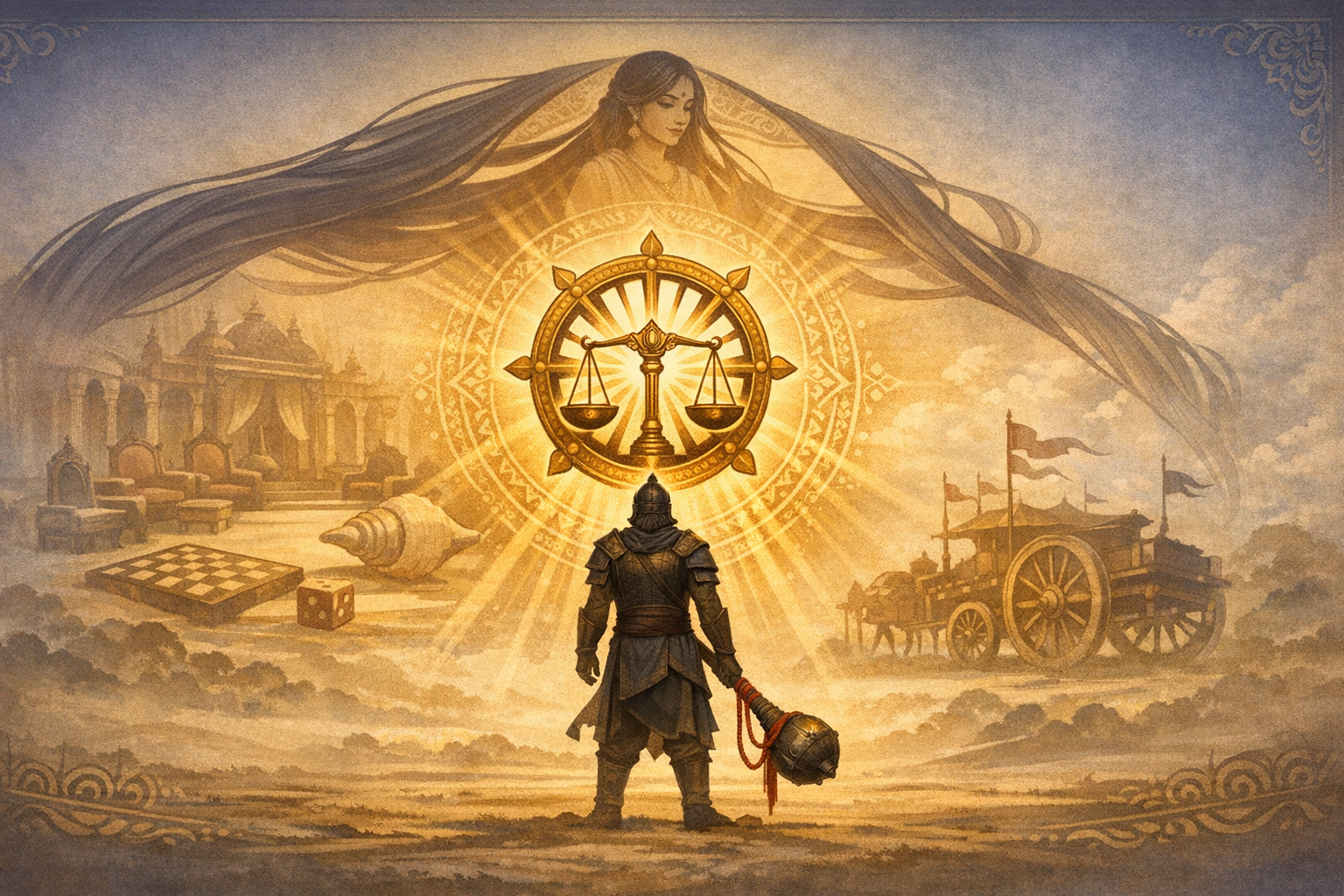
The turning point that seals Dushasana’s fate unfolds in the Sabha Parva during the rigged dice game orchestrated by Shakuni. When Draupadi is dragged by her hair into the Kuru assembly after Yudhishthira stakes and loses everything, the norms of rajadharma and sabha-dharma are placed on trial before the elders. Dushasana’s actseizing Draupadi, humiliating her publicly, and attempting to disrobe heris presented by the Mahabharata as a categorical violation of dharma. Even Bhishma, custodian of state ethics, recognizes the gravity of the conundrum yet stands constrained by technicalities; Vidura denounces the episode; and the silence or equivocation of the court compounds the moral breach.
This episode fuses two planes of law and morality: the legal anomalies of the dice stakes (including the question of whether Yudhishthira could pledge Draupadi after forfeiting himself) and the higher principle that strī-dharma (the moral protection due to a woman) cannot be overridden by contrived technicalities. The Sabha episode therefore frames Dushasana’s later death not as private vengeance but as the restitution of a public norm that Kuru sovereignty had failed to uphold.
From this collapse of justice arises a network of vows (pratijñā) that structure the Kurukshetra War. Karna’s insults, Duryodhana’s obscene thigh gesture, and Dushasana’s assault on Draupadi prompt Bhima to make three pivotal vows: to drink Dushasana’s blood, to break Duryodhana’s thigh, and to kill Karna’s allies as lawful reparation. In the epic’s economy of causation, these vows are not extralegal oaths but ethical promissory notes issued in the name of violated dharma, to be settled on the battlefield of a declared dharma-yuddha.
The narrative trajectory from Sabha Parva to Karna Parva and Shalya Parva shows how these vows are fulfilled under the codes and exceptions of yuddha-dharma. Classical norms prohibit certain actsstriking the unarmed, attacking many against one, or despoiling the fallenyet the Kurukshetra War repeatedly records transgressions by both sides, notably in the cruel destruction of Abhimanyu after he is dismounted and surrounded. Dushasana’s own battlefield conduct is marked by ferocity rather than restraint, deepening the karmic ledger opened in the Kuru court.
On the sixteenth day of the war, under Karna’s command of the Kaurava army, Bhima hunts for Dushasana. The encounter is described in uncompromising terms across recensions: Bhima drags Dushasana down, pins him with his knee, and tears open his chest. He then drinks the blood to honor his vow, anoints his hands with it, and, in several retellings, declares Draupadi’s hair avenged. The Pandava ranks erupt; the Kaurava lines waver. Whether read literally or symbolically, the scene is staged by the epic as the precise settling of an ethical debt incurred in the dice hall.
Readers often ask whether Bhima’s gruesome act itself violates dharma. The tradition wrestles with this question by invoking apad-dharmaexceptional ethics under conditions of grave moral emergency. The Mahabharata does not present delight in violence as virtuous; rather, it allows an extreme act to serve as the juridical closure to an extreme transgression. Where institutional rajadharma failed in the Sabha, battlefield dharma enforces the sentence through the agent most entitled to execute it: the kshatriya sworn by vow to protect honor and restore order.
Placed within a broader Indic philosophical frame, the episode also illustrates how karmic causation operates across dharmic traditions. Hindu śāstra emphasizes karmaphala and the restoration of cosmic and social balance when adharma overreaches. Buddhist thought on karma-vipāka similarly teaches that unwholesome intentions ripen into suffering until insight and ethical conduct interrupt the cycle. Jain doctrine details how violent passions (krodha, māna, māyā, lobha) attract karmic bondage that must be exhausted or expiated. Sikh wisdom articulates that actions unfold under Hukam, with accountability before the Divine and the sangat’s moral order. Across these traditions, the logic converges: humiliation, cruelty, and abuse of power produce inevitable reckoning; restoration may be painful, but it is oriented toward moral clarity and communal healing.
Dushasana’s death also illumines a foundational political tenet in the Mahabharata: rajadharma collapses when the dignity of women is commodified. The attack on Draupadi is not treated as a private insult but as treason against the moral constitution of the realm. This is why senior counselors’ silence is condemned so severely: when sabha-dharma yields to fear or faction, dharma finds enforcement on the open field of war. The law of consequences is not suspended because the offender is royal; indeed, it is intensified.
Furthermore, the epic frames Bhima’s action as pedagogical. The vividness of the scene imprints a civilizational warning: violating strī-maryādā corrodes sovereignty at its core. In this light, Dushasana’s demise is dharma’s public pronouncement that no polity can endure when its courts rationalize humiliation and its princes reward aggression.
Philologically, the episode’s through-line can be tracked across Sabha Parva for the dyuta and insult, and through Karna Parva for the killing of Dushasana, with corroborative motifs recurring in Shalya Parva and the concluding apportioning of retributions on the eighteenth day. Modern translations (e.g., van Buitenen, Debroy) and the Critical Edition (BORI) differ in detail but converge on the ethical architecture: vow, pursuit, execution, and restoration.
There is also symbolic resonance in Bhima’s gesture regarding Draupadi’s hair. In several recensions, Draupadi vows to leave her hair unbound until it is washed in Dushasana’s blood. Whether interpreted literally or as a ritual-metaphorical closure to defilement, the fulfillment asserts that dharma attends not only to abstract law but to embodied dignity and psychosocial repair. The epic thus interlaces juridical justice with ritual restitution.
At the level of political theory, the Mahabharata cautions that delaying justice multiplies the costs of its eventual enforcement. Had the Kuru court heeded Vidura’s counsel and redressed the wrong immediately, the chain of apad-dharma measures that culminated on the battlefield might have been averted. The lesson is neither bellicose nor pacifist; it is realist: just institutions must act promptly, or extraordinary remedies will define the moral horizon.
For contemporary readers across dharmic paths, the episode invites a united ethic. The dignity of every person, the inadmissibility of humiliation as political sport, and the accountability of power are non-negotiable. Where differences exist in metaphysics, there is shared affirmation in ethics: ahimsa is paramount in ordinary life; force is a last resort bounded by strict codes; vows bind leaders to the welfare of all; and karmic causation ensures that injustice triggers consequence.
In sum, Dushasana’s brutal end is not an outlier in a story of revenge; it is the epic’s carefully staged verdict that restores moral equilibrium. The event is legible as karmic retribution, as rajadharma enforced under apad-dharma, and as a civilizational injunction that the honor of women is inseparable from the legitimacy of rule. Through this lens, the Mahabharata speaks with a united dharmic voice: injustice, however powerful its patronage, must meet its verdictand that verdict, once postponed by cowardice, returns with uncompromising clarity.
Key takeaways for students of the Mahabharata and Indic ethics include: the Sabha Parva’s jurisprudential stakes; the vow-driven architecture of dharma-yuddha; the sixteenth-day chronology of Dushasana’s death; the interplay between institutional failure and battlefield enforcement; and the cross-dharmic coherence of karmic accountability. Each of these supports a unified ethic of dignity, responsibility, and restorative justice that remains urgently relevant.
Inspired by this post on Hindu Blog.