In Bengal’s sacred geography where song, ritual, and daily life converge, the figure of Ramprasad Sen (c. 1718–1775) endures as a luminous exemplar of bhakti directed to the Divine Mother, Kali. Among the many Hindu Stories associated with his life, the encounter with the notorious Raghu the dacoit has retained extraordinary power as a cultural memory: devotion disarmed violence, and compassion eclipsed fear. This narrative, preserved through Shyama Sangeet performance and oral retellings, continues to inform the Hindu way of life by demonstrating how transformative grace (kripa) can act within the most perilous human situations.
Historically, eighteenth-century Bengal under late Mughal and early Company rule saw intense devotional flowering and social volatility. Commercial roads and river routes were frequently threatened by armed bands known as dacoits (dakat in Bangla), even as Kali worship and village Shakta pithas anchored communities. Within this environment, religious song functioned as spiritual instruction, social glue, and emotional regulation—an accessible medium through which theology met lived reality.
Biographical sketches portray Ramprasad Sen as a householder-poet employed as an accountant under a zamindar, who poured his inner life into songs addressed to Maa Kali. While later accounts reference mentors within Shakta lineages, what is clear is the distinctive theological voice of his Shyama Sangeet: a child addressing the all-powerful Mother with radical candor, self-mockery, and boundless trust. As a Hindu Saint in the popular imagination, his legacy rests less on institutional office than on the experiential clarity his songs impart.
Shyama Sangeet—later anthologized as Ramprasadi—became a widely loved bhakti medium across Bengal. Performed in homes, village shrines, and public gatherings, these songs used vernacular Bangla, gentle refrains, and kirtan-friendly rhythms to carry subtle Shakta siddhanta into everyday consciousness. The genre remains central to Bengal’s Cultural Heritage and Hindu spirituality, shaping devotional sensibilities well beyond regional boundaries.
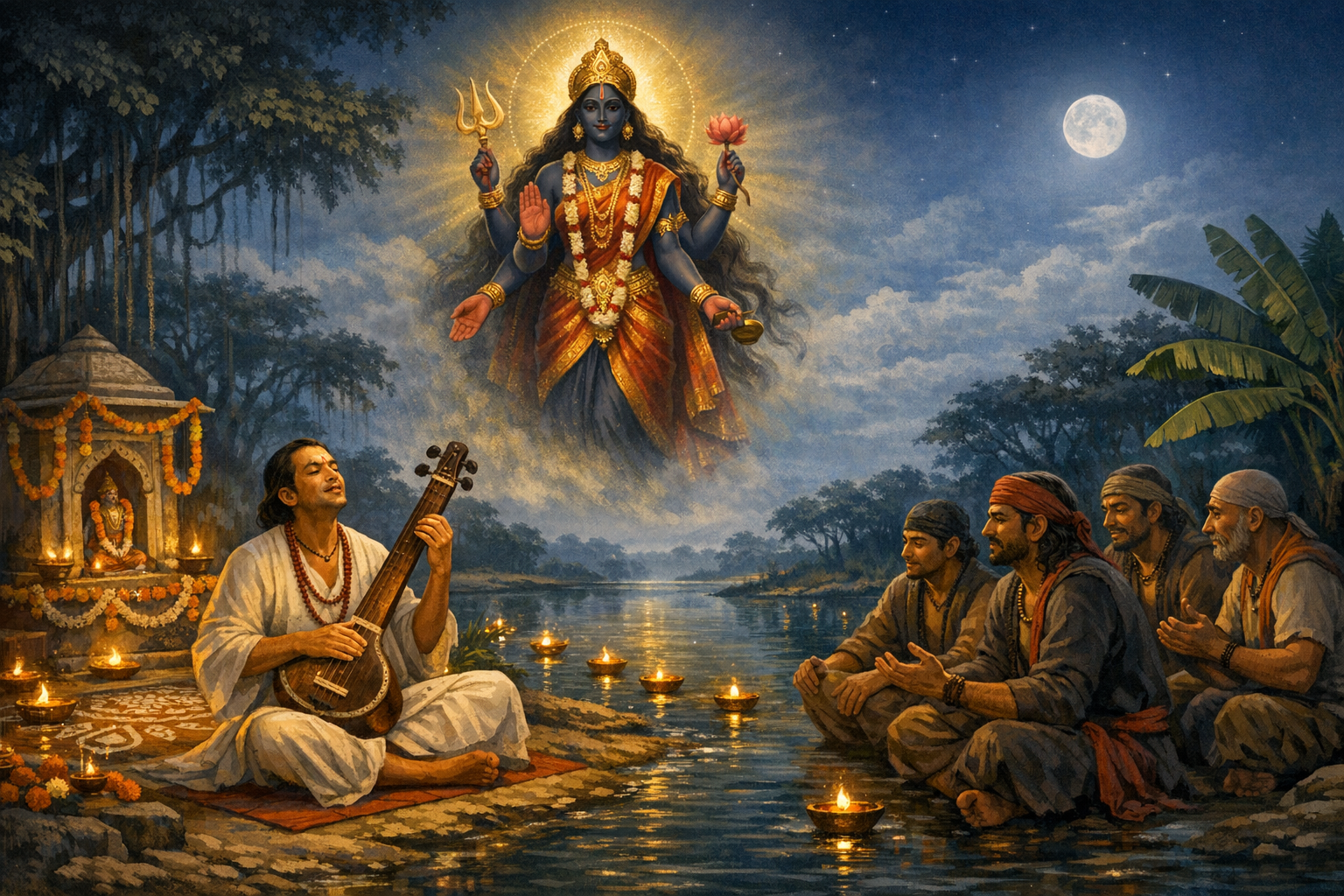
The episode with Raghu the dacoit is situated in this lived religious world. According to widely told versions, Ramprasad Sen, traveling at night along a forested path or riverbank, was seized by Raghu’s band. Some retellings frame the capture as a prelude to a sacrificial rite motivated by fear and superstition; others as a straightforward robbery. In all versions, the atmosphere is charged by imminent violence.
Asked for his final wish, Ramprasad Sen is said to have requested permission to sing once to Kali. As the melody rose—a Shyama Sangeet of absolute surrender—Raghu’s resolve reportedly dissolved. Weapons lowered, voices stilled; the leader, shaken by an unfamiliar tenderness, abandoned the deed and released the captive. Certain variants conclude with Raghu seeking guidance, offering restitution, or turning toward a life of service, underscoring a restorative arc rather than a merely dramatic reprieve.
Read theologically, the narrative dramatizes a core insight of the Bhakti Tradition: unmerited grace (kripa) manifests where there is total surrender (sharanagati), converting bhaya (fear) into bhakti (devotion). Read psychologically, the scene illustrates how music and sacred language can interrupt fight-or-flight reactivity, entrain calmer breathing, and open prosocial perception. In Shakta vision, Kali’s raudra (terrible) and karuna (compassionate) aspects meet in the Mother whose embrace is large enough to hold both the saint and the sinner.
The poetics of Ramprasad’s songs help explain this effect. The voice is intimate, often playful, and insistently honest—complaining to the Mother, bargaining, weeping, and finally trusting. Literary devices such as apostrophe, paradox, and self-deprecatory humor turn theology into felt experience. Because the idiom is vernacular and the meters are performance-friendly, the songs operate as lay theology—portable, memorable, and immediately applicable in the Hindu way of life.
Socially, the tale affirms a non-retributive ethic embedded in Hindu spirituality: transformation through compassion rather than annihilation through force. It is not a celebration of criminality, but a celebration of conscience awakened. By allowing a feared outsider to be seen as capable of change, the story proposes a restorative rather than purely punitive vision of order—an insight as relevant to contemporary justice debates as to village lore.
In comparative dharmic perspective, the motif is strikingly shared. Buddhist tradition recounts Angulimala, a feared brigand transformed by the Buddha’s presence and karuna. Sikh lore preserves the conversion of Sajjan Thug through Guru Nanak’s shabad. Jain narratives similarly valorize the power of ahimsa and aparigraha to tame violence. Across these traditions, the through-line is clear: the deepest power is not domination but inner reformation. Such resonances strengthen unity in spiritual diversity and model interfaith respect within the broader dharmic family.
From a historiographical standpoint, the Raghu episode is best approached as hagiography rooted in oral tradition rather than court-recorded history. Early printed collections of Ramprasadi songs, later biographies, and performance lineages transmit the tale with minor variations, indicating circulation rather than fabrication by a single source. For scholars of cultural history, the value lies not only in factual reconstruction but in understanding how communities encode ethics, theology, and emotion in story.
The narrative’s plausibility finds support in what contemporary research observes about music, breath, and emotion. Devotional singing typically lengthens the exhale, stimulates the vagus-mediated relaxation response, and fosters affiliative states; shared rhythm reduces perceived threat and increases trust. Within such a psychophysiological frame, Raghu’s sudden softening is neither sentimental nor implausible; it is a recognizably human response to sacred sound that aligns with the aims of the Bhakti Tradition.
Engagement with this legacy can be practical. Reading Shyama Sangeet aloud, learning a simple refrain, or attending a kirtan invites the same emotional pedagogy that shaped generations in Bengal. In home worship, one might set aside a few minutes nightly to address the Divine Mother—across traditions, as Devi, as compassion (karuna), as wisdom (prajna), or as the nameless ground—and observe how fear and anger yield to steadier presence.
At the same time, critical balance is essential. Romanticizing banditry or attributing all change solely to miracle undercuts the story’s ethical intent. The emphasis is not on spectacle but on responsibility: those touched by grace repair harm, restore what can be restored, and rejoin the community in constructive roles.
Ultimately, the enduring appeal of Ramprasad Sen’s encounter with Raghu the dacoit lies in its layered truth: historically situated in Bengal, theologically Shakta, psychologically astute, and ethically restorative. It is a Hindu Story that also speaks across the dharmic spectrum, reminding that devotion, song, and compassion remain among humanity’s most reliable instruments for disarming violence and renewing the heart.
Inspired by this post on Hindu Blog.