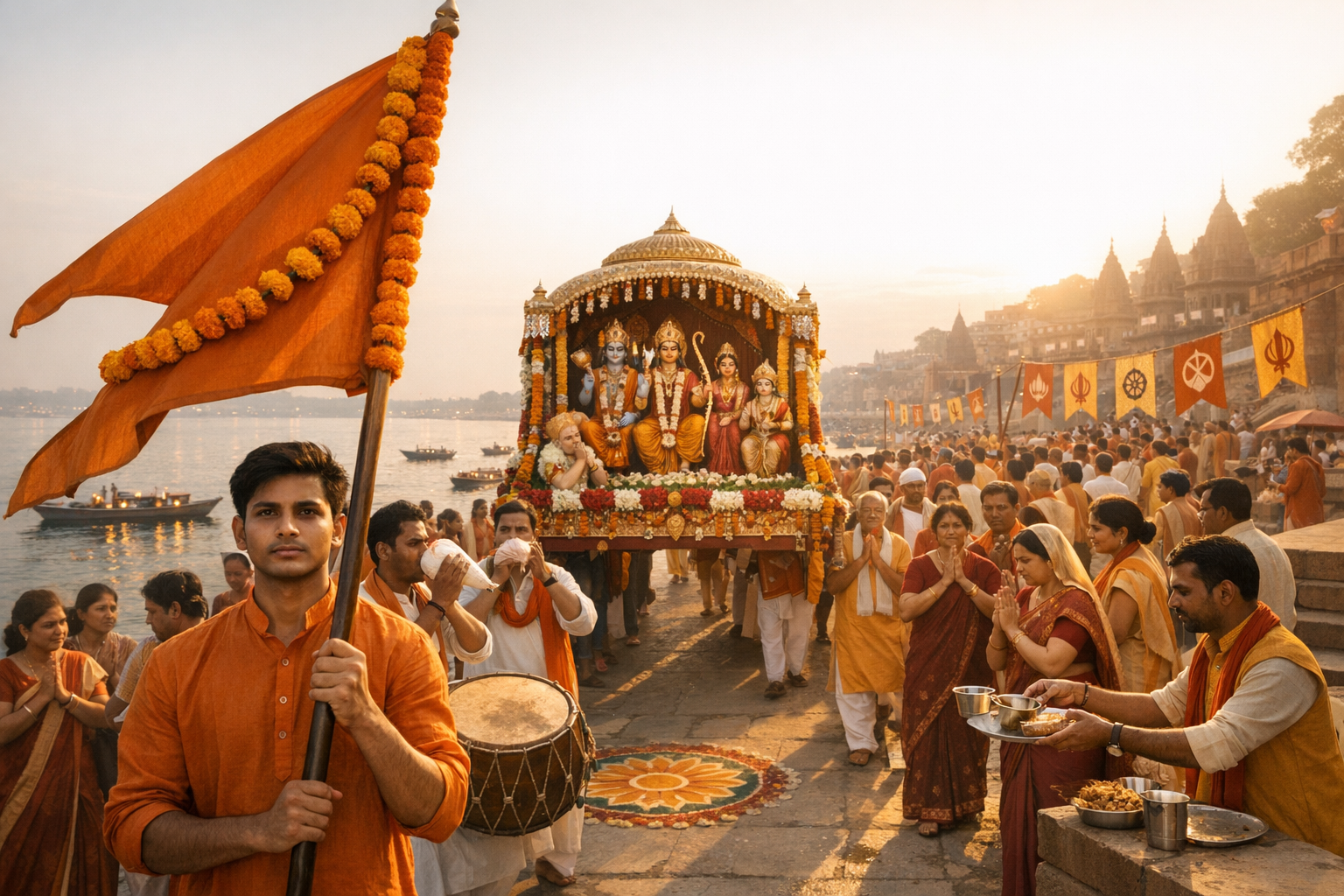
In Varanasi, hundreds of devotees observed Shri Ram Navami with a disciplined, dignified procession and a clear, collective pledge: to strive for Ramrajya and to strengthen Hindu unity in ways that also deepen harmony across dharmic traditions. The gathering signaled more than festivity; it expressed a civic and ethical intention to translate spiritual inspiration into everyday service (seva), ethical restraint (maryada), and justice (nyaya) that benefit the wider community. Participants framed the occasion as a living expression of Sanatan Dharma, aligning devotion to Sri Rama with concrete commitments to social cohesion and public welfare.
Shri Ram Navami, traditionally observed on the ninth day of the bright fortnight (Shukla Navami) in the month of Chaitra, commemorates the birth of Sri Rama, often honored as Maryada Purushottama—the exemplar of righteous conduct. In Varanasi, the day’s devotional atmosphere is typically marked by collective chanting, kirtan, and scripture recitation, practices understood not merely as ritual observances but as community-forming acts that reinforce shared values. This year’s emphasis on Ramrajya highlighted the festival’s contemporary resonance as a template for ethical public life rather than a purely liturgical event.
Varanasi—often described as one of the world’s oldest continuously inhabited cities and revered as Kashi—provides a powerful cultural setting for articulating such commitments. Its sacred geography, centered on the Ganga and a dense constellation of temples and ghats, naturally situates devotion within the rhythms of civic life. The procession’s scale and serenity, underscored by coordinated volunteerism and devotional music, conveyed a palpable sense of order and belonging that observers frequently associate with the city’s living heritage.
While processions on Shri Ram Navami vary by locality, they commonly take the form of a Shobha Yatra in which devotional singing, conch-shell calls, and the rhythmic energy of dhol and nagara provide a distinctly participatory cadence. The Varanasi procession mirrored this broader tradition, emphasizing self-discipline, hospitality, and mutual care—qualities that participants linked explicitly to the collective pledge for Ramrajya. Families, youth groups, and elders moved together with a sense of intergenerational continuity, reinforcing the impression that moral and cultural transmission remains a living social practice.
The call for Hindu unity at the event was framed not as exclusionary identity politics but as a constructive ethical alignment around dharma—duty, virtue, and the common good. Organizers and participants underscored that strengthening Hindu unity should function as a bridge to broader dharmic solidarity, explicitly acknowledging shared ethical vocabularies with Buddhism, Jainism, and Sikhism. This pan-dharmic ethos is consistent with the long-standing civilizational principle of “Vasudhaiva Kutumbakam,” the idea that the world is one family.
Within the Indian intellectual tradition, Ramrajya denotes an ethical vision of governance anchored in dharma—marked by justice, compassion, and the diligent protection of the vulnerable. Classical sources often portray the reign of Rama as characterized by social harmony, fair adjudication, and a balanced relationship between statecraft and moral duty. In contemporary civic discourse, Ramrajya is thus understood as a social contract of virtue, where personal conduct and public institutions reinforce each other to advance human flourishing.
Modern interpreters, most notably Mahatma Gandhi, repeatedly emphasized that Ramrajya is not a theocracy but a moral commonwealth in which governance upholds truth (satya), non-violence (ahimsa), equality before law, and welfare for all. This interpretive strand harmonizes easily with constitutional values, suggesting that spiritual ideals can enrich, rather than compete with, democratic norms. The Varanasi pledge was articulated in that inclusive register: a commitment to ethical public life grounded in spiritual discipline yet operationalized through lawful, plural civic action.
Classical treatises such as the Mahabharata’s Shanti Parva (on rajadharma) and the Arthashastra (on prudent statecraft) illuminate practical dimensions of such an ideal: prudent leadership, transparent administration, evidence-based justice, economic fairness, and public accountability. Ramrajya, considered alongside these texts, appears less as a utopian aspiration and more as a framework for aligning policy and culture with enduring virtues. The festival’s pledge, therefore, can be read as a social charter that seeks to integrate wisdom traditions with contemporary civic needs.
Importantly, the values associated with Ramrajya resonate across dharmic traditions. In the Buddhist political imagination, the ideal of a Dhamma-rāja emphasizes compassionate rule, ethical restraint, and attention to public welfare—forms of leadership that cultivate both inner and outer peace. Historical expressions of Dhamma-inspired governance further validate the view that moral law and public law can be mutually reinforcing.
Jain thought contributes complementary ethical scaffolding: ahimsa (non-violence) as the supreme duty, aparigraha (non-possessiveness), and samayika (equanimity) as foundations for interpersonal and institutional harmony. These principles translate readily into civic life through commitments to reduce harm, temper consumption, and resolve disputes with patience and fairness. Such norms offer pragmatic tools for building social trust, closely aligned with the pledge’s emphasis on ethical conduct.
Sikh teachings reinforce the operational dimensions of this civic ethic through seva (selfless service), sarbat da bhala (the welfare of all), and the vision of a just social order grounded in dignity and equality. Historical references to a halemi raj (a gentle, humane polity) highlight how a spiritually informed public ethic can promote both strength and compassion. Together, these dharmic perspectives generate a shared lexicon for justice, service, and responsibility that strengthens the inclusivity of the Varanasi pledge.
Participants in Varanasi connected these shared values to tangible civic aspirations. While the pledge itself was concise—Ramrajya and unity—it implicitly invites practical translation into neighborhood-level seva, collaborative problem-solving, and respectful dialogue across traditions. The social imagination on display favored everyday, scalable actions that build trust: tutoring initiatives, community kitchens, care for the elderly, and transparent local grievance redress—each consistent with a dharma-centered social compact.
In policy terms, a Ramrajya-aligned civic agenda can promote accessible justice, women’s safety, child welfare, and social security for the most vulnerable. It can strengthen institutional transparency, encourage ethical leadership, and align civic incentives with the common good. When communities internalize these goals as spiritual imperatives rather than purely bureaucratic mandates, compliance tends to be more resilient and participatory.
Heritage stewardship also features prominently in such a framework. Varanasi’s sacred and historical sites exemplify how cultural memory, pilgrimage, and local economies are intertwined. A dharmic approach to heritage emphasizes both preservation and living use—clean public spaces, respectful tourism, and local livelihoods—ensuring that devotion translates into custodianship of shared assets.
Inter-dharmic dialogue serves as another operational pillar. Regular sabhas and satsangs that include practitioners and scholars from Hindu, Buddhist, Jain, and Sikh communities can surface common ethical ground and workable joint projects. Such dialogue-based coordination helps depoliticize shared concerns, anchoring solutions in trust and mutual respect rather than competitive identity frames.
Accountability mechanisms can make such pledges measurable. Communities often track outcomes through simple, transparent indicators: volunteer hours devoted to seva, improvements in public cleanliness, response times for local grievances, reductions in interpersonal disputes, and participation rates across age and gender groups. Publicly sharing such metrics reinforces the credibility of spiritual commitments by demonstrating steady, verifiable progress.
Safeguards are equally essential. A dharmic civic compact resists communal polarization, remains within the ambit of law, and avoids coercion in matters of belief or practice. By emphasizing dignity, equality before law, and principled non-violence, communities ensure that devotional energy strengthens constitutional order and social inclusion rather than undermining them.
The Varanasi pledge also sits within a broader festival landscape in Bharat where Shri Ram Navami catalyzes reflective civic action. From Ayodhya to other sacred centers, the festival’s devotional core increasingly inspires service-oriented initiatives—health camps, educational support, and heritage care—without losing focus on bhakti. The momentum generated by major sacred sites, including the resonance of the Ram Janmabhoomi Mandir in Ayodhya, has amplified this ethos nationwide.
The sensory dimensions of the Varanasi procession embodied this synthesis of devotion and discipline. Conch-shell calls, synchronized bhajans of “Shri Ram Jai Ram Jai Jai Ram,” and orderly movement cultivated collective focus and calm. Participants frequently describe such moments as profoundly connective, where reverence for Sri Rama merges with gratitude for community and a renewed commitment to ethical living.
Ultimately, the pledge in Varanasi framed Ramrajya as an inclusive public ethic rather than a narrow slogan—an invitation to align personal conduct, community habits, and institutional norms with dharma. It affirmed that Hindu unity, rightly understood, strengthens pan-dharmic solidarity with Buddhism, Jainism, and Sikhism, enriching a shared civilizational fabric. In that spirit, the procession functioned as both prayer and policy compass, suggesting how faith-based inspiration can responsibly shape daily civic life.
By closing the gap between festival emotion and civic execution, the Shri Ram Navami observance in Varanasi offered a working model for other communities: celebrate devotion, affirm unity, and operationalize dharma through measurable, compassionate action. Such an approach honors tradition while addressing contemporary needs, demonstrating how the ethical heartbeat of Sanatan Dharma can guide inclusive development. The pledge’s moral clarity, community breadth, and practical orientation together offer a sustainable path toward Ramrajya as a lived reality.
Inspired by this post on Hindu Jagruti Samiti.