Cassia fistulaknown in Malayalam as Konna poo or Kanikkonna and widely called the golden shower treeunfurls luminous cascades of yellow just as the Vishu season arrives in Kerala. This striking phenological timing with the Malayalam month of Medam aligns the tree’s flowering with the solar new year, granting the blossom a central place in Vishu traditions. Across homes and temples, the golden inflorescences anchor the Vishukkani, the first auspicious sight that families behold at daybreak to invite prosperity, clarity, and well-being for the year ahead.
Botanically, Cassia fistula L. belongs to the Fabaceae (subfamily Caesalpinioideae). It is a medium-sized, deciduous tree reaching 10–20 meters under favorable conditions. Leaves are pinnate, typically bearing 4–8 pairs of opposite, elliptic leaflets. The tree’s pendant racemes of five-petaled, bright yellow flowers can extend 20–60 centimeters, creating the distinctive golden drapes that signal Vishu’s approach. Cylindrical pods, 30–60 centimeters long, mature after flowering; their interior is divided by transverse septa into many compartments, each with a single seed embedded in a dark, viscous pulp. While often nicknamed “Indian laburnum,” it should not be confused with the European laburnum (Laburnum anagyroides), which is toxic, nor with Koelreuteria paniculata (“golden rain tree”) used in some urban landscapes.
Native to South Asia, C. fistula occurs naturally from Sri Lanka and peninsular India through the Indo-Gangetic belt to Myanmar and parts of mainland Southeast Asia. It thrives in warm, monsoonal climates and lateritic or well-drained alluvial soils. In Kerala’s lowlands and the Western Ghats foothills, mass flowering typically peaks from March to May, often following a short dry spell. The golden inflorescences, visited by native pollinators such as bees, contribute to seasonal nectar flows in the landscape.
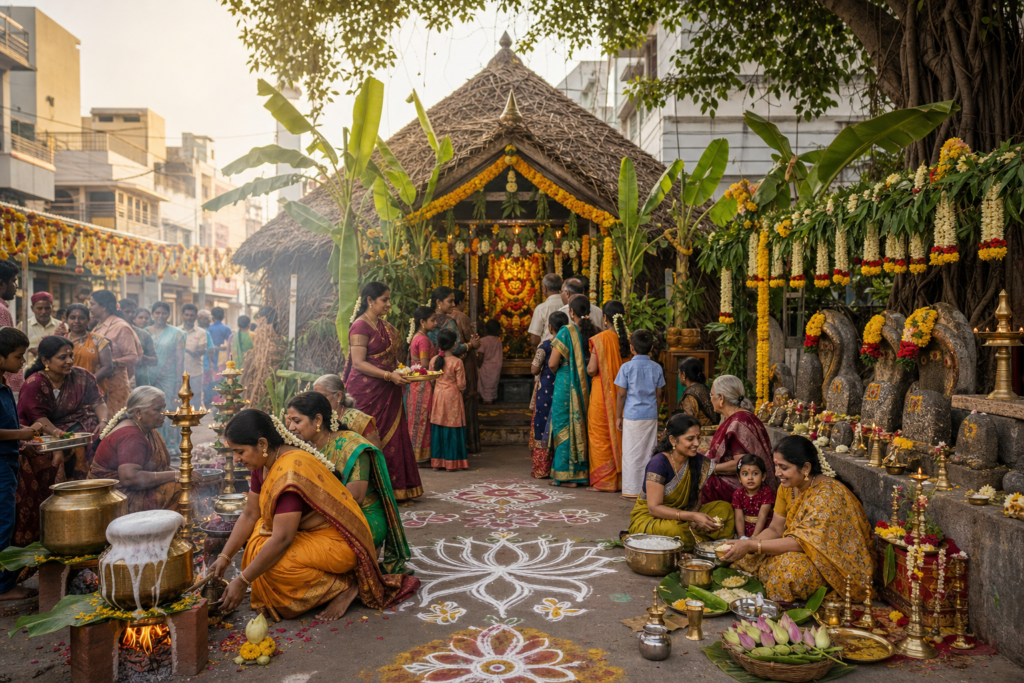
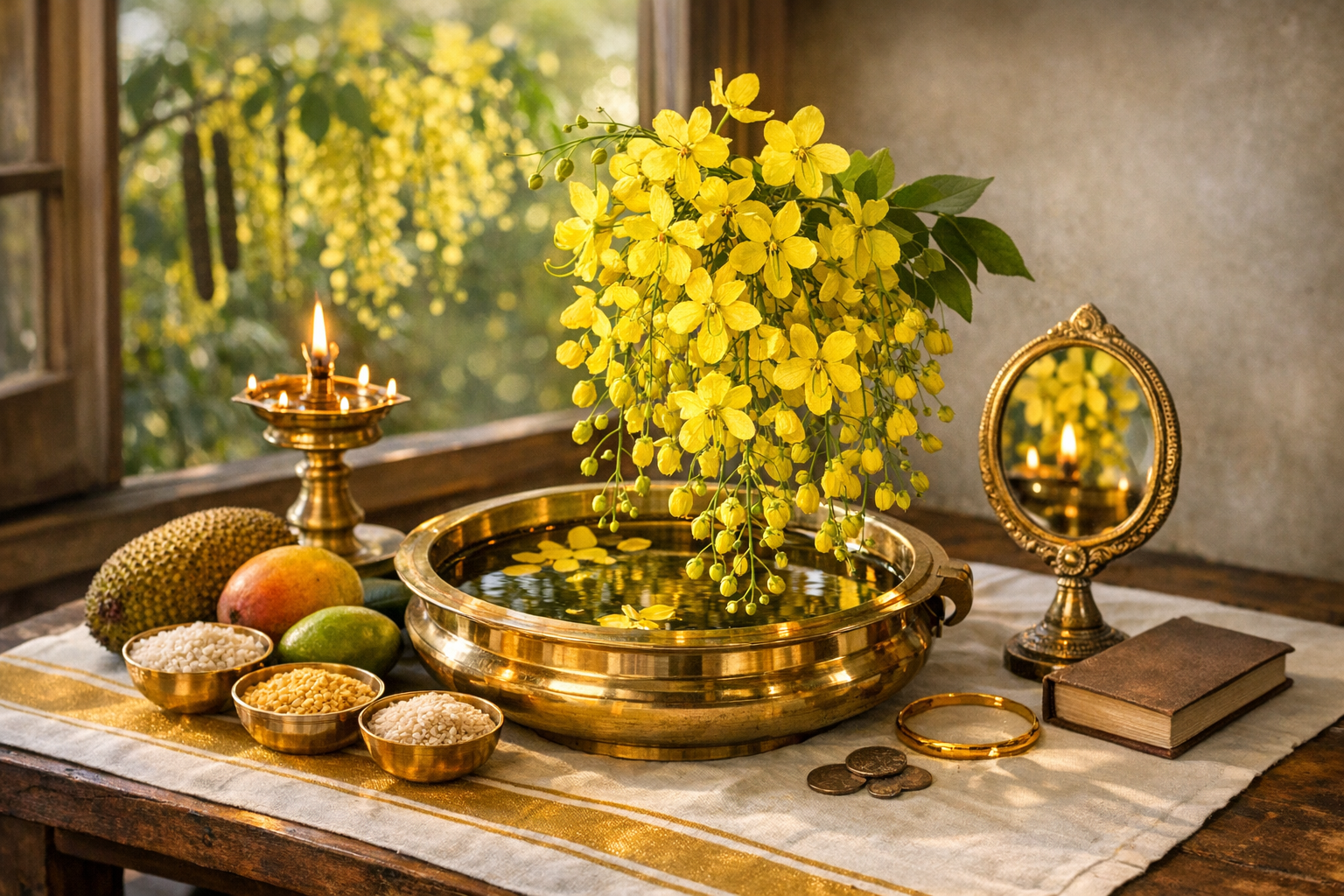
In Kerala, Konna poo is inseparable from Vishu. The festival is observed with the Sun’s entry into sidereal Aries (Mesha), the Malayalam month of Medam, usually on 14 or 15 April. At dawn, families practice Vishukkanithe intentional first sighting of auspicious itemsarranged in a brass uruli or on a designated altar space. The display traditionally includes kani konna blossoms, a lit nilavilakku, rice and pulses, ripe fruits (such as jackfruit and mango), a golden cucumber, a mirror (val kannadi or valkannadi), coins or a gold ornament, and a sacred text or image of Vishnu or Krishna. The experience is meant to saturate the senses with abundance, order, and luminosity before the year’s first words or tasks are undertaken. The day also features Vishukkaineetam, the customary sharing of small gifts or coins that extends this sense of auspicious flow into community bonds.
The symbolism is layered and cohesive. The blossom’s golden hue is associated with solar brilliance, ripeness, and prosperity. As Vishu inaugurates an agrarian and spiritual reset in the Malayalam calendar, the konna’s luminous racemes embody clarity of purpose, ethical renewal, and the promise of fruitfulness. The plant’s generous inflorescences aesthetically mirror the cherished ideal of shared abundance underpinning Vishu rituals and social customs.
Seen within a broader Dharmic frame, the golden shower tree’s April flowering resonates with other solar new year observances across the subcontinent. Vishu in Kerala, Puthandu in Tamil Nadu, Vaisakhi in Sikh and North Indian traditions, and Pana Sankranti in Odisha arise in the same seasonal window, each affirming renewal, gratitude, and community well-being. In Buddhist-majority Thailand, Cassia fistula (Ratchaphruek) is a national flower and often appears in public symbolism around the Songkran new year. Though practices vary, the shared preference for golden hues, grains, lamps, and water evokes unity in diversity across Hindu, Buddhist, Jain, and Sikh communities.
In Ayurveda, C. fistula is known as Aragvadha, classically translated as the “disease-remover.” The pulp of the mature pods is a gentle purgative used in virechana therapies and in formulations addressing constipation and certain skin conditions. Traditional texts and nighantus describe uses of the bark and leaves in decoctions for dermatological ailments. Modern phytochemical studies identify anthraquinones (notably rhein and emodin), tannins, and flavonoids that may underlie the plant’s pharmacological actions. As with all medicinal plants, dosage, anupana (vehicle), and indications require guidance from a qualified Ayurvedic Vaidya; self-medication, particularly in pregnancy or for children, should be avoided.
Kerala’s designation of Kanikkonna as the state flower reflects both cultural centrality and ecological familiarity. To support sustainable ritual use, communities increasingly emphasize ethical harvesting. Selective plucking of a few panicles per tree, avoiding damage to young branches, leaves enough inflorescences for pollinators and seed set. For Vishukkani preparation, fresh-cut racemes placed in water overnight retain turgor, fragrance, and color without stressing any single tree. Community planting around temples, schools, and public spaces ensures a resilient, locally available source of blossoms each year.
For households and institutions seeking to cultivate the tree, practical horticulture is straightforward. C. fistula prefers full sun, warmth, and well-drained soil with a pH between roughly 6.0 and 7.5. Once established, it is drought-tolerant, and flowering is often enhanced by a distinct dry period before the monsoon. Spacing of 6–8 meters allows for canopy development and airflow. Waterlogging should be avoided; organic mulches help conserve soil moisture in the pre-monsoon heat. In general, the species is resilient, with pests rarely reaching damaging levels under diversified, pesticide-sparing management.
Propagation is most reliable from seed. Because the seeds have a hard coat, germination improves markedly with scarification. A practical approach is to nick the seed coat lightly with a file or sandpaper and soak the seeds for 12–24 hours in clean water before sowing. Sowing depth of about 1 centimeter in a well-drained medium, consistent warmth, and light moisture yield germination typically in 10–20 days. Seedlings can be transplanted when they develop 4–6 true leaves. With adequate sunlight and care, flowering may begin in 3–5 years, aligning well with family or community plans to anchor future Vishu observances in homegrown trees.
Accurate identification prevents unintended substitutions. The golden shower tree bears long, cylindrical, segmented pods and pendulous racemes of large, open, five-petaled yellow flowers. European laburnum (Laburnum anagyroides), occasionally also called “golden chain,” has shorter racemes, different leaves, and contains toxic alkaloids; it should never be used in rituals or medicine. Another landscape species, Koelreuteria paniculata, sometimes informally labeled “golden rain,” displays panicles rather than long hanging racemes and develops papery lantern-like seed pods. Clear identification safeguards households, especially when procuring blossoms from unfamiliar sources.
Environmental stewardship deepens the meaning of Vishu. Planting native or regionally adapted Konna trees along streets and in courtyards contributes nectar resources for pollinators at a critical pre-monsoon window, provides seasonal shade, and enriches the cultural landscape. Public institutions can integrate Cassia fistula into climate-resilient urban forestry plans, balancing visual impact with maintenance needs (managing pod litter in walkways, for instance) through thoughtful siting.
Preparing a Vishukkani centered on kani konna can be both devout and ecologically mindful. Sourcing a few fresh racemes from home or community trees, arranging them with rice, pulses, fruits, a mirror, coins, a gold ornament, a sacred image, and a lit lamp in a clean, uncluttered space, and guiding children to the display at dawn weaves memory, ethics, and devotion into a single act. The golden blossoms, mirrored in the val kannadi and the lamp’s steady flame, become a lived metaphor for inner clarityan invitation to begin the year with goodness in thought, word, and deed.
Cassia fistula thus unites botanical science, Ayurveda, and Kerala’s cultural memory in one radiant emblem. The tree’s cycle of rest, renewal, and profuse flowering models the spirit of Vishu: a disciplined pause, a reorientation to light, and a confident return to life-affirming abundance. As households across Hindu, Buddhist, Jain, and Sikh lineages celebrate parallel spring new years, the golden showers of konna offer a shared, gentle reminderdharma flourishes when knowledge, compassion, and sustainability are held together.
Inspired by this post on Hindu Pad.