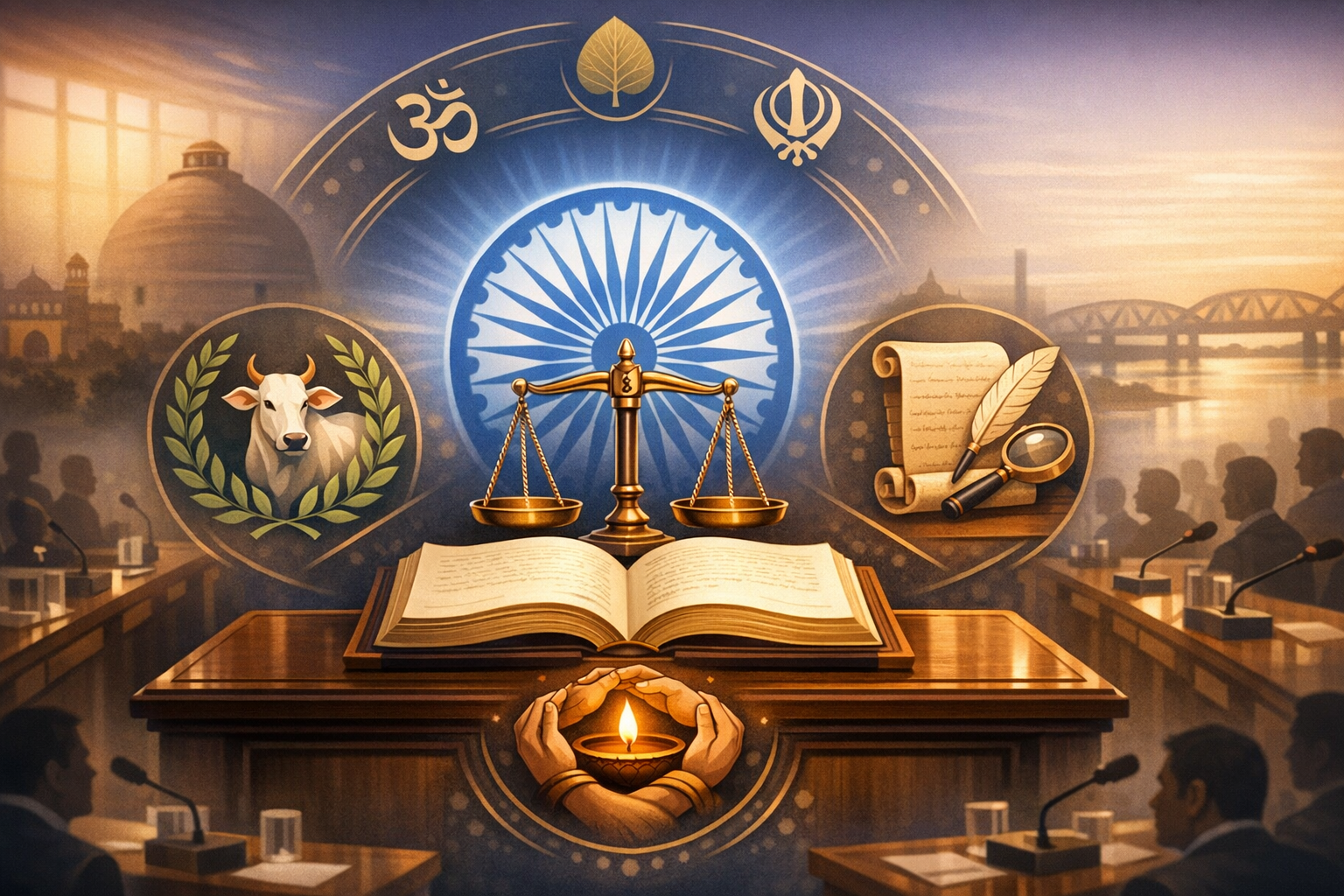
A State-level Hindu Rashtra Adhiveshan convened in Patna, Bihar, organized by Hindu Janajagruti Samiti (HJS), brought together participants to discuss questions of policy, constitutional identity, and cultural continuity. The gathering adopted three headline resolutions: removal of the word “secular” from the Constitution, a nationwide prohibition on cow slaughter, and the enactment of national anti-conversion laws. Each proposal sits at the intersection of constitutional law, federalism, and social cohesion, inviting careful examination beyond immediate headlines.
Viewed in an academic frame, the event functioned as a platform for civil-society advocacy within India’s democratic process. The resolutions reflect a strand of public opinion that seeks stronger protections for dharmic traditions alongside a sharper articulation of national identity. For many attendees, the deliberations were as much about safeguarding living practices and values as they were about statutory reform.
The call to remove “secular” from the Constitution’s Preamble invokes important constitutional history. The term was inserted by the 42nd Amendment (1976), during a moment of sweeping constitutional change. In Indian constitutional discourse, secularism has typically meant principled equidistancestate neutrality coupled with equal respect and protection for all faithsrather than a strict church–state separation familiar to some Western models. Any move to modify the Preamble would operate through Article 368 procedures and necessitate robust parliamentary debate, rigorous committee scrutiny, and broad public engagement.
Scholars often distinguish between the constitutional text and the lived doctrine of sarva dharma samabhava (equal regard for all paths), an idea deeply rooted in India’s civilizational ethos. The question is not merely semantic; it touches how law, policy, and administration translate pluralism into everyday fairness. In practice, Indian secularism has worked best when it protects diverse communities while minimizing politicization of faith.
The proposed nationwide ban on cow slaughter maps onto Article 48 of the Directive Principles, which encourages prohibition of slaughter of cows, calves, and other milch and draught cattle. India’s federal structure has led to a patchwork of state-level statutes, from complete prohibitions to graded restrictions. The Supreme Court has previously upheld stringent state regulations on cattle slaughter, emphasizing legitimate aims such as preserving breeds and supporting agrarian economies, while also noting that reasonable classifications and proportionality matter.
Policy design in this area must contend with practical realities: animal husbandry economics, support for farmers and gaushalas, management of unproductive and stray cattle, veterinary infrastructure, and livelihood transitions for communities tied to leather and allied trades. Jurisprudence and field research alike suggest that durable regulation aligns compassionate intent (ahimsa) with evidence-based animal welfare, supply-chain planning, and social-safety measures that prevent unintended hardship.
The third resolutionnational anti-conversion legislationintersects with Article 25 (freedom of conscience and the right to profess, practice, and propagate religion). In Rev. Stanislaus v. State of Madhya Pradesh (1977), the Supreme Court upheld state laws that curb conversion by force, fraud, or inducement, while affirming that voluntary transformation of belief remains protected. Several states have enacted “Freedom of Religion” Acts tailored to local contexts; a central framework would require precise definitions, strong due process, and procedural safeguards to ensure that the constitutional right to conscience is not chilled.
Internationally and within India, consensus has grown around the principle that coercion, deception, or material enticements have no place in matters of faith. Equally, interfaith dialogue, humanitarian work, and freely chosen spiritual journeys are valuable hallmarks of a plural society. If a nationwide law is contemplated, it should prioritize evidentiary standards, independent oversight, time-bound adjudication, and clear separation between social-service delivery and religious solicitation, so that both protection from coercion and freedom of religion are meaningfully upheld.
Across all three proposals, the thread that merits emphasis is dharmic unityshared values of non-violence, truth-seeking, compassion, and mutual respect that connect Hinduism, Buddhism, Jainism, and Sikhism. The most constructive policy pathways are those that strengthen this common ground, ensuring that any legal changes enhance trust between communities and do not inadvertently foster division.
Observers in Patna noted that discussions often returned to everyday experiences: how schoolchildren learn about India’s plural traditions; how farmers navigate cattle care; how interfaith neighborhoods sustain harmony; and how institutions apply laws fairly. These lived realities underscore that constitutional debates are not confined to courtrooms or assembliesthey are ultimately judged by their impact on social cohesion and daily dignity.
Historically, reform in India has progressed through iterative calibration between Fundamental Rights and Directive Principles, with courts applying tests of reasonableness and proportionality. This dynamic approach has allowed local innovation, acknowledging federal diversity while maintaining a national rights architecture. The Adhiveshan’s resolutions, therefore, must be evaluated in the light of constitutional continuityevolving through dialogue rather than abrupt rupture.
For cow protection, a nationally coherent but federalism-respecting framework could harmonize data standards (for cattle census, health, and movement), veterinary capacity-building, and funding for shelters and fodder. It could also support circular-economy models for organic manure and bioenergy, and provide targeted livelihood transition packages where needed. Such measures convert sentiment into systems, aligning compassion with capability.
On religious conversion, precision is paramount. Clear statutory language around “force,” “fraud,” and “undue inducement,” coupled with protections against misuse (including penal consequences for false or malicious complaints), is essential. Sensitization training for local administrators and police can reduce friction, while community mediation cellsstaffed by representatives from dharmic traditionscan help address grievances early and amicably.
The debate on the Preamble is especially delicate, because words can shape how institutions interpret the spirit of the Constitution. Careful legislative hearings, public submissions from scholars and community leaders across Hindu, Buddhist, Jain, and Sikh lineages, and transparent publication of comparative research could help ensure that any decision reflects both constitutional fidelity and civilizational wisdom.
Crucially, responsible advocacyby organizations such as Hindu Janajagruti Samiti (HJS) and by civil society at largecan model principled discourse: grounding claims in jurisprudence, embracing data-driven impact assessments, and avoiding rhetoric that “others” fellow citizens. India’s strength has long come from negotiating difference with dignity; that strength should remain the compass.
The Patna Adhiveshan has, in effect, spotlighted enduring questions: How should Indian secularism be understood in practice? What institutional architecture best supports cow protection without economic distress? How can the state protect individuals from coercion while safeguarding freedom of conscience? These are not binary choices; they invite synthesissamanvayabetween rights and responsibilities.
Policy blueprints emerging from such debates can include independent review mechanisms, transparent reporting, periodic sunset or review clauses, and consultative councils featuring voices from Hinduism, Buddhism, Jainism, and Sikhism. Done well, this architecture builds trust, reduces litigation, and reassures communities that law exists to protect, not to polarize.
Ultimately, the legacy of the Hindu Rashtra Adhiveshan in Bihar will be measured less by the dramatic contours of its resolutions and more by the quality of the constitutional conversation it catalyzes. If it channels public energy into rigorous, empathetic, and solutions-focused dialogue, it can help translate civilizational ethics into modern governanceupholding India’s unity in diversity while strengthening the dharmic fabric that so many participants sought to honor in Patna.
Inspired by this post on Hindu Jagruti Samiti.