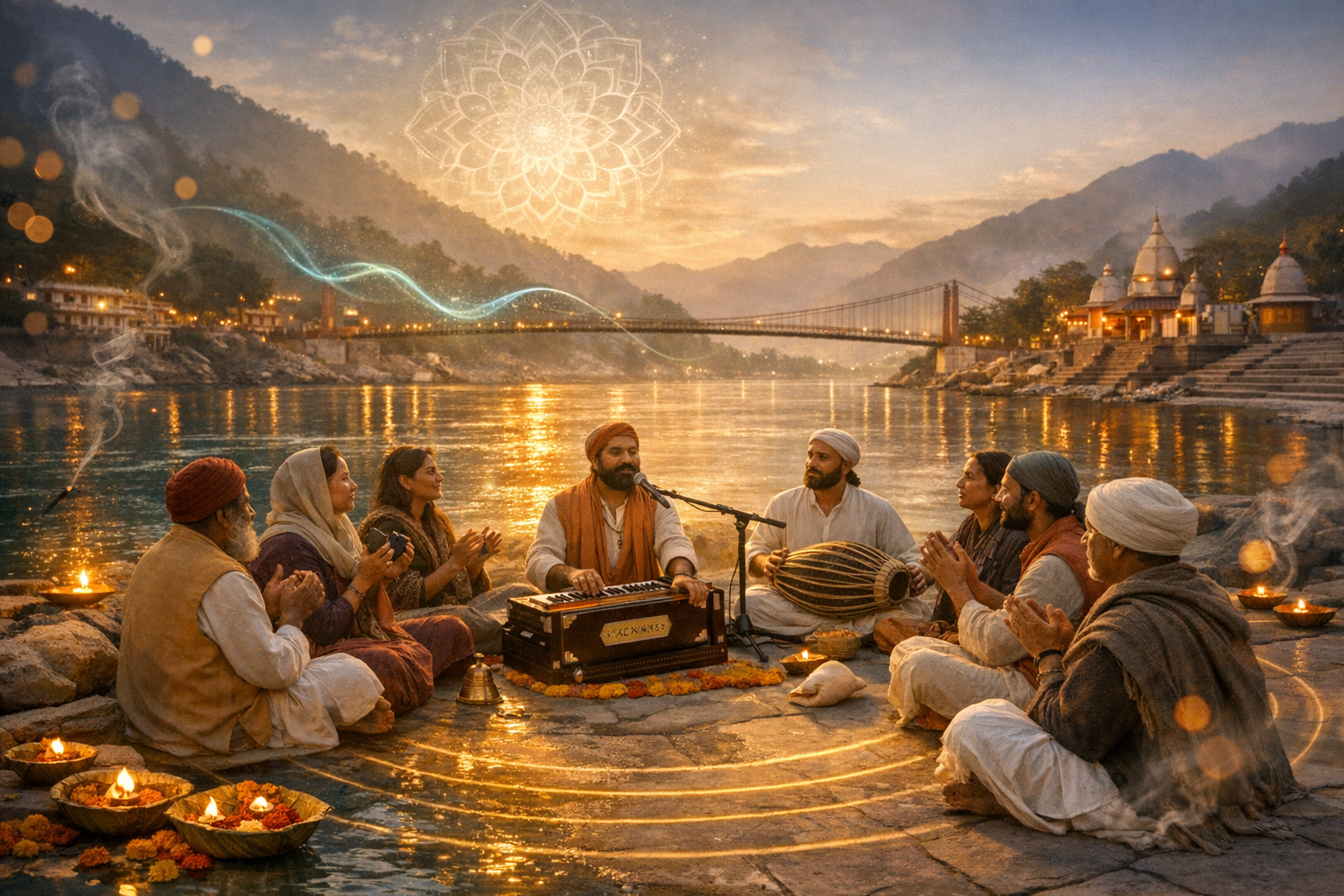
Rishikesh Kirtan Fest was conceived to offer an authentic immersion into the living worlds of dharmic spirituality, where shared chanting in public spaces and focused practice within a kirtan hall together form a continuous field of devotion, learning, and community. Set on the banks of Mother Ganga, the festival places the chanting of the holy names at its heart, allowing a palpable spiritual atmosphere to resonate across streets, river ghats, and intimate performance spaces for weeks at a time.
Rishikesh, long regarded as a sacred tirtha and a global locus for Yoga, provides a distinct confluence of sacred geography and contemplative practice. The sound of flowing Himalayan waters converges with bells, conch tones, and human voices to create a ritual soundscape that supports inner steadiness, ethical reflection, and collective joy. In this setting, kirtan is not an isolated performance but part of an integrated dharmic ecosystem that includes meditation, pranayama, study, service, and reverence for the river that sustains life along the Ganga-Brahmaputra basin.
Within the Bhakti Tradition, kirtan is understood as communal, call-and-response chanting that centers on mantras and divine names. Its lineage draws upon scriptural foundations in the Puranas and the broader currents of Hindu Dharma, where nama-sankirtana is praised as an especially accessible and potent practice for collective uplift. Musically, kirtan employs ragas, talas, and cyclical rhythmic structures; instruments such as mridanga or khol, kartals, and harmonium support vocal textures that invite every participant, regardless of training, into a shared field of devotion and attention.
In practice, a session typically begins with invocation and breath awareness, proceeds through progressively energizing call-and-response sections, and culminates in layered refrains where listeners organically become singers. The sacred names, including widely known maha-mantras, are phonetically simple yet semantically rich, designed for repetition, ease of memorization, and deep affective resonance. Over time, iterations of the same phrase reveal new nuances, allowing participants to experience shifts from restless mentation toward focused, compassionate presence.
The festival deliberately integrates street kirtan and hall-based kirtan to draw out distinct but complementary qualities. Street kirtan emphasizes public participation, inclusivity, and the gentle re-enchantment of civic space; the flow of Ganga, incidental footsteps, and temple bells merge with rhythmic clapping to produce a porous, living ritual. Hall-based kirtan, by contrast, offers controlled acoustics with longer reverberation times that enhance the sustain of harmonium drones and unison chant, supporting extended meditative focus and more intricate raga-tala exploration.
A typical daily arc in Rishikesh begins near sunrise with soft, contemplative chants aligned to morning ragas that emphasize clarity and awakening. Midday segments often include instructional workshops on Sanskrit pronunciation, tala counting, voice care, and the relation of mantra prosody to breath. Evenings tend to feature expansive, community-wide kirtan that dovetails with Ganga aarti, encouraging a balance of devotion, beauty, and civic coherence while foregrounding environmental reverence and social harmony.
Kirtan also serves as a natural bridge across dharmic traditions. In Sikhism, Gurbani kirtan and Naam Simran cultivate remembrance and humility through singing shabad with raga precision. In Buddhism, collective recitation in Pali or Sanskrit, and mantra practice in Mahayana and Vajrayana, develop concentration, compassion, and insight. In Jainism, the Navkar Mantra centers ethical intention and equanimity without sectarian boundary. These streams share core commitments to non-violence, truthfulness, and inner refinement, demonstrating that communal chanting is a shared dharmic grammar that nurtures unity in spiritual diversity across Hinduism, Buddhism, Jainism, and Sikhism.
Contemporary research helps explain why shared chanting exerts such integrative force. Rhythmic vocalization with slow, diaphragmatic breathing can enhance parasympathetic tone through vagus nerve pathways, improving heart rate variability and down-regulating stress responses. Group singing and synchronized clapping promote interpersonal synchrony, releasing neurochemicals associated with affiliation and trust, while steady percussion entrains attention and reduces cognitive load. These physiological and social effects align with classical claims that mantra and meditation cultivate steadiness of mind, affective balance, and ethical responsiveness.
Mantra science is both art and discipline. Successful pronunciation balances clarity with ease; overexertion tightens the laryngeal mechanism and diminishes resonance. Gentle nasal resonance, open vowels, and unforced projection allow overtones to bloom in a hall, while street settings benefit from crisp consonants and steady tempo. Participants are encouraged to hydrate, alternate between full-voice and softer participation, and rest when needed. Such protocols make immersion sustainable over weeks, safeguarding vocal health and maximizing contemplative benefit.
Integration with pranayama and meditation strengthens outcomes. Simple breath practices such as equal-ratio breathing before kirtan help stabilize rhythm and pitch perception; brief seated meditation after kirtan consolidates attention and anchors insights. Practitioners often report clearer affect, improved sleep quality, and a durable sense of gratitude when daily chanting is paired with modest periods of breathwork and silent sitting, consistent with the broader Yoga tradition of harmonizing body, breath, and mind.
Festival curation in Rishikesh observes ethical and ecological commitments intrinsic to dharmic practice. Offerings emphasize biodegradable materials, ghee lamps are used responsibly, and riverbanks are maintained with care. Sound levels are moderated to respect residents, wildlife, and the sanctity of the ghats. Programming welcomes all sincere seekers while discouraging proselytization and sectarian rivalry, cultivating spiritual coexistence in India as a lived, daily ethic.
From a musicological perspective, time-of-day ragas and tala cycles are selected to support the psychological arc of each session. Morning sessions may employ Bilawal or Bhairav families that complement clarity and steadiness; evening gatherings benefit from Khamaj or Yaman hues to invite sweetness and repose. Percussion choices shift between the rounded warmth of mridanga and the crisp articulation of kartals, while harmonium sustains a drone that supports modal stability and easy participation for first-time attendees.
Inclusive design is central. Clear aisles, seating for elders, and quiet corners for sensory-sensitive participants make the experience accessible. Instructional interludes explain mantra meanings and transliteration so that those from diverse linguistic backgrounds can join without hesitation. When Sikh shabad, Buddhist mantras, or Jain prayers are included in collaborative sessions, brief contextual introductions underline shared values and the non-competitive spirit of dharmic unity.
To understand community impact, organizers can combine qualitative reflections with simple indicators: attendance patterns across sites, average session duration, and brief well-being check-ins before and after practice. Where appropriate, anonymized heart rate variability snapshots or breath rate measures may be offered to volunteers to illustrate how chanting and pranayama influence physiological balance. These light-touch metrics, coupled with narratives from shopkeepers, sadhakas, and visiting pilgrims, create a grounded picture of spiritual, social, and civic resonance.
Those inspired to start a local kirtan circle can begin with a clear intention, a clean and quiet space, and two or three mantras set to comfortable tempos. Aim for 60 to 90 minutes including arrival silence, breath settling, progressive chanting, and a short closing meditation. Rotate leadership so multiple voices learn to guide. Keep lyric sheets with transliteration and meaning, and prioritize inclusivity over performance polish. Over time, introduce basic tala counting and raga mood to deepen musical and contemplative literacy without losing the simplicity that makes kirtan universal.
On the banks of Mother Ganga, the Rishikesh Kirtan Fest affirms an enduring truth shared across the dharmic family: singing the sacred in community refines perception, softens the heart, and strengthens the bonds that hold a plural society together. Through chanting, meditation, and service folded into a single rhythm of days, Rishikesh demonstrates how spiritual tradition, careful pedagogy, and ecological reverence can cohere into a vibrant, non-sectarian public good.
Inspired by this post on Dandavats.