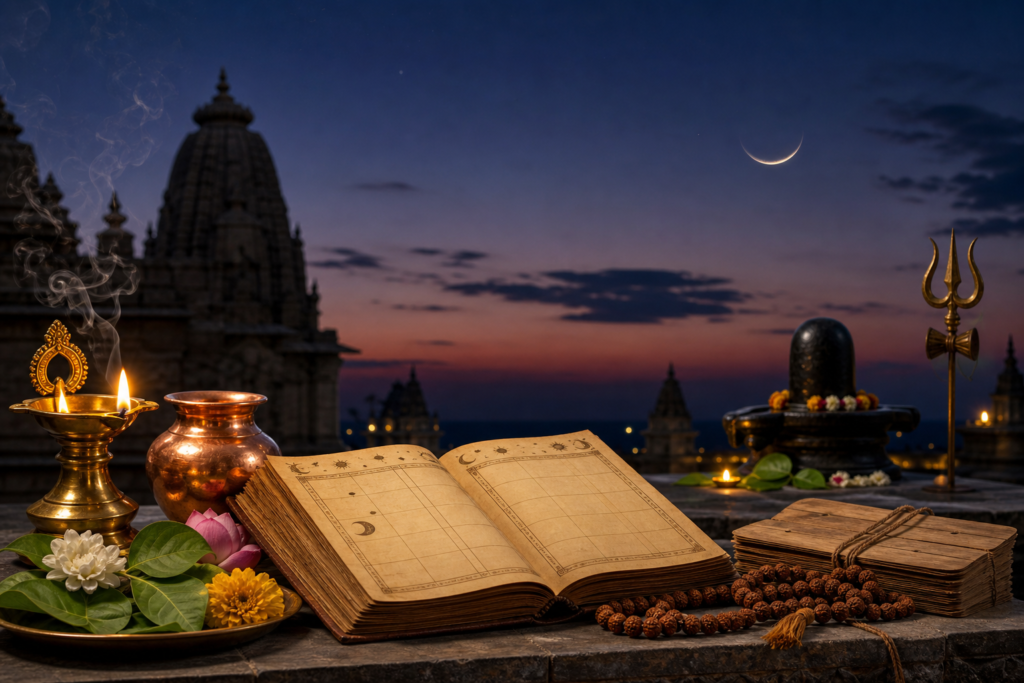
In the Mahabharata’s luminous moral universe, tapasthe concentrated heat of disciplined practicefunctions like an invincible shield. The image “beyond death’s arrow” dramatizes a truth the epic states with philosophical sobriety: a life saturated with sattva, ahiṃsā, and brahmacarya acquires a tejas that neither calamity nor fear can pierce. Within this horizon stands the figure remembered as Ariṣṭanemi (often identified in Jain sources as Neminātha), whose austere radiance crystallizes how spiritual intensity reconfigures the relationship with mortality. Although the extant Sanskrit recensions do not stage a literal duel between Ariṣṭanemi and Yama’s shaft, the Mahabharata’s theology of tapas makes such imagery intelligiblemortality is conquered not by force of arms but by the steady combustion of ignorance.
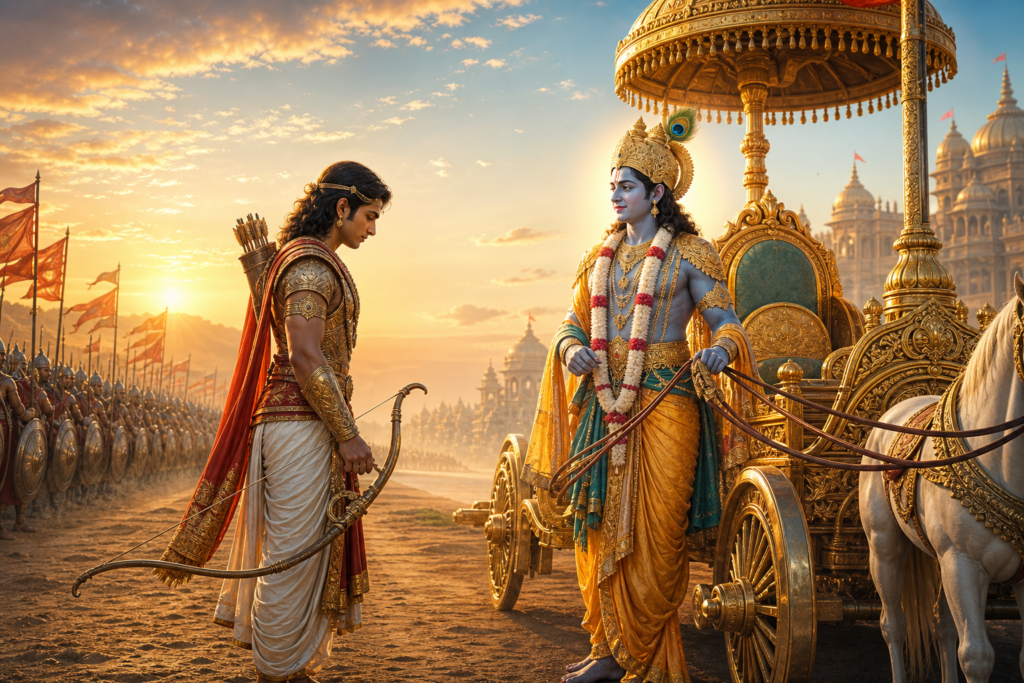
The sacred lineage of Ariṣṭanemi is a point of dialog across Dharmic traditions. Jain narratives present Neminātha (Ariṣṭanemi) as a Yādava, kinsman of Kṛṣṇa, whose renunciation at the very threshold of marriage epitomizes ahiṃsā. The Harivaṁśaclosely allied to the Mahabharata’s narrative worldretains genealogies that overlap with this memory, mapping a shared cultural milieu along the western seaboard that includes Dvārakā and Mount Girnar. This cross-textual convergence does not collapse distinct theologies; rather, it discloses a civilizational consensus that lineage is fulfilled not by conquest but by restraint, and that true sovereignty is inner mastery.
Philologically, ariṣṭa means unhurt or inviolate, and nemi denotes the rim or felly of a wheel; the compound evokes a perfection that “rolls unbroken.” Vedic poetry uses ariṣṭa-nemi for cosmic order and the unfrayed circumference of dharma’s wheel. In the epic imagination, this semantic field becomes ethical: the practitioner whose vows remain unfrayed acquires durability. The epithet thus reads as a spiritual biography in a single wordAriṣṭanemi, the one whose circle of discipline does not break.
What, then, is tapas in the Mahabharata? It is not mere mortification but a calibrated intensity that transmutes guṇas and orients the entire personality to dharma. Shanti Parva repeatedly ranks tapas above costly sacrifices and even above acts of spectacular charity, arguing that all meritorious works draw their power from inner heat. In this framework, ahiṃsā is not passive withdrawal but the most demanding austerity; brahmacarya is not a negation of life but a harnessing of its currents; and satya is the steady architecture that can bear such heat.
The epic describes two interlinked effects of tapas: brahmavarcasa (spiritual authority) and tejas (radiant potency). When cultivated through yama-niyama, vrata, and mindful simplicity, this radiance operates like subtle armor. The language is metaphorical yet exact: tejas is said to scorch adharma, repel hostile influences, and clarify buddhi at moments of peril. Thus “divine protection” is not external favoritism but the predictable outcome of inner physicsan economy of energy, attention, and ethical clarity that leaves little fuel for fear.
In this light, “death’s arrow” becomes both personified Mrityu and the thousand smaller darts of anxiety, compulsion, and despair. The Mahabharata’s narrative archive is rich with scenes in which disciplined presence changes mortal equations: the Savitrī–Satyavān dialogue that turns the chariot of Yama back through persuasive dharma; the quiet fearlessness of Bhīṣma on the bed of arrows; the serene endurance of Śuka who moves through the world untouched. These exemplars do not deny death; they disarm its terror.
Ariṣṭanemi’s renunciation, as preserved in Jain memory, throws this mechanism into relief. Confronted with the spectacle of animals prepared for slaughter at his wedding, he abandons pomp for aparigraha, integrating ahiṃsā, satya, asteya, brahmacarya, and aparigraha as the five mahāvratas. The decision is not otherworldly escapism but a recalibration of power: by exiting violence, he withdraws consent from the cycle that continually manufactures fear. In dharmic terms, that is a conquest of mortality at its psychological root.
From a comparative perspective, the Mahabharata, Jain āgamas, Buddhist nikāyas, and Sikh gurbāṇī converge on a single diagnostic: it is clinging that gives Mrityu his edge. The therapies differ in emphasistapas and bhakti in the Mahabharata, ahiṃsā and aparigraha in Jainism, sammā-vāyāma and the brahmavihāras in Buddhism, and nām-simran with sevā in Sikhismbut the prognosis is shared. Where craving ceases, the most feared arrow finds no mark.
Anekāntavāda provides a philosophical bridge for this unity-in-diversity. If reality admits many-sided description, then the various soteriological grammars of Hinduism, Jainism, Buddhism, and Sikhism can be read as complementary lenses on the same liberation. Ariṣṭanemi’s ahiṃsā-intensive path and the Mahabharata’s tapas-centered ethic are not competitors; each emphasizes facets the other keeps implicit. Anekāntavāda, properly understood, is not relativism but disciplined humility before the complexity of truth.
The mechanism by which tapas confers protection can be described with the classical language of yogic physiology. Ethical restraints (yama) reduce agitations in the citta, observances (niyama) stabilize attention, āsana and prāṇāyāma regulate energy flow, pratyāhāra prevents leakage of attention, and dhāraṇā–dhyāna–samādhi consolidate a field of awareness in which fear-events are seen and released. The resultant ojas and tejas are not mystical for their own sake; they represent an integrated nervous system and a clarified conscience.
Patanjali is famously wary of siddhis, yet both the Yoga Sūtra and the Mahabharata agree that consistent samyama yields side-effects: enhanced clarity, resilience, and intuitive discrimination (prajñā). In epic terms, this is the “divine protection” that guards an ascetic in forests and battlefields alike. The safeguard is not a bargain with heaven but the direct corollary of a mind that neither lunges toward nor recoils from experience.
Ethically, the heat of tapas must be tempered by karuṇā to avoid becoming a private project of spiritual inflation. Ariṣṭanemi’s story centers this balance: compassion interrupts ceremony, and restraint becomes public pedagogy. The Mahabharata’s householder ideal (gṛhastha-dharma) and the ascetic ideal (sannyāsa-dharma) are often staged as a conversation rather than a contest, and Ariṣṭanemi offers a grammar for translating between them: uncompromising ahiṃsā joined to unostentatious simplicity.
Historically, places like Girnar have functioned as living laboratories of this ethic. Pilgrims report that the terrain itself teaches measured breath, careful step, and shared carean ecology that mirrors inner discipline. In the broader Yādava cultural zone around Dvārakā, the memory of Kṛṣṇa and Neminātha coexists without anxiety, underscoring a civilizational comfort with multiple pathways converging on mokṣa.
To read “beyond death’s arrow” technically is to read it as a two-stage attainment. First comes abhayam, the extinction of the neurocognitive reflex of fear through satya–ahiṃsā–brahmacarya. Second comes mokṣa, the cessation of the causes that bind awareness to becoming. The Mahabharata’s teaching that dharma protects those who protect dharma (dharmo rakṣati rakṣitaḥ) thus acquires a physiological contour: protect your attention with vows, and attention will protect your life with clarity.
A practical sādhanā blueprint emerges from these sources: begin with a clear vrata (ahiṃsā in thought, speech, and action), reduce sensory excess (pratyāhāra), stabilize breath (prāṇāyāma), anchor daily meditation (dhyāna) in a spirit of sevā, cultivate metta/maitrī toward all beings, and adopt aparigraha to free energy from acquisition. Across months, practitioners commonly report reductions in reactivity, more lucid decision-making, and a felt “radius” of calm that de-escalates conflictprecisely the epic’s signature of tejas.
The comparative archive also makes room for critique and calibration. Buddhism’s Middle Way cautions against self-harm disguised as austerity; Sikh wisdom warns that ‘tap’ without nām is brittle; Jain teachers insist that ahiṃsā without vigilance (apramāda) deteriorates into sentiment. The Mahabharata, too, refuses spectacle in place of substance. In bringing these voices into conversation, a composite ethic takes shapeardent yet humane, resolute yet supple.
In narrative terms, the epic does not need Ariṣṭanemi to shatter Yama’s shaft to make its point. It offers, instead, a durable anthropology: when attention is purified and compassion universalized, death’s approach no longer tyrannizes meaning. Markandeya’s vision of aeons within Nārāyaṇa, Savitrī’s fearless reasoning with Yama, and Ariṣṭanemi’s renunciation at the threshold of power are variations on a single ragafreedom from fear.
For readers navigating contemporary uncertainty, this teaching is immediately actionable. A modest daily regimen of ahiṃsā, prāṇāyāma, and silent maunam refines attention; reducing digital excess approximates pratyāhāra; honest speech builds satya; deliberate generosity trains aparigraha. The outcome is not theatrical invincibility but a steadiness that, like a well-made wheel, rolls unbroken across uneven ground.
Seen through the lens of anekāntavāda, honoring Ariṣṭanemi within a Mahabharata-centered reflection does not conflate traditions; it exemplifies civilizational literacy. Hinduism’s tapas, Jainism’s ahiṃsā, Buddhism’s mindfulness, and Sikhism’s nām-simran articulate a harmony of practice. Their shared promise is not exemption from dying but emancipation from the fear that makes life smaller than it could be.
Thus the phrase “beyond death’s arrow” resolves into a precise claim: where discipline, compassion, and insight converge, Mrityu ceases to be an adversary and becomes a teacher of immediacy. AriṣṭanemiAriṣṭa-nemi, the unbroken rimnames that possibility: a life whose vows do not fray, whose radiance does not waver, and whose courage invites others into the same generous freedom.
Inspired by this post on Hindu Blog.