In the sacred landscape of South Indian temple architecture, the Padma Nidhioften paired with the Śaṅkha Nidhistands out as a serene yet powerful emblem of auspiciousness. Widely visible at the thresholds of great temples in Tamil Nadu and across the Dravidian cultural sphere, these figures function as liminal guardians: quiet sentinels that invite abundance, sanctify entry, and orient devotees to the moral and cosmological order embodied by the temple. Their presence speaks simultaneously to artistic refinement, Agamic orthodoxy, and a living tradition that continues to inform how sacred space is conceived and experienced.
Padma Nidhi belongs to the larger semantic field of Kubera’s treasures. In Sanskrit, nidhi denotes a treasure or inexhaustible store, and the corpus of Ashta-Nidhi (eight treasures) associated with Kuberaalso known as Vaiśravaṇaincludes Padma (lotus) and Śaṅkha (conch), among others. The lotus signals purity, fertility, and the blossoming of spiritual insight, while the conch carries connotations of primordial sound, victory, and protection. When personified as benevolent yakṣa-like figures, Padma Nidhi and Śaṅkha Nidhi translate this metaphysics into legible temple iconography.
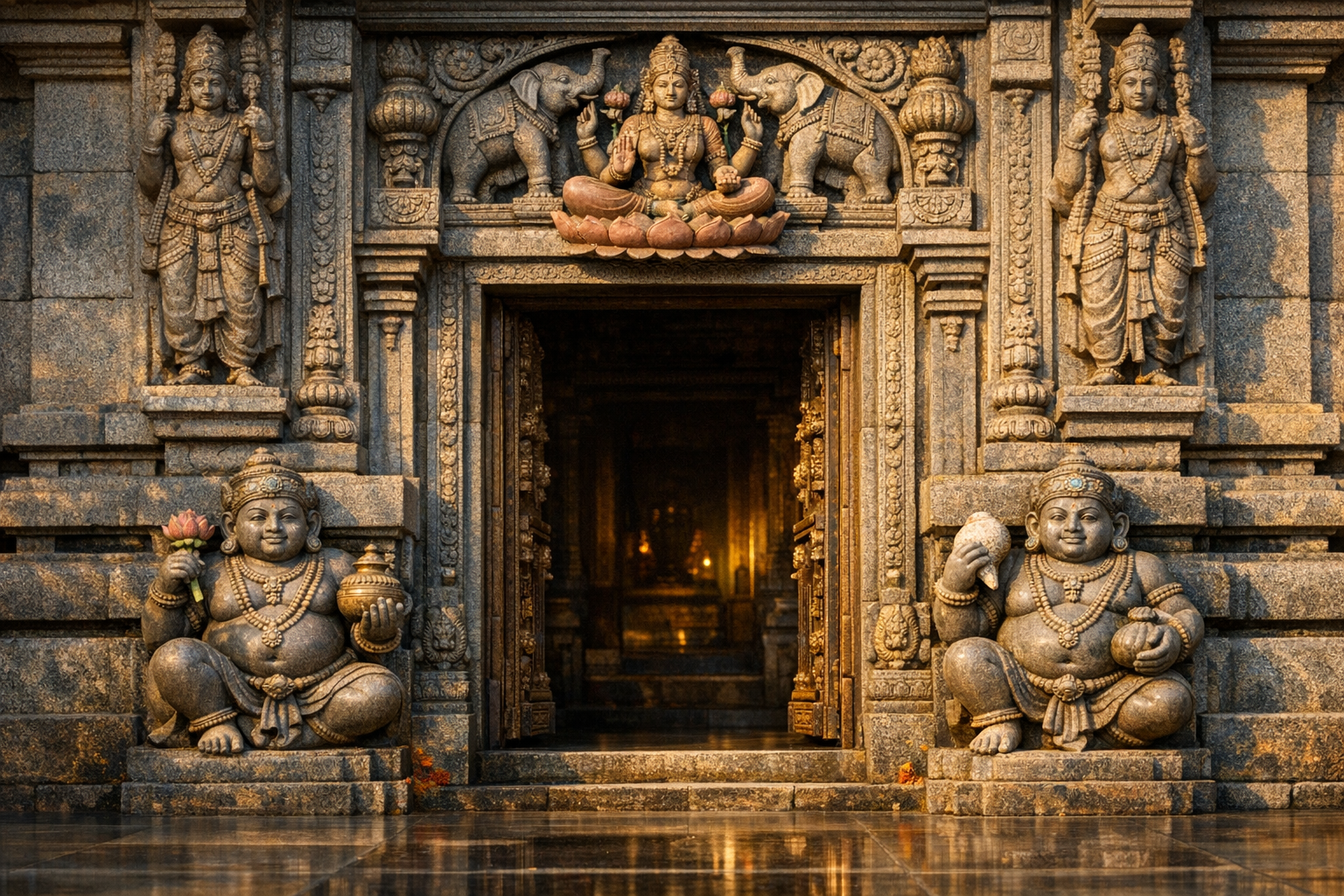
Agamic and Śilpa-śāstra traditions, such as the Mānasāra, Mayamata, and allied South Indian treatises, articulate the logic of thresholds with remarkable precision. Doorframes, jambs, lintels, and adjoining plinths are not merely structural members; they are symbolic interfaces that regulate movement from profane to sacred space. Within these prescriptions, auspicious figures, vegetal motifs, and protective emblems mark the passage, with the Nidhis often situated at or near the base of the doorjambs, balancing the more overtly guardian-like dvarapālas and the lalāṭabimba image of Goddess Lakṣmī (frequently Gaja-Lakṣmī) above the lintel.
Iconographically, Padma Nidhi is typically rendered as a compact, pot-bellied, childlike or dwarfish figure with a serene countenance. The icon may hold or be associated with a stylized lotus, a purse-like bag, a cornucopia, or a treasure urn (kumbha), alluding to the wellspring of material and spiritual prosperity. Jewelry, anklets, and waistbands are commonly indicated; the gesture vocabulary may include subtle forms of varada (boon-giving) or a composed, inward-turned stance that implies unspent potential. The companion Śaṅkha Nidhi often carries or is associated with a conch, completing an iconographic dyad that harmonizes abundance with protection and auspicious sound.
Placement is as important as form. In many South Indian temples, especially those of the Chola, Pandya, and later Vijayanagara–Nayaka periods, the Nidhis occupy the threshold’s lower visual field, balancing the vertical iconographic order of the doorway. Dvarapālas announce protective vigilance; Gaja-Lakṣmī above proclaims sovereign grace; and the Nidhis below, close to the devotee’s line of sight at entry, quietly stabilize wealth, fertility, and well-being. While local workshops interpret details differently, the triadic logic of guardian, grace, and treasure is a consistent semiotic thread in Tamil Nadu temples.
Historically, the motif consolidates during the Pallava and early Chola phases (c. 7th–12th centuries CE), achieving elegant maturity in the High Chola era and enduring into the Pandya and Vijayanagara–Nayaka periods. Temples in Kanchipuram, Thanjavur, Kumbakonam, and Srirangam frequently preserve the pair, sometimes with vibrant regional stylistic variations: rounded physiognomies under the Cholas, more angular modeling under later dynasties, and occasional stucco or polychrome embellishments in Nayaka renovations. The pan-regional spread into Karnataka and Andhra temple idioms underscores the flexibility of the Nidhi concept within Dravidian temple architecture.
Beyond the visual language, there is a cosmological frame. Kubera, as Dikpāla of the north, embodies stewardship over wealth, order, and distributive justice in the sacred geography of the Vāstu Puruṣa Maṇḍala. The Nidhis, as personified treasures, literalize this stewardship at the doorway. They are not deities to be propitiated independently, but auspicious presences that align economic life with dharma, suggesting that true prosperity is as much ethical and communal as it is material.
Number symbolism enriches this meaning. In traditional Indian numeration, terms such as padma and śaṅkha also function as names for very large numbers. Their appearance as Nidhis thus bridges aesthetics, liturgy, and mathematics, intimating a vision of prosperity that is cosmic in scale yet intimately grounded at the temple threshold. The motif educates silently: abundance is real, but it belongs within a measured, righteous order.
Ritual practice reinforces this pedagogy. During festival processions, pilgrims and hereditary priestly lineages move across thresholds that the Nidhis sacralize. Observant visitors may pause at entry, mentally acknowledging protectors and treasuries alike, before crossing into the inner precincts. Temple economiesdonations, offerings, and the care of shared resourcesfind in the Nidhis a visual ethic: wealth must circulate in service of the deity, community, and the maintenance of sacred heritage.
Pan-Dharmic resonances deepen the significance. Kubera/Vaiśravaṇa appears prominently in Buddhism as the northern Lokapāla and a guardian of monasteries, while Jain art preserves auspicious pairs akin to Śaṅkha Nidhi and Padma Nidhi at gateways and pillars as signs of well-being and right order. Although iconographic canons vary by tradition, the shared vocabulary of threshold guardians and auspicious treasures affirms a civilizational unity across Hinduism, Buddhism, and Jainism. This unity rests on a simple proposition: social prosperity is inseparable from ethical conduct and reverence for the sacred.
From a craft perspective, the Nidhis reveal knowledge of stone behavior and workshop specialization. Carved primarily in granite across Tamil Nadu, they display careful undercutting in ornaments, compact massing to resist weathering, and visual clarity at human eye level. In some shrines, later stucco or pigment layers testify to a living tradition of re-sanctification and renewal without compromising core iconographic cueslotus for Padma Nidhi, conch for Śaṅkha Nidhi, and the unmistakable pot-bellied, youthful form.
For visitors seeking to identify the pair in situ, several field cues help. Look near the base of the primary doorway into the garbha-gṛha or the mukha-maṇḍapa, below the lalāṭabimba (often Gaja-Lakṣmī). Note the dvarapālas flanking the jambs at a higher register; then, at ankle-to-knee height, locate the compact dwarfish figures, one with lotus attributes (Padma Nidhi) and the other with conch attributes (Śaṅkha Nidhi). Together with auspicious pots (kalaśa) and vegetal scrolls, these form a threshold program that blends protection, grace, and prosperity.
Regional case studies in Tamil Nadu reinforce this reading. At major Śrī Vaiṣṇava temples such as Srirangam and Varadaraja Perumal in Kanchipuram, the threshold program elegantly integrates Nidhis with Vaishnava emblems, while notable Śaiva temples retain the pair alongside Śaiva-specific door guardians and lintel imagery. Although sculptural condition varies due to age and restoration histories, the semiotic intention of the Nidhi pair remains legible: the temple’s entry is a promise of holistic abundance under divine guardianship.
Conservation and documentation are essential to sustain this meaning. Environmental wear, episodic repainting, and ad hoc repairs can blur iconographic attributes. Sensitive conservation practicesguided by Agamic counsel and art-historical documentationhelp retain the intelligibility of the Nidhis without erasing traces of living devotion. Digital recording, epigraphic correlation, and comparative surveys across dynastic phases (Pallava, Chola, Pandya, Vijayanagara–Nayaka) further enrich scholarly and community understanding.
From an interpretive standpoint, Padma Nidhi can be read as a visual ethic that binds prosperity to responsibility. The lotus signals that abundance must unfold with purity; the conch, that it should be heralded and defended through righteous action. Placed where the devotee pauses, the Nidhis enact a subtle threshold vow: one enters not merely to seek wealth, but to learn how to hold, use, and share it dharmically.
In sum, the Padma NidhiKubera’s lotus treasure personifiedanchors a multi-layered program of Temple Architecture in South India that is at once aesthetic, theological, and civic. Through careful placement, unmistakable iconography, and resonance across Dharmic traditions, the Nidhis continue to educate hearts and minds about the nature of true abundance. Their enduring presence at the gates invites every visitor to cross into a space where wealth means both material sufficiency and the flowering of inner virtue.
Inspired by this post on Hindu Blog.