
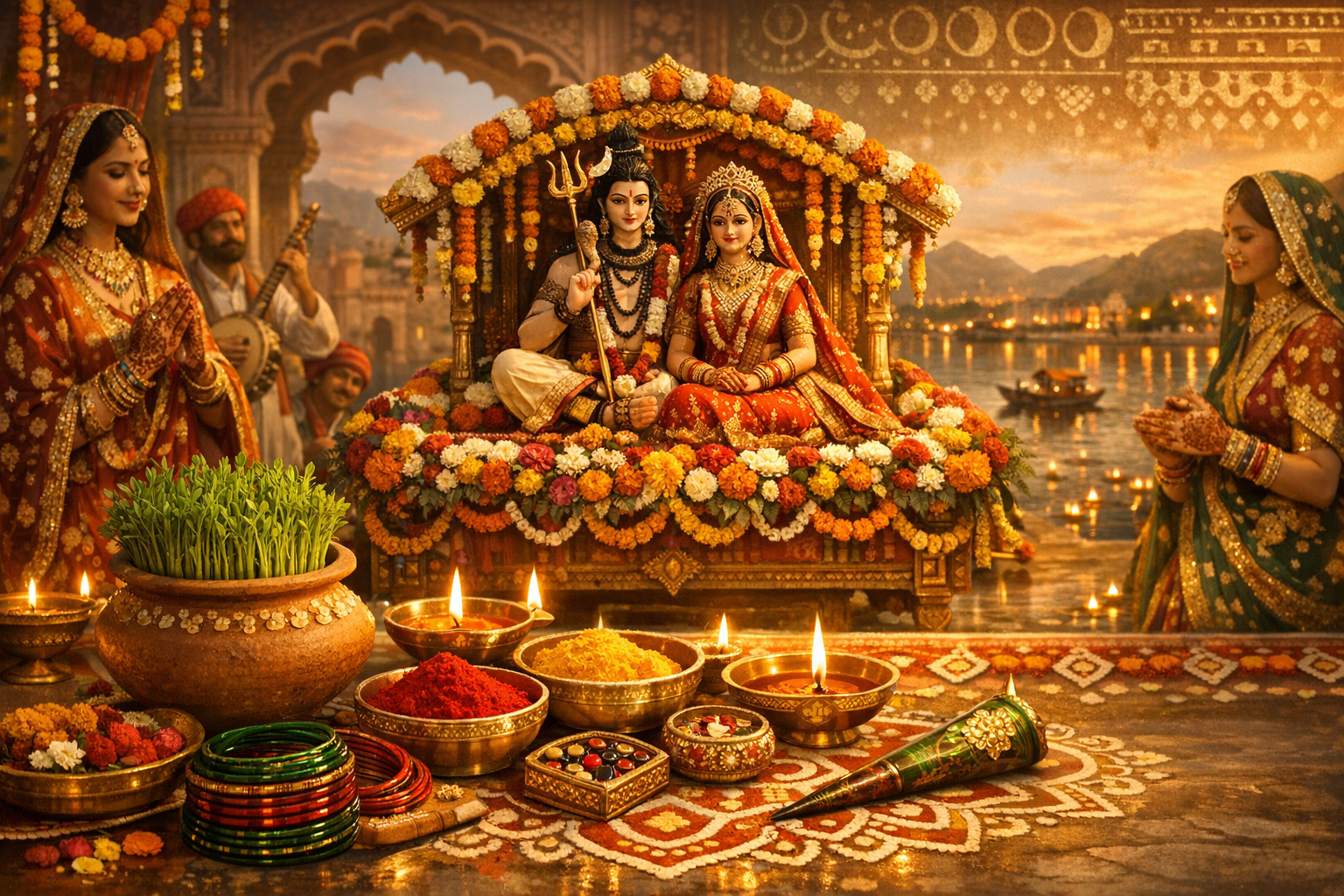
Gangaur is among Rajasthan’s most cherished celebrations of the Divine Feminine, centering on Gauri (Goddess Parvati) and her consort, Shiva (also venerated locally as Isar). Rooted in the early spring lunar cycle of Chaitra, the observance honors marital harmony, prosperity, and inner strength. In 2026, the principal day of worship, Chaitra Shukla Tritiya (Gauri Tritiya), falls on 21 March 2026 in most Indian Panchangs, while the broader festival typically spans from Chaitra Shukla Pratipada through Tritiya, with some communities extending public processions and immersion rites to Chaturthi.
Etymologically, ‘Gan’ denotes Lord Shiva and ‘Gauri’ denotes Goddess Parvati; the compound Gangaur venerates their complementary presenceShiva as the ascetic ideal and Gauri as the sustaining Shakti. This paired divinity, often embodied as the Isar–Gaur idol couple, represents a balanced household, righteous action, and auspicious well-being (saubhagya). The symbolism resonates across India’s dharmic tapestry, affirming reverence for wisdom, compassion, and ethical living.
As a spring rite, Gangaur aligns the agricultural rhythm of renewal with the spiritual themes of fidelity and abundance. Chaitra, the first month of the Hindu lunisolar calendar, opens with the bright fortnight (Shukla Paksha). The Tritiya tithi is dedicated to Gauri’s grace, and the vrata (fast) is undertaken to invite harmony within families and communities. Unmarried girls customarily participate to pray for a virtuous life-partner, while married women invoke blessings for mutual thriving, resilience, and longevity in marriage.
Dating for Gangaur follows tithi-based reckoning rather than fixed solar dates. In 2026, Chaitra Shukla Tritiya falls on 21 March for most of India; however, regional Panchang traditions, time zones, and tithi start–end boundaries (sunrise to sunrise or tithi overlap) can yield minor variations. Local temple calendars should be consulted to confirm the precise muhurta for puja and any community processions.
The festival arc generally begins on Chaitra Shukla Pratipada and unfolds through a sequence of daily observances culminating on Tritiya. In certain lineages, ceremonial immersion (visarjan) of the Isar–Gaur murtis and khetri (sprouts) is performed on Chaturthi, preserving the longer festival window known in parts of Rajasthan.
A hallmark of Gangaur in Rajasthan is Sinjara, customarily observed on Chaitra Shukla Dvitiya (the day before Tritiya). On Sinjara, married women receive gifts of suhaag items (such as bangles, bindi, sindoor, mehendi, and cosmetics) from their parental homes, while sweetsoften including regional favorites like ghevarare shared. The atmosphere is one of gentle anticipation, beautification, and sisterhood, as homes and courtyards fill with song and preparation.
At the heart of Gangaur stands the Ganagauri Vrat. The sankalpa (sacred intention) invokes Gauri’s auspiciousness, protection, and abundance for the household. Observance patterns vary by family and region: many follow a light or phalahara fast, some adopt a single-sitting meal after puja, and others abstain from grains or specific foods. The vrata is guided by principles of purity, non-harm, and mindful discipline, bringing body, speech, and mind into devotional alignment.
Ritual practice frequently includes fashioning or installing Isar–Gaur idols in clay or wood, decorating them with fine attire and ornaments, and preparing a small bed of sown grains called khetri. Barley or wheat seeds are traditionally sprouted in an earthen pot from the festival’s outset; the verdant shoots are offered to Gauri as a sign of fertility, agricultural vitality, and the life-affirming cycle of nature.
Daily puja for Gangaur typically involves offering turmeric (haldi), vermillion (kumkum), flowers, incense, lighted lamps (deepa), and suhaag items, alongside folk songs that recount Gauri’s virtues and the grace of Isar–Gaur. Women adorn their palms with mehendi, braid the day’s worship into domestic rhythms, and nurture the khetri with water and prayers. The home becomes a living shrine where aesthetics, ethics, and devotion converge.
On Chaitra Shukla Tritiya (21 March 2026), the main puja reaches its zenith. Communities gather for processions that carry the beautifully adorned Isar–Gaur across neighborhoods to nearby water bodies, where symbolic immersion, blessings, and collective rejoicing take place. After the evening rites, participants commonly break their fast and distribute prasad, sealing the festival’s vows with gratitude.
Rajasthan’s public dimension is especially famed. In Jaipur, Udaipur, Jodhpur, and other historic centers, Gangaur processions animate the walled city streets with traditional attire, music, and decorated palanquins. Udaipur is renowned for a ceremonial boat segment on Lake Pichola, where reflections of lamps ripple across the water at dusk. These civic observances transmit intangible heritage to younger generations and invite visitors into a carefully preserved cultural continuum.
Material culture in Gangaur is deeply symbolic. Suhaag items celebrate auspicious married life; mehendi’s intricate geometry signifies joy, protection, and devotion; the khetri’s green shoots embody the vital stirrings of spring; and water immersion returns the festival’s sanctified materials to the elemental source. Together, these gestures affirm a balanced cosmoshousehold, environment, and divinity in concert.
Socially, Gangaur nurtures kinship and communal reciprocity. Craftspeople, especially potters and painters, play a pivotal role in preparing idols; sweetmakers and florists contribute to the sensory fabric of the season; and neighborhood groups coordinate songs and processions. In Rajasthan’s plural civic life, Jains and other communities commonly participate in Gangaur as a shared cultural celebration, reflecting the inclusive ethos that characterizes India’s dharmic traditions.
The theological core also invites a wider dharmic reading: the reverence for Shakti’s compassionate wisdom and the ethical household resonates across Hinduism, while the veneration of the feminine principle finds echoes in Buddhist traditions and the dharmic emphasis on virtue in Jain and Sikh thought. Framed this way, Gangaur becomes a bridge of understandingaffirming unity in diversity and the shared values of dignity, compassion, and righteous conduct.
Contemporary practice increasingly foregrounds environmental care. Households and communities are turning to unfired clay idols, natural dyes, and designated immersion tanks to protect lakes and rivers. Responsible disposal of puja materials, minimal plastics, and organic mehendi affirm the dharmic principle of ahimsa (non-harm) and stewardship of the natural world.
For 2026 planning, the key date is Gangaur Tritiya on 21 March 2026. The observance broadly spans Chaitra Shukla Pratipada to Tritiya, with some localities concluding on Chaturthi the following day. Because tithi boundaries can straddle civil dates, consulting the local Panchang ensures accurate muhurta for household and community pujas, especially outside India where time zones may shift the visible tithi.
Typical home preparations include Isar–Gaur murtis (clay or wood), an earthen pot and grains for khetri, haldi, kumkum, flowers, incense, a lamp, sweets for offering, suhaag items such as bangles and mehendi, and a clean altar space. Many families also keep a small vessel of water for symbolic immersion if access to a public water body is limited; materials are then respectfully returned to nature following local guidelines.
Visitors and first-time participants will find that Gangaur’s ethos is both intimate and communalwelcoming observation at neighborhood shrines or designated procession routes. Basic etiquette includes maintaining decorum during aarti and folk singing, seeking permission before photographing private rituals, and following local directions for crowd flow during city processions.
Seen in a wider cultural lens, Gangaur 2026 stands as a luminous springtime convergence of aesthetics, devotion, and civic life. It sustains the ethical household ideal through Ganagauri Vrat, renews environmental kinship through khetri and water rites, and showcases Rajasthan’s performative heritage through solemn yet joyous public processions. Above all, it reaffirms a shared dharmic commitment to unity, compassion, and the enduring strength of the sacred feminine.
Inspired by this post on Hindu Pad.
