A Holi celebration at a US preschool—referenced online as the Farragut Preschool Holi event—triggered an intense social media debate after a viral post framed the activity as evidence of “Hindutva replacement.” Reporting dated March 7, 2026 (TOI World Desk), amplified the controversy and quickly drew polarized reactions. Set against this backdrop, a careful, fact‑based analysis shows how such cultural programs can remain constitutionally sound, educationally meaningful, and socially unifying, while avoiding the escalation of Hinduphobia or the vilification of any other faith tradition.
Clarity of terms matters. Hinduism (Sanatana Dharma) is a diverse, non‑creedal religious and civilizational matrix encompassing plural paths—bhakti, jnana, karma, yoga, and more—alongside countless local customs. “Hindutva,” by contrast, is a political ideology that some interpret as a cultural nationalism. In US school settings, a child‑friendly Holi activity typically aims at cultural literacy and community inclusion; it does not and should not serve as political advocacy. Conflating a preschool cultural lesson with ideological mobilization risks misreading intent and undermines religious literacy.
Holi, the festival of colors, marks the arrival of spring and the triumph of resilience over adversity, often narrated through the Prahlada–Holika episode and celebrated with color play, music, and sweets. In the extended Dharmic family, Sikh communities observe Hola Mohalla with martial displays and kirtan near the same season, and many Jains participate in regional Holi customs. Across the subcontinent and the diaspora, Holi functions as a cultural bridge: neighbors gather, children learn about seasons and stories, and communities experience joy that transcends boundaries.
For diaspora families, school‑based recognition of Holi affirms belonging in a multicultural society. For educators, it is a pedagogical opportunity to teach geography, history, literature, color theory, and social‑emotional skills. For classmates of all backgrounds—Christian, Jewish, Muslim, Buddhist, Jain, Sikh, humanist, or non‑religious—participation (or respectful observation) promotes empathy and fosters the civic value of living well with difference. These are the everyday dividends of cultural appreciation, not cultural replacement.
The rhetoric of “Hindutva replacement” illuminates a wider online pattern: political frames are increasingly projected onto child‑centered cultural events, especially those associated with Hindu, Buddhist, Jain, and Sikh communities. Such frames are emotionally potent, but they conflate culture‑teaching with proselytization or political recruitment. This conflation inadvertently fuels Hinduphobia, which manifests as stereotyping Hindu traditions as exotic, dangerous, or inherently political, thereby stigmatizing ordinary Hindu and Dharmic lives in diaspora contexts.
The constitutional and policy landscape in the United States provides a clear pathway to lawful, inclusive practice. Under the First Amendment’s Establishment Clause, public schools must not endorse or denigrate any religion. However, longstanding guidance recognizes that teaching about religion in a neutral, educational manner is permissible and often essential to robust cultural literacy. Federal guidance on religious expression in public schools, as well as widely cited court decisions, supports neutral instruction about religious holidays and traditions as part of a secular, pedagogically valid curriculum.
Judicial precedents offer contours. In Engel v. Vitale (1962) and Abington v. Schempp (1963), the Supreme Court barred state‑sponsored devotional activities while affirming the academic study of religion. Lower courts, such as in Florey v. Sioux Falls School District (8th Cir. 1980), have permitted neutral teaching about religious holidays. More recently, jurisprudence has emphasized a “history and tradition” lens for certain Establishment Clause questions, yet public schools still must avoid coercion, proselytizing, or preferential treatment. In short, schools may teach about Holi as culture and history; they may not conduct devotional rituals or advance any religious creed.
Context matters for preschools as well. Many US preschools are private or parochial, and their rights and responsibilities differ from those of public institutions. Private centers often feature cultural days consistent with institutional mission and family preferences, governed by anti‑discrimination and health‑and‑safety rules. Publicly affiliated preschools must follow neutrality requirements but retain space to teach about world traditions with age‑appropriate materials and clear pedagogical aims.
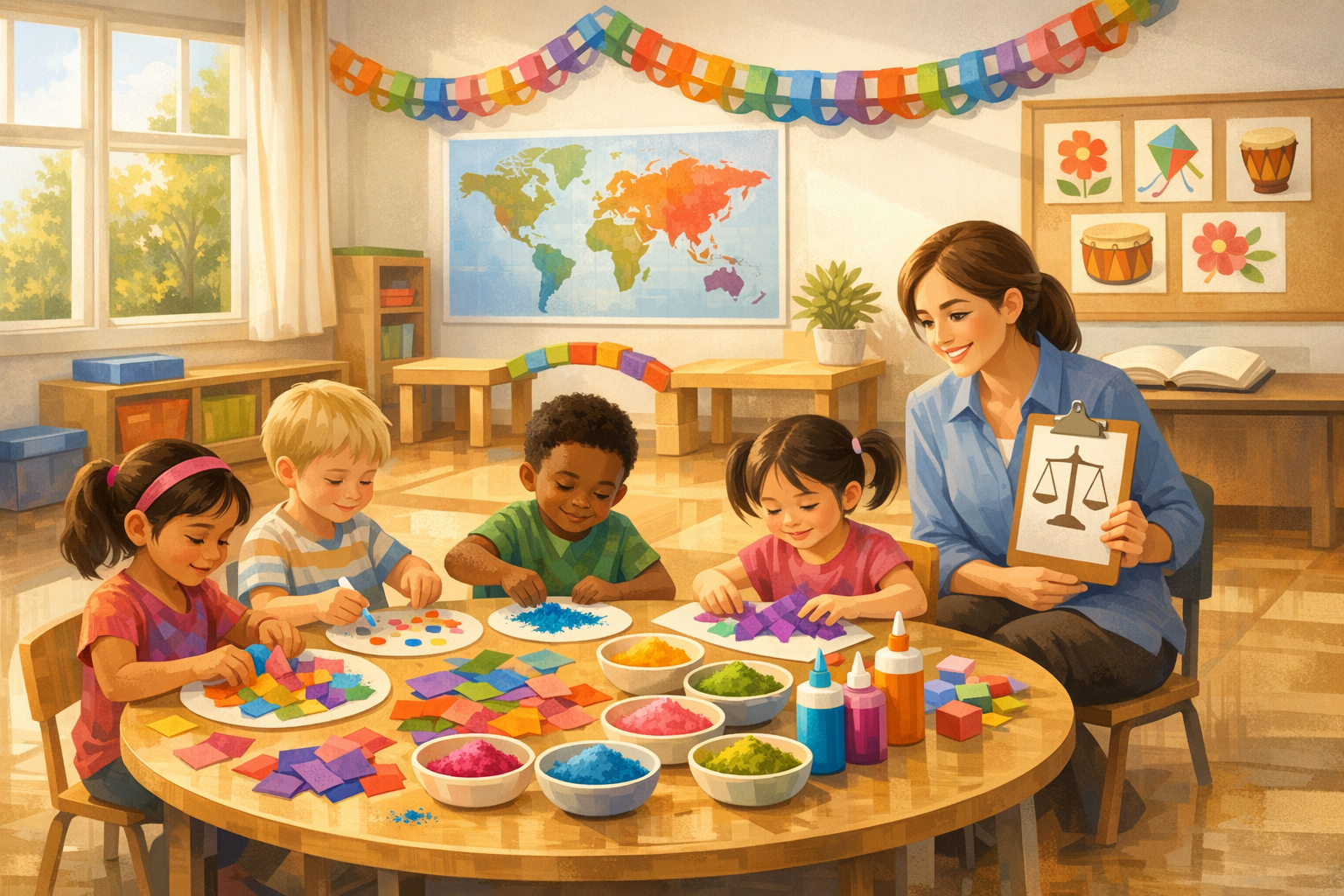
Distinguishing “teaching about” from “teaching into” religion is the linchpin of lawful, inclusive design. Teaching about Holi entails exploring its history, stories, art, music, regional diversity, and diaspora expressions, with optional, non‑devotional activities such as color‑theory crafts or music appreciation. Teaching into religion—inviting children to recite mantras as belief, conducting puja, or substituting curricular goals with religious observance—would be inappropriate in public settings. Properly designed programs remain squarely on the former side.
Understanding the dynamics of online virality helps explain why a preschool event can ignite outsized controversy. Platforms reward novelty and outrage, and short clips can make a classroom moment appear to be religious exercise when it is in fact a cultural demonstration. This is not a uniquely Hindu challenge; comparable misunderstandings have affected Jewish Hanukkah activities, Islamic Eid lessons, Christian Christmas carols, and Buddhist Vesak references in curricula. The remedy is not cultural erasure but improved context, transparency, and parental engagement.
From a social‑development perspective, inclusive recognition of festivals like Holi benefits all children. Age‑appropriate cultural learning correlates with stronger social‑emotional skills, reduced prejudicial attitudes, and greater classroom cohesion. For Hindu American children, visibility combats invisibility—an often‑reported stressor in minority communities—and reduces the likelihood of internalized stigma. For classmates, such lessons demystify unfamiliar practices and normalize pluralism as a civic virtue.
Addressing Hinduphobia requires both precision and empathy. Hinduphobia can appear as casual mockery of deities, misrepresentation of symbols like the sacred syllable Om or the swastika in its Dharmic context, portrayal of vegetarian ethics as backward, or blanket suspicion that any Hindu cultural presence is “political.” The antidote is sustained religious literacy, not reactive othering. Educational neutrality, transparent communication, and a commitment to Unity in Diversity offer durable safeguards.
There is also an interfaith opportunity. Dharmic traditions have long modeled coexistence through concepts like Anekantavada in Jainism, sarva‑dharma‑sambhava in Hindu thought, Guru Nanak’s teachings on shared humanity in Sikhism, and Buddhist compassion as social ethos. Framing a preschool Holi day as an exercise in cultural appreciation—alongside lessons that similarly introduce Christmas, Hanukkah, Eid, Vesak, and Hola Mohalla—reorients the conversation from competition to complementarity.
Practical design choices keep programs inclusive and lawful. First, center clear secular learning objectives such as art, music, storytelling, color science, geography, and social‑emotional learning. Second, provide opt‑in or opt‑out mechanisms for families who prefer alternative activities. Third, include contextual notes for staff that distinguish cultural learning from religious observance. Fourth, avoid devotional elements; teach stories as literature and heritage, not as catechism. Fifth, invite parent volunteers as cultural resource people under teacher supervision, ensuring balanced representation across the academic year.
Sixth, communicate proactively with families: publish a brief description of the activity, its curricular goals, and any materials used. Seventh, ensure accessibility and safety by using non‑toxic, hypoallergenic color powders or paper‑based color crafts when appropriate, and accommodate sensory sensitivities. Eighth, pair Holi with broader units on spring festivals worldwide to underscore parity and avoid perceptions of favoritism. Ninth, document post‑event reflections for continuous improvement. Tenth, train staff annually on the difference between cultural education and religious exercise under the Establishment Clause.
Educators and media alike can reduce misinformation. When posting images or clips, add captions that make the educational purpose explicit. If a video shows children enjoying colors, an accompanying description can clarify that the activity was part of a social‑studies unit on global spring festivals with age‑appropriate art and storytelling. Journalists can include legal and curricular context rather than amplifying decontextualized frames that inflame rather than inform.
Community organizations have a constructive role. Hindu American Community groups and interfaith partners can prepare short, neutral toolkits for schools—glossaries, story summaries, and safety tips—aligned with best practices for cultural appreciation. Sikh partners can offer insights on Hola Mohalla as a companion lesson; Jain partners can highlight ethics of friendship and hospitality often associated with spring festivals; Buddhist partners can share reflections on compassion and renewal that resonate across the season.
Far from signaling “replacement,” a well‑designed Holi lesson demonstrates what pluralism looks like in practice: the school neither adopts a creed nor erases identity; it equips children to understand neighbors with curiosity and respect. That is the essence of cultural appreciation and the surest path away from Hinduphobia or suspicion of any other faith. The viral controversy surrounding the preschool Holi event underscores a simple truth—when cultural learning is transparent, neutral, and empathetic, it strengthens social trust.
The way forward is bridge‑building. Replace suspicion with context; replace caricatures with careful teaching; replace zero‑sum frames with shared civic purpose. In classrooms where colors fly as symbols of spring and friendship—without devotion, coercion, or hierarchy—young learners practice the habits of interfaith dialogue and Unity in Diversity that plural democracies require. That vision honors the dignity of Hindu, Buddhist, Jain, Sikh, Christian, Muslim, Jewish, and non‑religious families alike and keeps schools aligned with both constitutional law and community harmony.
Inspired by this post on Struggle for Hindu Existence.