
Mahesh Navami, also known as Mahesh Jayanti or Mahesh Navmi, is a Shaiva festival observed primarily by the Maheshwari community and widely respected across North and West India. In 2026, Mahesh Navami falls on June 23, aligning with the Navami tithi of Shukla Paksha in the Jyestha month of the Hindu calendar (विक्रम संवत्). The day is dedicated to Lord Shiva in his epithet Mahesh (Maheshvara, the Great Lord), and it serves as a devotional and cultural anchor that blends family piety, communal service, and preservation of living heritage.
From a calendrical perspective, Mahesh Navami is fixed by the lunar tithi rather than the civil (solar) date. The observance is scheduled when the Navami tithi (Shukla Paksha of Jyestha) is operative, which can occasionally cause regional and diaspora variations due to time-zone differences and local panchang conventions. Most communities prioritize the Navami prevailing during the day for congregational worship; where the tithi spans two civil dates, local sampradaya guidelines and the community panchang typically resolve the observance.
The theological significance of the epithet Mahesh is rooted in Sanskrit“Maha” (great) and “Isha/Ishvara” (Lord)encapsulating the transcendence and immanence of Shiva described in Shaiva texts such as the Shiva Purana. Devotees venerate Shiva as the compassionate protector who dissolves obstacles and inner turbulence, guiding spiritual aspirants toward clarity, self-restraint, and inner liberation. This doctrinal frame underscores why Mahesh Navami is associated with vows (vrata), mantra-japa, and seva (service).
For the Maheshwari community, Mahesh Navami also honors a shared civilizational memory. Community oral histories recount that vows taken before Lord Shiva on a Jyestha Shukla Navami established the collective identity of the Maheshwaris, who thereafter embraced the name and patronage of Mahesh. Many retellings reference the organization of distinct lineagesoften cited as “72 or 72½”though the precise enumeration varies by source and region. In contemporary practice, the day functions as a cultural homecoming that reinforces kinship, ethics in commerce, and philanthropy.
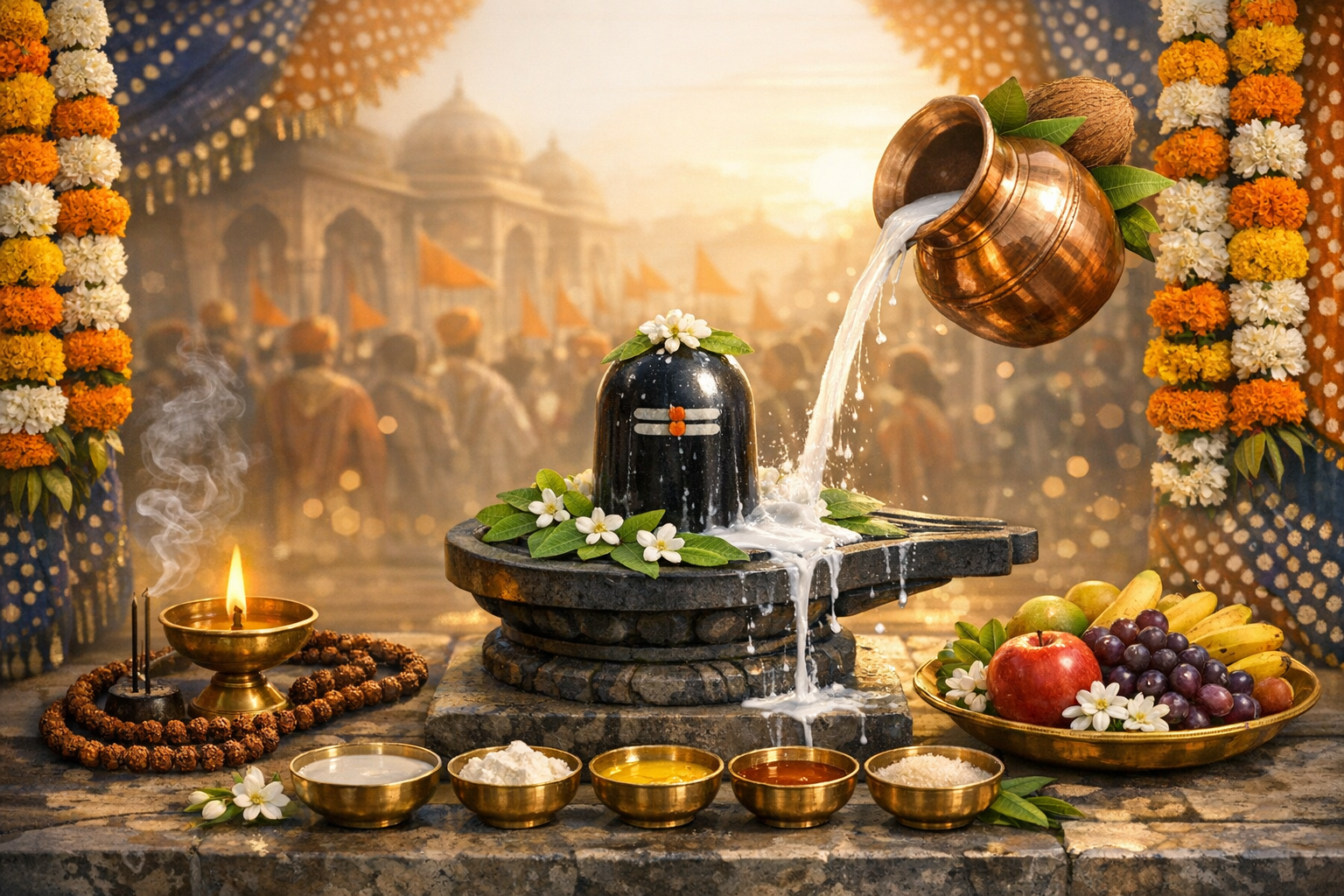
Rituals on Mahesh Navami typically begin at dawn with snana (purificatory bath), a clean puja space, and a formal sankalpa (vow) to worship Lord Shiva for inner purification and communal well-being. Devotees install a Shivalinga or a consecrated image of Shiva and offer water, followed by Abhishekam with Panchamritamilk, curd, ghee, honey, and sugarprogressing to fragrant water perfumed with sandal. The offering of Bilva Patra is considered especially meritorious; incense, lamp (deepa), and naivedya complete the core sequence before the aarti.
Mantra-sadhana anchors the puja. Recitations commonly include Om Namah Shivaya, the Mahamrityunjaya Mantra, Shiva Panchakshara Stotra, and, where possible, portions from Sri Rudram (Namakam/Chamakam). Devotees often perform a set count of japa using Rudraksha beads, emphasizing steady breath, attentive posture, and mental clarity. In many communities, collective kirtan and bhajansechoing “Har Har Mahadev”bring families and neighbors together in devotional fellowship.
Many observe a vrata (fast) on Mahesh Navami. Fasting ranges from nirjala (without water) for seasoned practitioners to phalahara (fruits), milk, or sattvic preparations such as sabudana-based dishes. The vrata is concluded with a parana (fast-breaking) after puja and aarti, ideally by consuming prasad first. Households may complement the day with charityannadana, blood-donation drives, and educational supportreflecting the Shaiva ethos of compassion in action.
Temple and community-level celebrations are prominent. Shobha yatras (devotional processions) featuring symbols of Mahesh, devotional tableaux, and traditional music are common in regions with strong Maheshwari and Marwari presence, especially across Rajasthan and neighboring states. Community halls and local Shiva temples host group Abhishekam, Rudrabhishek, cultural programs for children, and bhandara (community meals), reinforcing intergenerational bonds and civic responsibility.
Mahesh Navami also serves as a bridge for dharmic unity. While the festival is Shaiva in focus, its core valuesseva, self-discipline, and reverence for liferesonate with the broader dharmic traditions of Jainism (ahimsa and anuvrata), Buddhism (karuna and mindful conduct), and Sikhism (seva and langar). Many families describe a felt sense of shared ethics across these paths, nurturing harmony within extended and diaspora communities and affirming the civilizational ethos of “Vasudhaiva Kutumbakam.”
Practical timing guidelines are typically adopted to maintain clarity and communal coherence. Where detailed city-specific muhurta is unavailable, communities prioritize daytime Navami for congregational worship. Individual households may complement the collective schedule with personal sadhana at Brahma Muhurta (pre-dawn), Madhyahna (midday), or during the evening Sandhya, ensuring that the Navami tithi remains operative for the principal puja where feasible.
Culturally, Mahesh Navami underscores ethical commerce and philanthropyvalues historically associated with the Maheshwari community. Narratives shared in family gatherings emphasize dana (charity), dayitva (responsibility), and satya (integrity) as living applications of Shaiva ideals in professional and civic life. Such accounts, often rooted in grandparents’ recollections of temple bells, bilva fragrances, and communal kitchens, lend the day a deeply personal texture.
Eco-conscious observances have become integral to the festival’s contemporary expression. Households are encouraged to use reusable puja vessels, minimize single-use plastics during bhandara, source flowers and Bilva Patra responsibly without damaging trees, and conserve water during Abhishekam by using measured libations. These practices align devotion with stewardship, reflecting the dharmic principle that sanctity and sustainability advance together.
For devotees traveling or living outside India, diaspora temples typically publish localized schedules for June 23, 2026, with adjustments for time zones. Participation may include morning Abhishekam, evening satsang, children’s cultural recitals, and community meals, enabling transmission of traditions to younger generations while welcoming neighbors from diverse backgrounds to experience the festival’s inclusive spirit.
In terms of liturgical detail, households may prepare a simple puja set: clean altar cloth; copper or brass kalasha; Shivalinga or an image of Shiva; Panchamrita ingredients; Bilva Patra; seasonal flowers; incense; lamp; and sattvic naivedya. A concise home sequence includes sankalpa, Ganesha dhyana, Shiva dhyana, Abhishekam, Panchopachara (gandha, pushpa, dhupa, deepa, naivedya), mantra-japa, and aarti. Where possible, elders guide children through meanings of each step, embedding practice with understanding.
Mahesh Navami is occasionally referred to as a community “jayanthi,” marking a reaffirmation of identity and values rather than a historical birth anniversary of a single figure. The emphasis rests on continuity: safeguarding temples, supporting education, and reinforcing household dharma. By coupling ritual with social good, communities preserve a festival that is both spiritually elevating and socially consequential.
In 2026, the confluence of Jyestha Shukla Navami and devoted Shaiva worship on June 23 offers a timely occasion to renew ethical commitments at home and in society. Whether through a quiet chant of Om Namah Shivaya, a family Abhishekam with Bilva Patra, or a neighborhood bhandara, Mahesh Navami invites collective remembrance that dharma flourishes when devotion, knowledge, and service move together in harmony.
Inspired by this post on Hindu Pad.
