
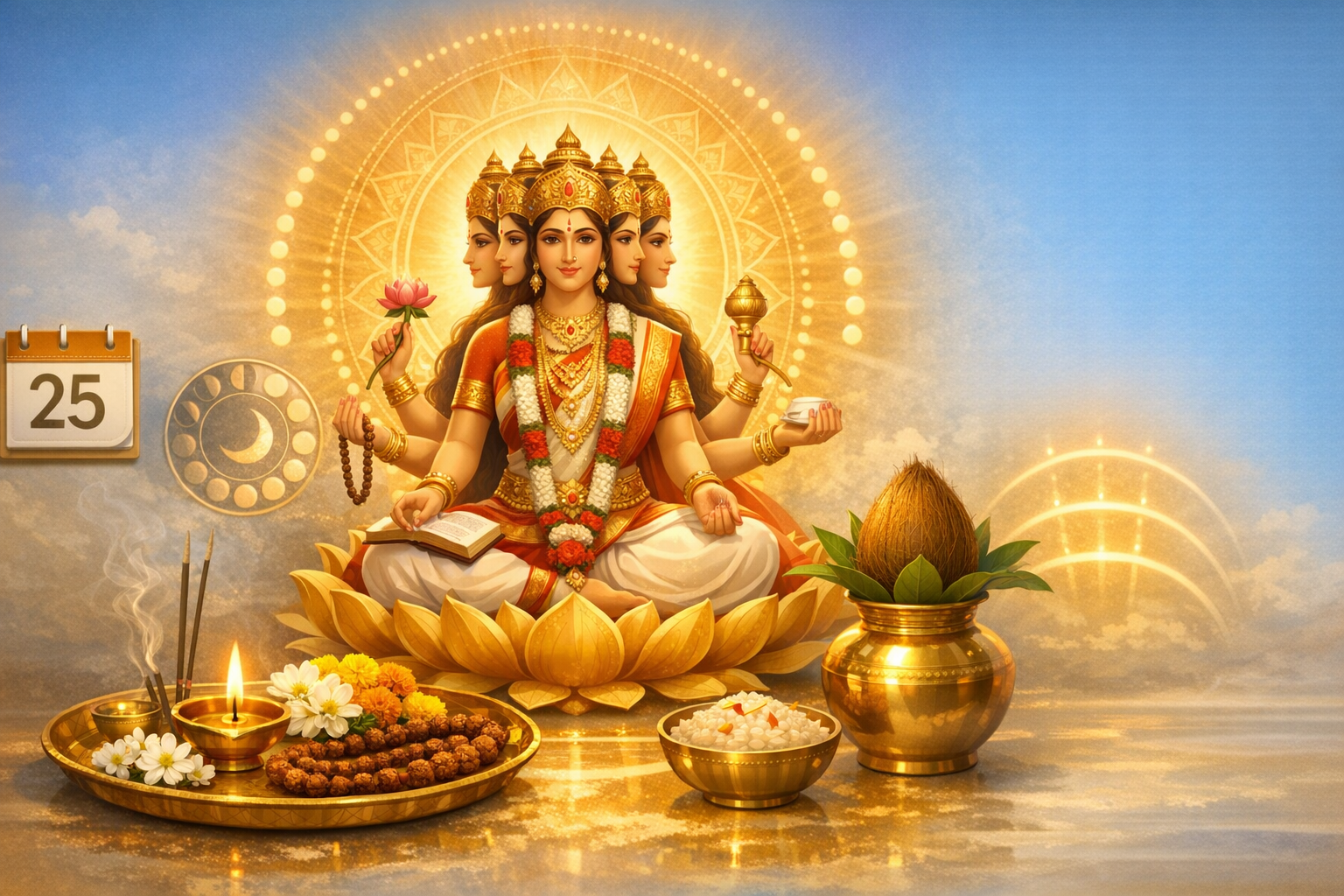
Gayatri Jayanti (also spelled Gayathri Mata Jayanthi) commemorates the first appearance of Goddess Gayatri, revered as Veda Matathe Mother of the Vedasand the personified light of knowledge that animates Vedic revelation. In 2026, Gayatri Jayanti falls on 25 June. The observance honors Devi’s role as the luminous force behind the Gayatri Mantra and celebrates the ideal of inner illumination that unites the wider dharmic familyHinduism, Buddhism, Jainism, and Sikhismthrough shared commitments to wisdom, compassion, and ethical self-cultivation.
As per most Hindu lunar calendars, Gayatri Jayanti is observed on Jyeshtha Shukla Paksha Navami. Regional and sampradaya variations exist: some lineages solemnize the festival on Jyeshtha Shukla Paksha Ekadashi, and others associate the commemoration with Guru Purnima (Vyas Purnima) due to the connection with Bhagavan Veda Vyasa’s redactional work and the mantra’s revelation lineage through Rishi Viśvāmitra. For 2026, the date recognized widely is Thursday, 25 June, with local panchang calculations (anchored to sunrise) determining the practical span of Navami tithi at each location.
Gayatri occupies a unique theological position across Śruti–Smṛti traditions. As Veda Mata, Devi is simultaneously a personal deity and the archetype of Gayatri chandas (24-syllable Vedic meter). Iconographically, Panchamukhi (five-faced) Gayatri embodies the integrative intelligence of the five pranas and the five sheaths (pañcakośa), while doctrinally she is linked with Savitṛ (the life-bestowing solar principle) and often presented in harmony with Saraswati, Lakshmi, and Parvati as a composite of knowledge (vidyā), prosperity (śrī), and strength (śakti). The festival, therefore, is not only devotional but also pedagogical: it re-centers the pursuit of inner clarity as the foundation of virtuous action.
The heart of this observance is the Gayatri Mantra from the Rigveda (3.62.10), traditionally received through the rishi-paramparā of Viśvāmitra and directed to Savitṛ as the devata, with Gayatri as the chandas. Recited universally in sandhyā-vandana and in innumerable home liturgies, the mantra is:
Om bhūr bhuvaḥ svaḥ tat savitur vareṇyaṁ bhargo devasya dhīmahi dhiyo yo naḥ pracodayāt
From a technical perspective, Gayatri chandas comprises 24 syllables arranged as three padas of eight syllables each (8+8+8), a metrical symmetry that supports steady breath, attention, and contemplative rhythm. Within the Vedic liturgical grammar (ṛṣi–chandas–devatā–viniyoga), Gayatri’s rishi is Viśvāmitra, chandas is Gayatri, devatā is Savitṛ, and viniyoga is for japa-dhyāna leading to buddhi-prakāśa (illumination of intellect). The mantra’s tri-partite structure maps naturally onto the three daily sandhyās (dawn, noon, dusk), binding cosmological time to interior practice.
Historically, Gayatri’s prominence is anchored in the Rigvedic corpus and reinforced by later Upanishadic and Puranic literature, where Gayatri is not only a meter but a living symbol of prajñā (wisdom). The association of Gayatri Jayanti with the revelation lineage underscores the transmission of sacred knowledge from vision (dṛṣṭi) to disciplined practice (abhyāsa), mirroring how dharmic traditions translate metaphysical insight into embodied ethics.
Observance practices on Gayatri Jayanti emphasize inner stillness, mantra-japa, and reverential worship (pūjā-vidhi). Households typically begin with snāna (purificatory bath) and a simple saṅkalpa to honor Gayatri Mata and cultivate clarity of thought. Offerings often include a clean white or yellow cloth, a lamp (dīpa), water in a kalaśa, flowers (preferably white or yellow), incense, and sattvic naivedya such as kṣīra (sweet rice), fruits, or panchāmṛta. Devotees frequently perform arghya to the Sun at sunrise and align japa with the tri-sandhyā cycles, integrating the day’s rhythm with contemplative discipline.
Pūjā-vidhi at home can be structured with panchopachāra (five-offering) or, where feasible, śoḍaśopachāra (sixteen-offering) worship. After invoking purity (ācamana) and a brief prāṇāyāma for steadiness, worship proceeds through dīpa, dhūpa, puṣpa, and naivedya, culminating in āratī. Japa of the Gayatri Mantra in rounds of 108 (or 1008 for advanced aspirants) is common, using a rudrākṣa or tulasī mālā, with attention on correct pronunciation and unforced breath. Where initiation (dīkṣā) and training are available, some communities also perform a brief homa with clarified butter, maintaining safety and scriptural fidelity.
Many adopt a light vrata (fasting or partial fasting) on Gayatri Jayanti, choosing a sattvic diet and periods of mauna (constructive silence) to conserve energy for prolonged japa and svādhyāya (scriptural study). Seva (service), dana (charity), and compassionate engagement with community are encouraged as natural expressions of cultivated clarity. Across temples and learning centers, the day is often marked by group japa, recitation of Gayatri sahasranāma selections, and educational discourses on Vedic mantras and Hindu calendar timing (tithi, nakshatra, yoga, karaṇa) to deepen understanding without sectarian exclusivity.
Concerning muhurta, practitioners prioritize the Navami tithi in their locality, with Brahma-muhūrta (pre-dawn) favored for meditation and dawn sandhyā. Abhijit-muhūrta (midday) supports concise worship when schedules are constrained, and dusk sandhyā concludes the core daily cycle. Because tithi spans can shift around sunrise, local panchang consultation is prudent to schedule the principal puja and japa while Navami prevails.
Devotees frequently report a quietly transformative affective contour to the day: at sunrise, steady recitation induces a palpable sense of inner spaciousness; by noon, attention becomes more one-pointed; by dusk, the mantra’s cadence often leaves a residue of calm alertness. These experiential notes align with contemporary research on mantra-based meditation, which broadly indicates improvements in attentional stability, stress regulation, and affective balance when practice is consistent and ethically framed.
Gayatri Jayanti also offers a gentle bridge across dharmic traditions. While the Gayatri Mantra is Vedic in origin and primarily used in Hindu practice, the values it symbolizesclarity of mind, reverence for light as knowledge, disciplined compassionresonate with Buddhist cultivation of prajñā and karuṇā, Jain emphasis on ahiṁsā and self-restraint, and Sikh simran’s focus on remembrance of the One. The festival thus becomes an occasion to appreciate a shared civilizational ethic: wisdom pursued through contemplation, ethics, and service.
Practical guidance for 2026 can be summarized in simple phases: prepare a clean, quiet space and materials the day before; rise early for Brahma-muhūrta to begin with a short prāṇāyāma; offer arghya to the rising Sun; perform panchopachāra or śoḍaśopachāra pūjā to Gayatri Mata; undertake japa in disciplined cycles across tri-sandhyā; read a passage on Vedic mantras or a brief section from the Upanishads; conclude at dusk with a modest āratī and sankalpa to extend daily practice beyond the festival day.
Questions of eligibility and inclusion are often addressed today with an emphasis on universality and compassion. While traditional contexts situated Gayatri within initiatory frameworks, many contemporary acharyas and community leaders encourage sincere, respectful recitation by all who approach the mantra with humility, correct pronunciation, and ethical intentaffirming equality of spiritual aspiration across gender and community while honoring lineage wisdom. The guiding principle remains straightforward: practice that uplifts clarity, non-violence, and service harmonizes with dharma.
In 2026, observing Gayatri Jayanti on 25 June with attentiveness to Jyeshtha Shukla Paksha Navami provides a disciplined yet welcoming framework to deepen practice. By aligning devotion (bhakti), knowledge (jñāna), and selfless action (seva), the day magnifies the “light” Gayatri representsan inner radiance that benefits householders and renunciants alike, and one that strengthens unity across the broader dharmic family. With steady japa, mindful puja, and a spirit of inclusion, Gayatri Jayanti becomes a living pedagogy of clarity, compassion, and shared flourishing.
Inspired by this post on Hindu Pad.
