Chaitra Pratipada (also known as Chaitra Padyami) marks the first lunar day of the bright fortnight of the Chaitra month and is widely celebrated as Ugadi (Yugadi) in the Telugu and Kannada traditions and as Gudhi Padwa in the Marathi tradition. For 2026, the Ugadi and Gudhi Padwa date in India is 19 March 2026, when Chaitra Shukla Pratipada prevails at sunrise across most Indian time zones. In Goa and other Konkan communities, the day is similarly observed with regionally distinct customs, underscoring a shared sense of renewal anchored in the Hindu lunisolar calendar.
Recognized as the Telugu New Year and Kannada New Year, Ugadi reorients social and spiritual life around a fresh Panchang (almanac), while Gudhi Padwa, the Marathi New Year, ceremonially welcomes the year with the iconic raising of the gudhi. Though the nomenclature and culinary offerings differ, both observances center on auspicious beginnings, dharmic resolve, and community cohesion. The alignment of these traditions on Chaitra Pratipada highlights the continuity of timekeeping and ritual life across regions.
From a calendrical standpoint, Chaitra Pratipada is determined by the tithi (lunar day) in force at local sunrise. Southern and western India typically follow the Amanta lunisolar convention, wherein the month ends on Amavasya (new moon), making the morning after the new moon the first day of Chaitra. If Chaitra Shukla Pratipada does not prevail at sunrise locally, observance shifts to the next sunrise—a key reason dates can vary by geography and by Panchang school. As with all lunisolar festivals, those living outside India should confirm local observance through a reliable Panchang calibrated to their location.
With Ugadi 2026, many Telugu and Kannada Panchangs designate the rollover to Parabhava Nama Samvatsaram in the 60-year Jovian cycle. The Samvatsaram naming tradition, deeply embedded in the Panchang, provides a cultural and astrological frame for the year’s reflections. While contemporary readers may approach these year-names as cultural markers rather than deterministic forecasts, their continuity preserves a living bridge to classical time-reckoning.
Panchanga Shravanam (listening to the new year almanac) remains a central practice. The five limbs of the Panchang—Tithi (lunar day), Vāra (weekday), Nakshatra (lunar mansion), Yoga, and Karana—together provide a holistic picture of the day’s qualities. Households and temples often recite or discuss the Panchang for the new year, considering indicators like Shubha (auspiciousness), community welfare, seasonal rhythms, and recommended observances. Such readings are approached as guidance for mindful living rather than as rigid prescriptions.
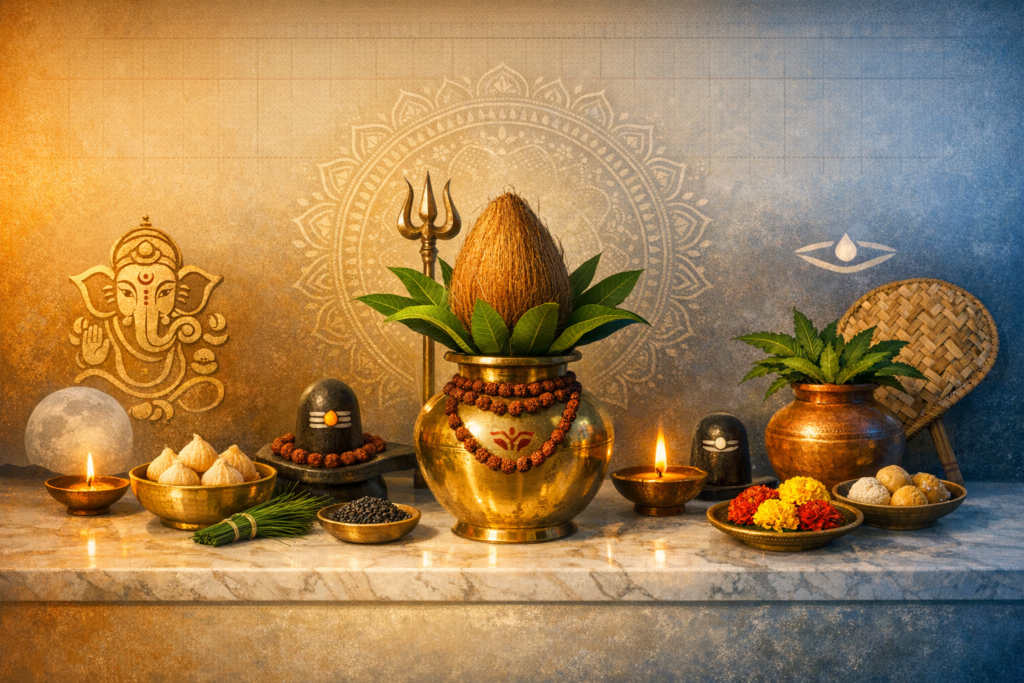
Ugadi customs emphasize purification and gratitude. Many households undertake abhyangasnanam (ritual oil bath) at dawn, adorn entrances with fresh mango-leaf toranas, draw intricate kolam/muggu/rangoli, don new attire, and visit temples for darshan and sankalpa. Charity (dāna) and acts of service reinforce the ethic of beginning the year with compassion and social responsibility, aligning personal intention with community welfare.
A hallmark of Ugadi is the preparation of Ugadi Pachadi, a seasonal blend symbolizing life’s six tastes (ṣaḍ-rasa): neem (bitter), jaggery (sweet), tamarind (sour), green chili or pepper (pungent), salt (salty), and raw mango (astringent/tangy). This thoughtful harmony of flavors embodies an enduring philosophical insight—life brings a spectrum of experiences, and equanimity (samatva) matures through accepting and integrating them. Families often share reflections on gratitude, resilience, and balanced living while partaking of this prasad.
Gudhi Padwa centers on the raising of the gudhi—a vibrant victory standard mounted outside homes. Traditionally, a bamboo staff is draped with a bright silk cloth, adorned with neem and mango leaves, sometimes a garland of sugar crystals (gaathi), and capped with an inverted metal kalash. Facing east or north, the gudhi is revered as a brahmadhwaj (standard of Brahma) and as a symbol of triumph of dharma, cultural memory, and auspicious renewal. Processions, community decorations, and collective greetings animate neighborhoods across Maharashtra, Goa, and the Konkan.
Foodways reinforce memory and festivity. In many Marathi homes, festive meals feature puran poli and shrikhand-puri, while a neem–jaggery mixture is shared as prasad—a parallel to Ugadi Pachadi’s ethic of integrating life’s rasas. In the Telugu and Kannada landscape, seasonal raw mango dishes, jaggery-til preparations, and regionally loved sweets evoke the arrival of Vasant (spring) and the promise of a good harvest.
Chaitra Pratipada also inaugurates broader spring observances across the dharmic spectrum. Chaitra Navaratri begins the same day in many regions, culminating in the celebration of Sri Rama Navami. Closely adjacent spring new-year observances—including Navreh (Kashmiri Hindu New Year) and Cheti Chand (revered by Sindhi communities)—echo the same theme of regeneration. A few weeks later, Puthandu (Tamil New Year) and Vaisakhi (of great significance in Sikh tradition) arrive on solar Chaitra/Mesha Sankranti, together affirming unity in religious diversity across Hindu, Buddhist, Jain, and Sikh heritage through shared rhythms of nature, gratitude, and ethical renewal.
How the date is derived merits special attention. The operational rule in classical Jyotisha is that the festival is observed on the civil day when Shukla Pratipada is present at local sunrise; if absent, observance moves to the next sunrise. Panchang compilers rely on astronomical parameters (for instance, those stemming from Surya Siddhanta and later refinements) to compute exact tithi spans, then apply regional conventions (Amanta or Purnimanta) and sunrise rules. Hence, Ugadi and Gudhi Padwa 2026 are observed on 19 March within India, while locations far to the west or east may see calendar drift of a civil day.
Practical muhurta considerations are guided by the Panchang. Families often raise the gudhi or perform Ugadi puja in the early morning during the Pratipada tithi, taking care to avoid Rahu Kalam as per local custom. Where appropriate, Abhijit muhurta around midday can serve as a secondary option. Regional practices such as Tarabalam and Choghadiya are also consulted to fine-tune personal or community timings.
Community life adds resonance to the day. Cultural troupes bring streets alive with dhol-tasha and lezim; homes and public spaces feature elaborate rangoli; and temples organize special alankarams, archana, and Panchanga Shravanam. In many cities and towns, literature, music, and dance programs—spanning forms like Kuchipudi, Bharatanatyam, and Yakshagana—reaffirm the blend of devotion and artistry that defines the season.
A brief calendrical crosswalk is useful for orientation. The Indian National Calendar (Saka) is a solar framework in which Chaitra 1 typically begins around March 22 (March 21 in leap years). By contrast, Ugadi/Gudhi Padwa on 19 March 2026 follows the lunisolar rule tied to tithi at sunrise. Similarly, North India often counts months by the Purnimanta system (month ending on Purnima), while much of the Deccan follows the Amanta system—different doorways into the same cyclical time.
For the global diaspora, the guiding principle is locality. Because tithis change with longitude, latitude, and sunrise times, Ugadi and Gudhi Padwa may fall on 18, 19, or 20 March depending on one’s location. Checking a trusted, location-aware Panchang or a temple calendar ensures fidelity to classical rules while keeping community observance cohesive.
Beyond custom and calculation, the day’s heart lies in its ethical and contemplative thrust. Themes of self-cultivation—samyama, gratitude, and service—find concrete expression in dāna, community kitchens, shared meals, and inclusion of neighbors and friends. The festival’s shared values—non-harm, truthfulness, generosity, and inner discipline—speak to a pan-dharmic ethos that nurtures harmony across Hindu, Buddhist, Jain, and Sikh communities.
In sum, Chaitra Pratipada 2026—celebrated as Ugadi and Gudhi Padwa on 19 March across India—combines precise lunisolar timekeeping with living tradition. From Panchanga Shravanam and Ugadi Pachadi to the gudhi’s triumphant flutter in the spring breeze, the observances invite reflection on beginnings, responsibility, and unity in spiritual diversity. As the year designated Parabhava Nama Samvatsaram unfolds, households and communities step forward with resolve, aligning personal intention with the timeless cadence of the dharmic calendar.
Inspired by this post on Hindu Pad.