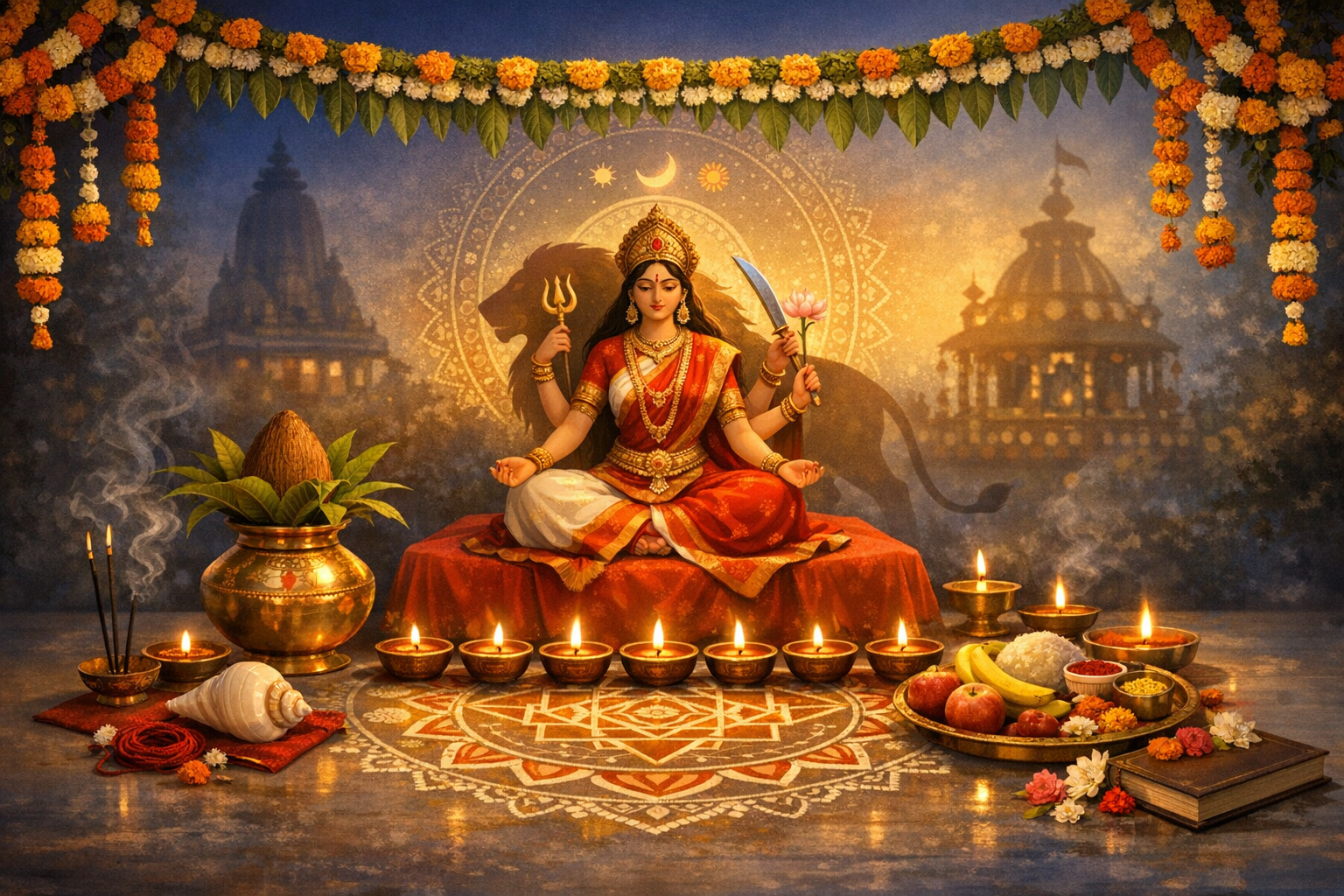
Bhavani Jayanti, also called Bhavani Ashtami, falls on Chaitra Shukla Ashtami, the eighth lunar day of the bright fortnight of the Hindu month of Chaitra. In 2026, this observance aligns with Thursday, 26 March, and within Chaitra Navratri it is widely recognized as Durgashtami; in several eastern and coastal regions it also overlaps with Ashokashtami.
The date is fixed by the Hindu calendar (Panchang) through the tithi system, where each tithi marks a 12-degree separation in the ecliptic longitudes of the Moon and the Sun. Because tithis begin and end at different clock times across locations, households and temples consult their local Panchang for precise puja windows, especially for evening rites and Sandhi Puja.
Goddess Bhavani is venerated as a powerful and compassionate manifestation of Devi (Durga), embodying shakti—the dynamic energy that protects, nourishes, and transforms. In living tradition across Maharashtra and beyond, devotion to Bhavani symbolizes a balanced synthesis of courage (kshatra) and compassion (karuna), a harmony cherished in both household worship and historic lineages.
Scripturally, Ashtami during Navratri resonates with the Devi Mahatmya (Chandi Path), where the Mother Goddess decisively subdues chaotic forces to restore dharma. The liminal junction of Ashtami and Navami, known as Sandhi Kaal, carries heightened devotional emphasis in many traditions, marking the transition from fierce protection to benevolent grace and inner composure.
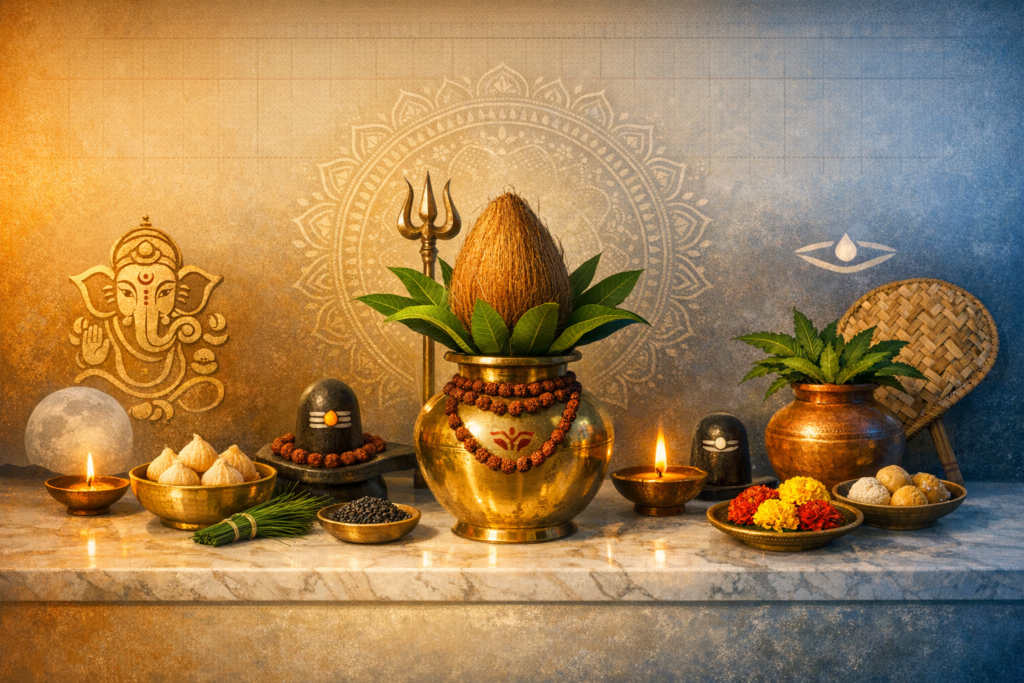
Common observances include a morning snana, a sankalpa to honor Śrī Bhavani, lighting of a deepa, recitation of Durga Saptashati (or selected adhyayas), and offering of sattvic naivedya. Many families perform Kumari Puja or Kanya Pujan—reverentially honoring the living embodiment of the Goddess in young girls through a respectful welcome, simple offerings, and prasada distribution.
Fasting (vrata) on Bhavani Ashtami varies by health and guidance, ranging from nirjala (complete), to phalahara (fruits and milk), to anukalpa (select sattvic grains). The intent is inner clarity and self-discipline rather than austerity for its own sake; elders, expectant mothers, and those with medical conditions typically adapt the vrata mindfully to maintain well-being.
Home worship is often arranged around a clean altar, with a picture or murti of Bhavani, flowers, incense, and water for achamana. Devotees frequently include japa of the simple, potent mantra “ॐ देवी भवान्यै नमः”, quiet reading from the Devi Mahatmya, meditation on the Mother’s protective presence, and, where feasible, acts of annadana or community seva to align personal devotion with social care.
Regional traditions add rich texture to the day. In Maharashtra, the Tulja Bhavani Temple at Tuljapur and numerous Bhavani shrines remain focal points for special abhishekam, alankara, and public seva; narratives of Chhatrapati Shivaji Maharaj’s devotion to Bhavani continue to inspire ethical leadership grounded in dharma and service.
In Odisha, the same tithi is renowned as Ashokashtami, marked in Bhubaneswar by the Rukuna Rath of Lord Lingaraja, while Shakti worship and Chaitra Durgashtami prayers are also observed across the state. In parts of West Bengal and Assam, Basanti Durga Puja in Chaitra mirrors the fervor of Shardiya Navratri, with homes and temples performing anjali and Chandi recitation.
Across North India, Chaitra Navratri Ashtami typically features Kanya Pujan and simple community meals, while in Nepal and the Himalayan belt, Vasanta Navratri upasana highlights seasonal renewal and sattvic living. Global congregations adapt these observances with accessible, eco-conscious materials and multilingual liturgy to meet local needs.
The theological tenor of Bhavani Jayanti is inclusively dharmic. Shakti is affirmed as the life-empowering principle recognized across Indic streams; the spirit of compassionate strength resonates with Sikh simran and seva (as reflected in compositions such as Chandi di Var), with Buddhist emphasis on fearless wisdom and karuna, and with Jain dedication to ahimsa and disciplined vrata—affirming unity in spiritual diversity.
From a Panchang perspective, the day’s most sought-after interval is the Sandhi Puja window spanning the Ashtami–Navami junction—traditionally observed for 48 minutes (24 before and 24 after the transition). As the exact moment differs by longitude and time zone, practitioners rely on local almanacs or temple notices to align homa, pushpanjali, and deepa offerings with accuracy.
Symbolically, Ashtami is often associated with stabilizing eightfold virtues and energies directed toward family and social well-being. Bhavani’s worship on this day therefore carries a civic as well as a spiritual message: protect without hatred, serve without pride, and persevere without fear—ideals that support community harmony and ethical action.
Throughout Chaitra Navratri, families narrate lived experiences of calm, focus, and renewed purpose arising from daily arati and disciplined routine. Children engage through bhajans and stories, while elders model mindful fasting and evening pradakshina, creating intergenerational bonds around Devi bhakti that make the festival both instructive and heartening.
Eco-conscious worship aligns naturally with dharmic care: locally sourced flowers, reusable brass or clay lamps, minimal plastic, and responsible disposal of organic offerings. Many communities complement puja with tree-planting, blood donation, or food distribution, integrating adhyatma with lokasangraha—care for the wider world.
For 2026, devotees can anticipate Bhavani Ashtami on 26 March, with Ram Navami likely following the next day in many regional calendars, completing Chaitra Navratri’s narrative arc from Shakti to the maryada of Śrī Rama. Those in the diaspora may encounter date shifts based on local sunrise and tithi boundaries and are advised to consult regional Panchang guidance.
Key reminders include prioritizing local Panchang for tithi start–end times, observing vrata in a health-conscious manner, and upholding a spirit of inclusion that honors the many valid paths within the dharmic family. Approached with reverence and care, Bhavani Jayanti deepens inner resilience, nurtures ethical living, and strengthens social harmony.
Inspired by this post on Hindu Pad.