Across Bengal’s riverine plains, where paddy sways with monsoon winds and the household rhythm follows the agricultural calendar, a time-honored mode of Lakshmi worship takes shape in grain and earth. Referred to as Bedi Lakshmi or Beri Lakshmi, this aniconic, altar-centered practice anchors prosperity not in a sculpted image but in living seed, consecrated boundaries, and the ethics of household stewardship. It exemplifies how Bengali traditions integrate ecology, economy, and devotion into a single, pervasive ritual language.
The designation Bedi Lakshmi draws upon bedi (Bengali: vedi), the sanctified altar or plinth of Vedic rite, while Beri Lakshmi evokes beri, the protective boundary or enclosure. Both names emphasize what devotees enact: abundance gathered and safeguarded within dharma’s limits. The “sacred grain-filled form” is not merely symbolic decoration; it is a ritual system in which rice, soil, water, and household labor become vessels of śrī—radiant well-being and auspicious prosperity.
Within Bengal’s annual cycle, Lakshmi Puja on the full-moon night of Sharad (Kojagari Purnima) is a principal occasion for this worship. In many districts, additional Thursday observances in the late-autumn months and post-harvest practices associated with nabanna (new rice) extend the devotional season. The result is a continuum of household rites in which Bedi or Beri Lakshmi becomes a focal point for thanksgiving after the rains and a pledge to care for the resources that sustain family and community.
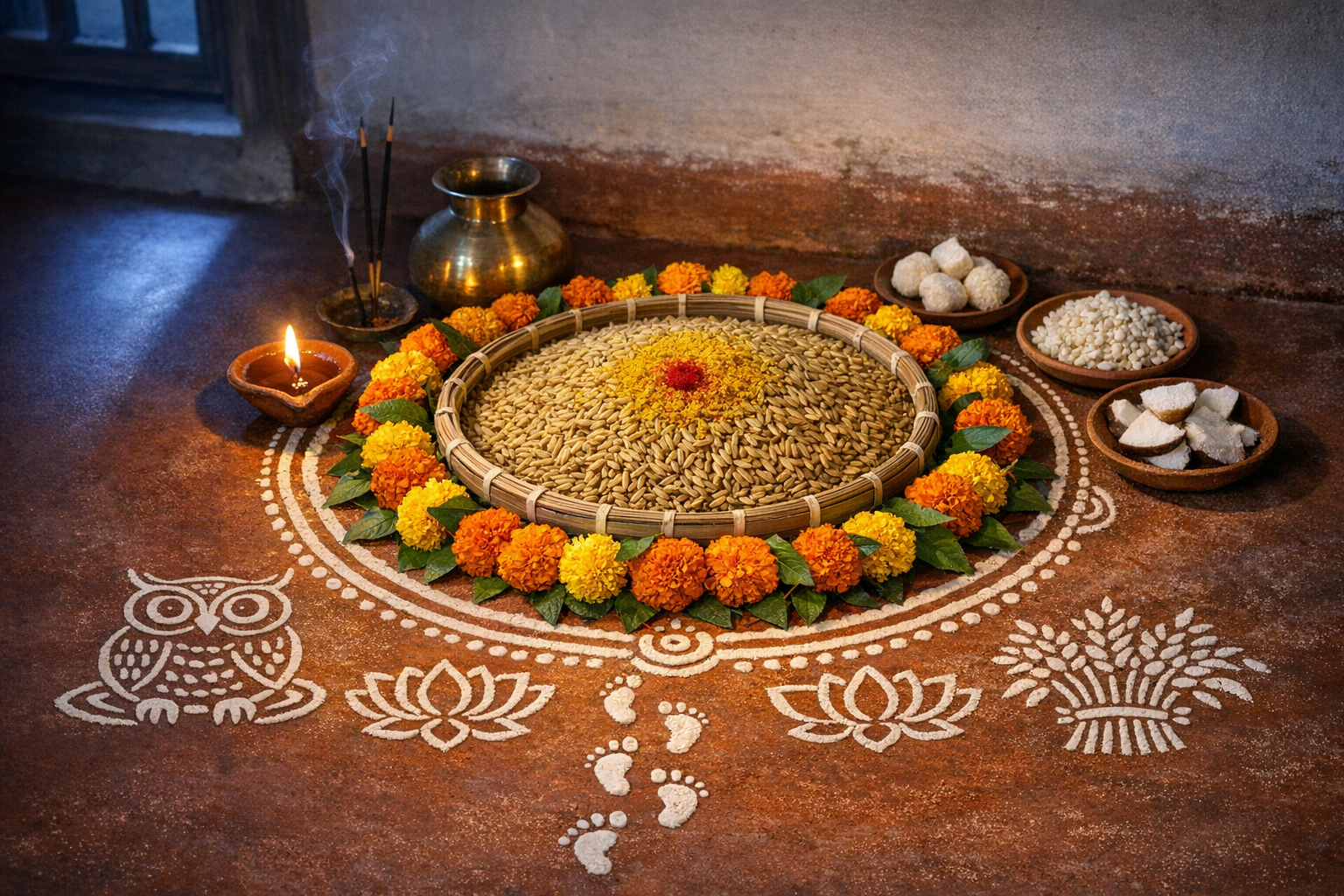
In its most widespread form, the altar is established upon a carefully cleaned floor marked by alpana in rice-paste motifs. A shallow earthen tray, bamboo winnow (kulo), or low wooden platform is layered with dhān (unhusked paddy), often mixed with a pinch of turmeric and adorned with vermilion. Around this grain core, a boundary is articulated—by lines of rice paste, concentric rings of flowers, or an enclosure of leaves—giving the rite its distinctive “bedi/beri” identity. A lamp, incense, water in a small vessel, and rice-based sweets complete an offering tableau that is unmistakably agrarian in material grammar and profoundly theological in intent.
Households speak of a quiet, anticipatory joy that settles over living rooms and courtyards as dusk gathers on Kojagari night. The first flame touches the wick, and the owl—the gentle ulūkā, Lakshmi’s vahana much loved in Bengal—appears in simple alpana lines near lotus rosettes and paddy-sheaf motifs. Children trace tiny footprints from the threshold to the altar, marking the imagined arrival of Lokkhi into the domestic heart. These gestures, while intimate and familiar, encode a serious ethic: prosperity flows in where cleanliness, care, and right relationship with the earth are maintained.
At a technical level, Bedi/Beri Lakshmi is an aniconic representation in which the deity’s presence is invoked through sanctified substances rather than a carved murti. The bedi (altar) functions as a microcosmic field, and the grain is a living index of potentiality—nutritional, economic, and spiritual. The boundary conveys a second principle: abundance without discipline becomes dissipation; abundance within dharma becomes shared wealth. This is ritual semiotics with pragmatic consequence, teaching through touchable matter what scriptures teach through verse.
During the pūjā, invocatory mantras seat Lakshmi in the grain-filled altar. Offerings commonly follow the pañcopacāra or ṣoḍaśopacāra sequence—fragrance, flowers, lamp, incense, and food—rendered in household-appropriate forms. Food offerings emphasize rice in its many Bengali expressions: naba-anna (new rice), puffed rice, rice flour confections, along with coconut, banana, and seasonal sweets. The worship culminates in ārati, a circular lamp offering that visually affirms the altar as a radiant, life-nourishing center.
Materials in this practice are chosen not only for availability but also for meaning. Unhusked paddy embodies potential and protection; turmeric signals sanctity and health; vermilion marks auspicious thresholds; the bamboo winnow associates abundance with patient, embodied labor. Even the rice-paste alpana is semiotically dense: lotus motifs evoke Lakshmi’s cosmic seat; conch spirals recall auspicious resonance; paddy sheaves encircle the altar in a ring of sustainable plenty.
Ethnographic accounts from districts such as Birbhum, Bankura, Nadia, and 24 Parganas note a consistent pattern in household participation. Women often lead as ritual specialists, orchestrating preparation, drawing alpana, and setting the sequence of offerings. Elders narrate proverbs and songs that associate good order, clean thresholds, and skillful hands with Lokkhi’s favor. Younger family members learn by doing—shelling coconuts, sorting flowers, lighting wicks—thus absorbing a living curriculum of stewardship and gratitude.
Timing links the rite to agrarian ecology. Kojagari Purnima arrives when autumn skies clear and rice panicles bend with grain; it is a season when households hold their breath between labor and harvest. The altar’s paddy core becomes an embodied prayer that work will ripen into food security, that rain-fed bounty will translate into a just household economy, and that prosperity will carry the moral hue of śrī rather than the shadow of hoarding.
In some homes, the grain from the altar is later sown in a corner of the courtyard or mixed into the family’s seed stock, extending ritual efficacy into agricultural practice. In others, the rice joins pantry stores as a talisman of continuity. Both pathways express a circular ethic: what is worshipped as sacred must be returned to the cycle of use, cultivation, and care. The altar, then, is not a terminus but a hinge between devotion and livelihood.
Relating Bedi/Beri Lakshmi to textual frames, the practice resonates with śrī-lakṣmī
traditions in Purāṇic and Vaiṣṇava streams while remaining distinctly domestic and regional in its material vocabulary. It stands at a fruitful intersection of Śākta (Goddess-centered) sentiment—especially strong in Bengal after Durga Puja—and Vaiṣṇava devotion to Lakshmi as the ground of sustenance and order. The grain altar thus becomes a bridge: it is cosmically oriented yet immediately practical, scripturally consonant yet crafted from the tools and textures of household life.
Alpana design—drawn freehand with rice paste—encodes a quiet geometry of care. Circles around the altar imply wholeness and guarding; petalled lotuses open toward the lamp’s light; fine lines suggest irrigation channels or the veining of leaves. Practitioners often remark that drawing alpana slows the breath and centers attention, preparing the mind for worship while visually teaching how boundaries and openings cooperate to make a home thrive.
The owl motif, frequent in Bengal’s Lakshmi iconography, is read locally not as omen but as pedagogue. With wide, wakeful eyes, it stands for vigilance over stores, humility amid wealth, and the refusal to be dazzled by excess. Placed beside paddy and lamp, it completes a triad: resource, energy, oversight. In this lens, Bedi/Beri Lakshmi trains household perception as much as it petitions divine grace.
Comparative perspectives across eastern India reveal thematic kinships. Odisha’s autumnal household rites around rice and prosperity offer cognate motifs, though with distinct liturgical accents. In wider Dharmic contexts, there is deep consonance: Buddhist ethics emphasize mindful consumption and interdependence; Jain practice prioritizes non-violence and restraint; Sikh tradition elevates seva, kirat karo, and vand chhako—work honestly and share the fruits. All four traditions affirm that abundance is healthiest when it is conscientious, compassionate, and shared.
As urbanization accelerates, many Bengali families adapt Bedi/Beri Lakshmi to small apartments and diaspora settings. Compact altars replace large platforms; potted rice grass or a symbolic handful of dhān stands in for field-fresh sheaves; alpana migrates to removable mats or eco-safe chalk. What remains constant is the ethic: clean spaces, carefully chosen offerings, clear intentions, and gratitude embodied in grain.
Sustainability naturally threads through this practice. Biodegradable materials dominate; plastic is unnecessary; and the rite invites a circular mindset in foodways, from mindful shopping to respectful storage and equitable sharing. The altar becomes a lesson in regenerative culture: what nourishes the household must in turn nourish soil, neighbor, and future seasons.
For households seeking to observe Bedi/Beri Lakshmi with fidelity, attention to local custom matters. Elders’ guidance on timing, songs, and offerings situates the rite within family memory; neighborhood priests can help align household practice with scriptural norms where desired; and above all, the material heart of the altar—grain, water, lamp—grounds the rite in the simple, potent language that has carried it through centuries.
From a symbolic standpoint, the grain-filled core can be read across layers. As seed, it is potential; as food, it is realized nourishment; as offering, it is gratitude; as stored wealth, it is responsibility. The boundary answers each layer with a question: how will potential be guarded, nourishment be shared, gratitude be enacted, and wealth be stewarded? Bedi/Beri Lakshmi poses these questions gently but insistently within the rhythms of domestic time.
Practitioners frequently recount the subtle transformation the ritual seeds in daily life. Cupboards get ordered; wastage is noticed and reduced; seasonal menus are planned with care; neighbors exchange prasad and recipes. Such unassuming shifts exemplify how a “household altar” can reorganize attention, weaving a moral economy from the threads of cooking, cleaning, budgeting, and celebration.
In scholarship on Bengali traditions, Bedi/Beri Lakshmi is often cited as a model of living heritage—transmitted orally and practically, highly adaptable, yet conceptually robust. It demonstrates an indigenous theory of value formation in which prosperity is neither a mere windfall nor a private hoard but a cultivated relationship among land, labor, knowledge, and virtue. In this sense, the altar is a theory diagram as much as a devotional node.
Ultimately, Bengal’s Bedi/Beri Lakshmi offers a quietly radical proposition: prosperity is most secure when it is ritually remembered as interdependence. Seed remembers soil; household remembers village; worship remembers work; and abundance remembers its duty to flow. In aligning grain with grace, and boundary with responsibility, this tradition continues to shape both the spiritual imagination and everyday ethics of Bengali life.
Inspired by this post on Hindu Blog.