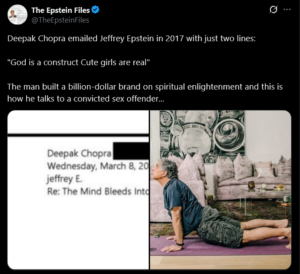
A wave of headlines and social-media threads has claimed that “Deepak Chopra appears in the Epstein files.” Because any allegation linked to Jeffrey Epstein carries grave moral and legal weight, precision and context are essential before drawing conclusions—especially for communities already navigating loaded narratives about faith, culture, and identity.
In public discourse, the phrase “Epstein files” generally refers to unsealed court exhibits and materials associated with civil litigation, including Giuffre v. Maxwell (unsealed in early 2024 in the Southern District of New York) and related proceedings tied to the U.S. Virgin Islands’ suits against financial institutions. These materials include contact lists, calendars, emails, and travel or phone logs. Crucially, the mere appearance of a name in such files does not, by itself, establish wrongdoing; individuals can surface for a range of reasons—from social introductions and professional overlap to third-party references—without any criminal implication.

Regarding Deepak Chopra specifically, social media users and some outlets have circulated screenshots of purported email exchanges. Authenticity and context remain decisive: excerpted lines can mislead if they omit timestamps, recipients, or surrounding content. That said, three frequently shared lines attributed to Chopra read: “My biological needs are met occasionally”; “I do enjoy the company of younger intellectually sharp and self aware women and love to engage them to inspire and stimulate them”; and “God is a construct Cute girls are real.” Even if authentic, these statements have been widely criticized for tone and judgment. On their face, however, they do not constitute evidence of criminal conduct.
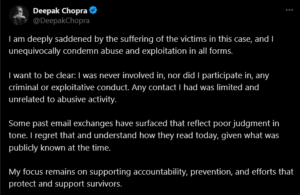
Chopra has issued a public response affirming survivor-centered accountability while denying any complicity in abuse: “I am deeply saddened by the suffering of the victims in this case, and I unequivocally condemn abuse and exploitation in all forms. I want to be clear: I was never involved in, nor did I participate in, any criminal or exploitative conduct. Any contact I had was limited and unrelated to abusive activity. Some past email exchanges have surfaced that reflect poor judgment in tone. I regret that and understand how they read today, given what was publicly known at the time. My focus remains on supporting accountability, prevention, and efforts that protect and support survivors.” – Deepak Chopra.

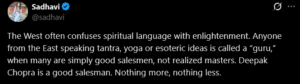
Public reaction has ranged from calls for due process to sweeping generalizations about “gurus.” Some argue Chopra is not a realized master but a popularizer of wellness concepts. One pointed view circulating online states: “The West often confuses spiritual language with enlightenment. Anyone from the East speaking tantra, yoga or esoteric ideas is called a ‘guru,’ when many are simply good salesmen, not realized masters. Deepak Chopra is a good salesman. Nothing more, nothing less. -Sadhavi.” The underlying concern—commodification of South Asian spiritual vocabulary—warrants careful discussion without enabling bias against sincere practitioners or teachers.
Another thread driving controversy is the recurring debate about yoga’s origins. Chopra has been quoted as saying, “I must repeat, that yoga did not originate in Hinduism.” Academic consensus situates the formative textual and philosophical roots of yoga within the broader Indic dharmic matrix—closely tied to Hindu traditions through the Upanishads, the Bhagavad Gita, and Patanjali’s Yoga Sutra—while also acknowledging cross-pollination with Buddhism and Jainism across centuries. Thus, while yoga today is practiced trans-religiously, scholarship overwhelmingly traces its foundational sources to Hindu thought within a shared Dharmic civilizational context.

Chopra’s earlier political commentary has also resurfaced. He has been quoted as saying: “In India, this is particularly inflammatory, because there’s a rise of Hindu fundamentalism. We saw what that did in Gujarat, where, you know, Muslims were scorched and they were killed, and there was almost a genocide of the Muslims.” Events in Gujarat in 2002 have been extensively studied, with casualties documented among both Hindus and Muslims. Characterizations such as “almost a genocide” remain contested, and a fair accounting requires acknowledging the suffering of all victims and resisting narratives that flatten complex communal tragedies into single-cause explanations.
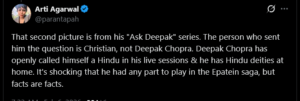
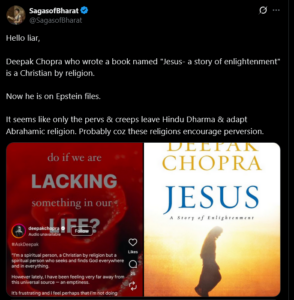
There are also competing social-media claims about Chopra’s religious identity. Some users infer that his books on Jesus imply conversion to Christianity; others counter that he has described himself as a Hindu in live sessions and maintains Hindu deities at home. Writing about Jesus—or any revered figure across traditions—does not, by itself, denote religious conversion. Absent verifiable public declarations to the contrary, the norm should be to honor a person’s self-description, which in Chopra’s case has consistently emphasized a Hindu background and a pluralistic, interfaith spirituality.
Concurrently, commentators have referenced other public figures whose names appear in documents or online discourse, including Mira Nair, and have even attempted to pull Indian political leadership into insinuations. Here again, reputational fairness requires a disciplined line: inclusion in a contact list or a log is not guilt; responsibly distinguishing contact from complicity is fundamental to justice.

For many in the global Hindu, Buddhist, Jain, and Sikh communities, these cycles of headlines can feel like a recurring pattern: complex legal material gets condensed into provocative claims, which then fuel broader attacks on traditions, teachers, or entire communities. A Dharmic response is both principled and practical: condemn abuse wherever it occurs; center survivors; demand due process; and reject collective blame. Ahimsa (non-harm), karuna (compassion), anekantavada (appreciation of multiple perspectives), sarbat da bhala (welfare of all), and satya (truthfulness) converge across Dharmic paths to guide that response.
Information hygiene is indispensable. Before sharing viral screenshots, readers should consider: Has the material been verified against primary court filings? Does the excerpt include context, dates, and recipients? Is a name’s presence being conflated with participation? Has reputable reporting corroborated the claim? Sensationalism can quickly morph into stigmatization—especially of minority communities—if these questions are ignored.
The Hinduphobia debate also surfaces here. It is legitimate to call out bigotry against Hindus and other Dharmic practitioners. Yet rhetorical escalation into reciprocal attacks on Christians, Muslims, Jews, or any other community replicates the same prejudice being opposed. Comparative “whataboutism” over institutional abuse helps no one. The consistent standard should be universal: protect children; hold perpetrators and enablers accountable; uphold compassion and fairness for all communities.
Amid these controversies, it is worth reiterating yoga’s civilizational arc: it is both an inheritance stewarded by Hindu traditions and a shared Dharmic resource enriched through exchanges with Buddhism and Jainism. Recognizing layered origins and cross-fertilization strengthens, rather than weakens, an inclusive and historically grounded understanding. Dharmic unity thrives when heritage is honored and sincere seekers of all backgrounds are welcomed.
At present, responsible conclusions are necessarily measured: (1) Chopra’s name and alleged emails appear in materials circulating from unsealed records; (2) he denies any criminal or exploitative involvement and acknowledges poor judgment in tone; (3) the appearance of a name in legal exhibits is not proof of wrongdoing; (4) broad-brush attacks on Hindus, “gurus,” or any faith community are unjustified and corrosive; and (5) the principled path emphasizes survivor-centered justice, primary-source verification, due process, and Dharmic solidarity across Hindu, Buddhist, Jain, and Sikh communities.
Ultimately, this moment invites recommitment to truth, non-harm, and compassion. In practice, that means resisting rumor, centering survivors, and refusing to let predatory crimes become a pretext for civilizational slander. With patience, clarity, and care for one another, communities can transform a sensational headline into a learning moment for pluralism, accountability, and shared human dignity.
Inspired by this post on Hindu Human Rights Blog.