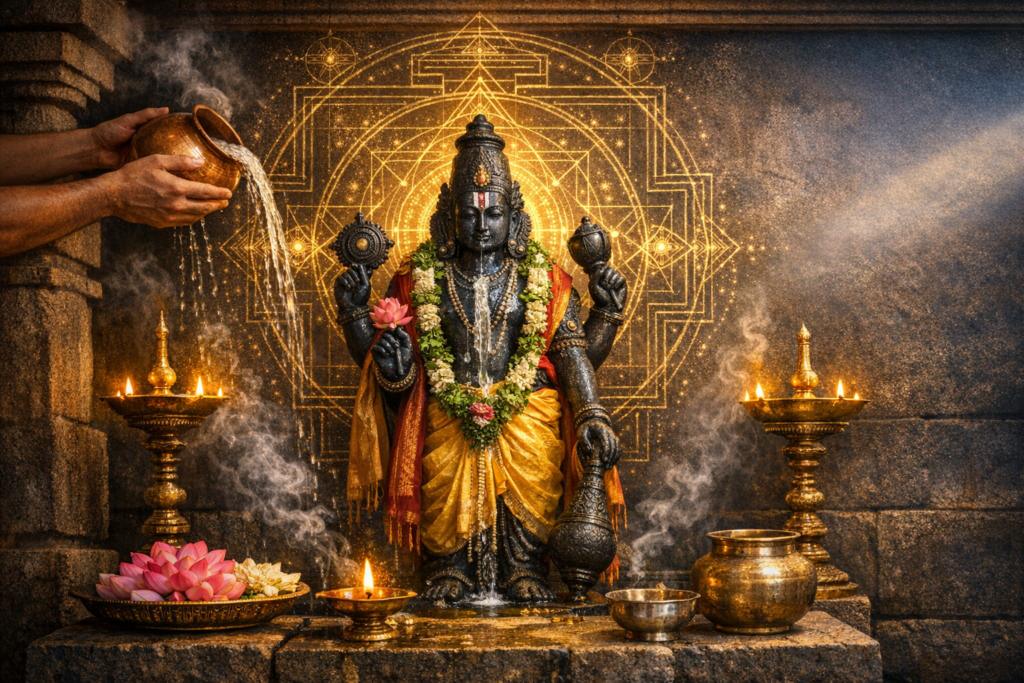
Accounts of the early pastimes of Caitanya Mahaprabhu describe a decisive moment of grace. After Sarvabhauma Bhattacarya denounced himself as an offender and sought refuge, the Lord conferred mercy by first manifesting a four-armed Visnu form. Immediately thereafter, He revealed the original two-armed Krsna form, marked by a blackish complexion and a flute near His lips. The sequence signaled both majesty and intimacy—cosmic sovereignty followed by the approachable sweetness of Krsna.
Overwhelmed, Sarvabhauma Bhattacarya prostrated, then rose with folded palms to offer prayers. By the Lord’s mercy, essential truths became clear to him. He grasped the centrality of chanting God’s holy names and recognized the imperative to share love of God wherever life leads. The transformation was not merely doctrinal; it was experiential, reshaping perception, devotion, and purpose.
In the theology of bhakti, such theophanies serve as hermeneutic keys. The four-armed Visnu form affirms divinity beyond time and space, while the two-armed Krsna form emphasizes the personal, relational core of devotion. Read together, these manifestations illuminate a consistent message in Gaudiya traditions: humility invites mercy, mercy reveals truth, and truth culminates in nama—constant remembrance through chanting. The narrative thus underscores that inner change arises when reverence meets surrender.
These themes resonate beyond a single lineage. Practices of sacred sound and loving remembrance are honored across dharmic paths—japa and kirtan in Hinduism, the Namokar Mantra in Jainism, Namo Amitabha and mindful recitation in Buddhism, and Naam Simran in Sikhism. Each tradition recognizes sound as a vehicle for clarity, compassion, and inner steadiness. The episode with Sarvabhauma Bhattacarya therefore speaks to a shared civilizational insight: when the heart turns to the Divine with sincerity, understanding deepens and conduct softens.
Contemporary readers can translate these insights into daily life through humility in relationships, regular engagement with sacred names, and acts of seva that distribute love of God as tangible kindness. Even brief, attentive chanting can anchor the mind, while community practice (kirtan) strengthens collective well-being. As devotion matures, generosity follows—listening more carefully, serving more readily, and seeing dignity in all. Such application embodies unity-in-diversity and nourishes harmony among Hinduism, Buddhism, Jainism, and Sikhism.
Ultimately, the early miracles of Caitanya Mahaprabhu are not presented as spectacle but as pedagogy: revelation that educates the heart. Sarvabhauma Bhattacarya’s change of view illustrates how devotion reorders priorities, aligning insight with compassion. The path indicated is simple yet profound—chant sincerely, love widely, and let realization be measured by service. In that alignment, awe becomes guidance, and guidance becomes shared peace.
Inspired by this post on Dandavats.