The Kurukshetra War had raged for ten days under the formidable command of Bhishma. As the revered grandsire of both Kauravas and Pandavas, Bhishma Pitamaha led the Kaurava forces with unmatched discipline and skill. Each day, thousands fell to his arrows, yet the five Pandava brothers remained unharmed. In this crucible of conflict, the seeds of suspicion took root in Duryodhana’s mind, reshaping the course of the war.
Convinced that familial affection restrained Bhishma from striking the Pandavas, Duryodhana confronted him with accusations of partiality. Stung by the charge yet unwavering in composure, Bhishma vowed to end the Pandavas’ lives the very next day. He prepared five golden arrows, empowered by intent and discipline, symbolically dedicated to defeating each of the brothers and breaking their collective strength.
Still uneasy, Duryodhana demanded custody of the arrows for safekeeping until morning. Bhishma, committed to transparency and duty, handed them over without protest. In that exchange, suspicion overshadowed strategy: what was meant to ensure victory instead opened the door to an unforeseen reversal.
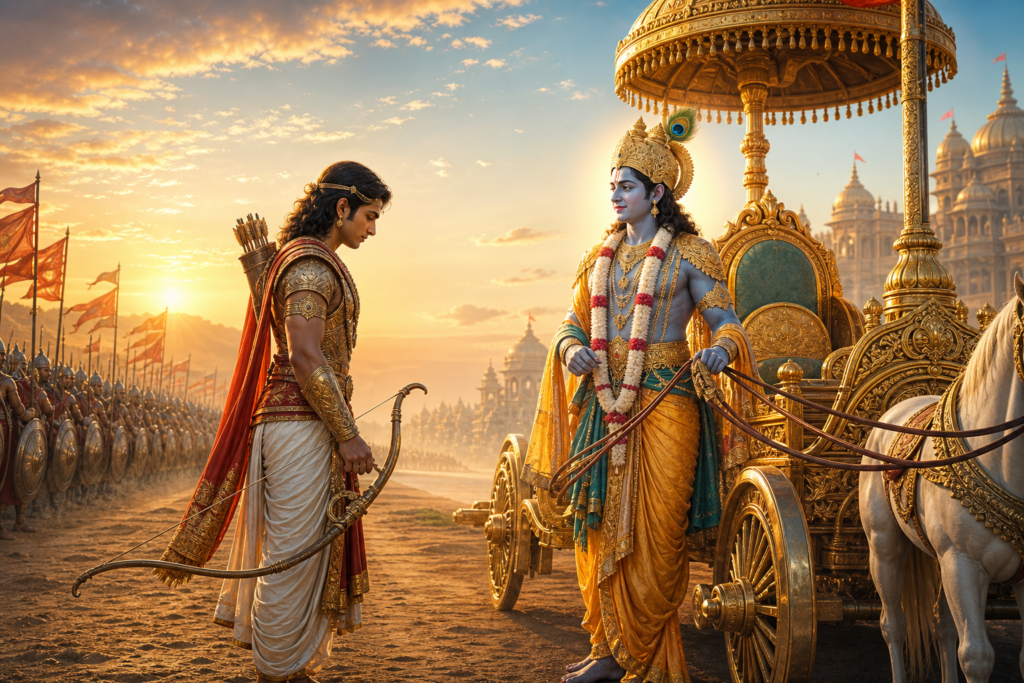
Krishna, ever alert to the moral and strategic currents of the war, recognized the moment’s gravity. He reminded Arjuna of a boon owed by Duryodhana from an earlier episode, when the Kaurava prince had been captured by the Gandharvas and freed through the intervention of the Pandavas. Acting on Krishna’s counsel, Arjuna entered Duryodhana’s camp at night and requested the five golden arrows as his boon. Bound by kshatra-dharma and personal honor, Duryodhana yielded the arrows, fully aware that his commitment to a given word outweighed tactical advantage.
At dawn, Duryodhana returned to Bhishma in agitation, alleging that the grandsire had foreseen this outcome. Bhishma responded with a measured reflection on daiva (destiny) and puruṣārtha (human effort): had the arrows remained with him, his vow might have found fulfillment; since they had been claimed through Dharma, fate had intervened. He pledged nevertheless to exhaust his might in battle and clarified the ethical constraint that would later guide his fall: he would not raise weapons against Śikhaṇḍi, honoring the complex arc of that soul’s prior grievance. This disclosure ultimately framed the conditions under which Bhishma would be brought down.
The episode of the five golden arrows offers layered insights into Mahabharata ethics and strategy. Suspicion corrodes trust and destabilizes alliances; clarity of intention steadies judgment under pressure. Duryodhana’s adherence to his word, Arjuna’s disciplined restraint, Bhishma’s fidelity to oath and ethical boundaries, and Krishna’s farsighted counsel together demonstrate how Dharma operates not as blind fatalism but as morally informed action within the flow of destiny.
Read through a dharmic lens that unites Hinduism, Buddhism, Jainism, and Sikhism, the narrative resonates with shared values: vigilance against the inner poisons of doubt and anger, commitment to truthful speech, respect for vows, and mastery over impulse. The emphasis on right intention, self-mastery, and ethical conduct parallels the Jain ideal of restraint, the Buddhist guard against kleśas, and the Sikh insistence on integrity and honor. Such convergence underscores a common civilizational ethic, inviting unity rather than division.
For contemporary life, the five golden arrows caution against decision-making fueled by mistrust. Whether in leadership, community work, or family life, suspicion without evidence undermines cooperation, while principled commitments build durable trust. The Kurukshetra War thus offers enduring guidance: align strategy with Dharma, guard the mind from corrosive doubt, and recognize that true strength emerges when ethical clarity and capable action move together.
Inspired by this post on Hindu Blog.