In the pre-dawn hush across South India, doorsteps brighten with delicate white lines as rice powder meets the earth. In Tamil Nadu this practice is known as Kolam, and in many other regions it is called Rangoli. Beyond ornament, it functions as a threshold ritual that blends aesthetics, ecology, and spirituality, embedding daily life within a larger fabric of dharma, hospitality, and auspiciousness.
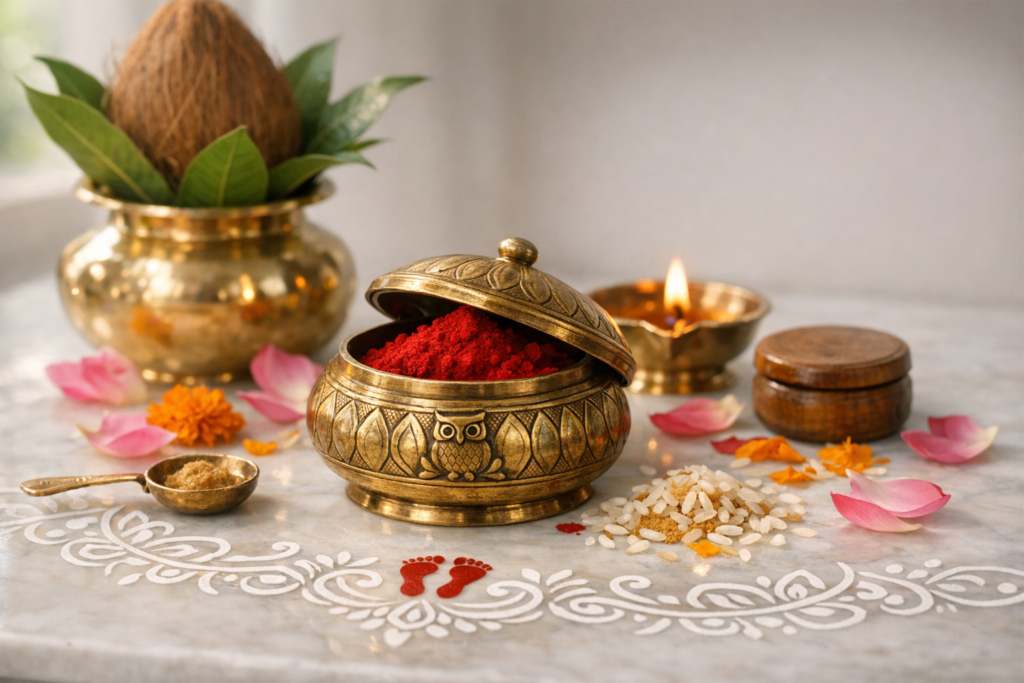
Typically made with finely ground rice flour or rock powder, a kolam unfolds on the threshold using a grid of dots and interlaced curves. Its impermanence is part of the meaning: drawn each morning and surrendered each evening to footsteps, wind, and rain, it models the cyclical renewal that marks so much of South Indian culture. The practice is at once meditative and mathematical, calling on symmetry, proportion, and measured hand-movements.
Within Hindu traditions, the kolam signals sacred welcome. It is linked to cleanliness, order, and the invitation of Lakshmi, while also expressing a household’s readiness to receive guests with warmth. The blend of ritual purity, social hospitality, and everyday artistry renders the threshold a living symbol of cultural continuity and community identity.
Many oral traditions describe a deeper spiritual dimension: the kolam as a means of karmic cleansing. Some lineages convey the belief that sustained practice can purify burdens across seven janmas (lifetimes). Academically, this claim is best understood as an ethical and symbolic teaching—daily, embodied virtues such as attention, non-harm, and generosity are cultivated over long arcs of time, shaping outcomes in this life and, for those who hold that view, beyond it.
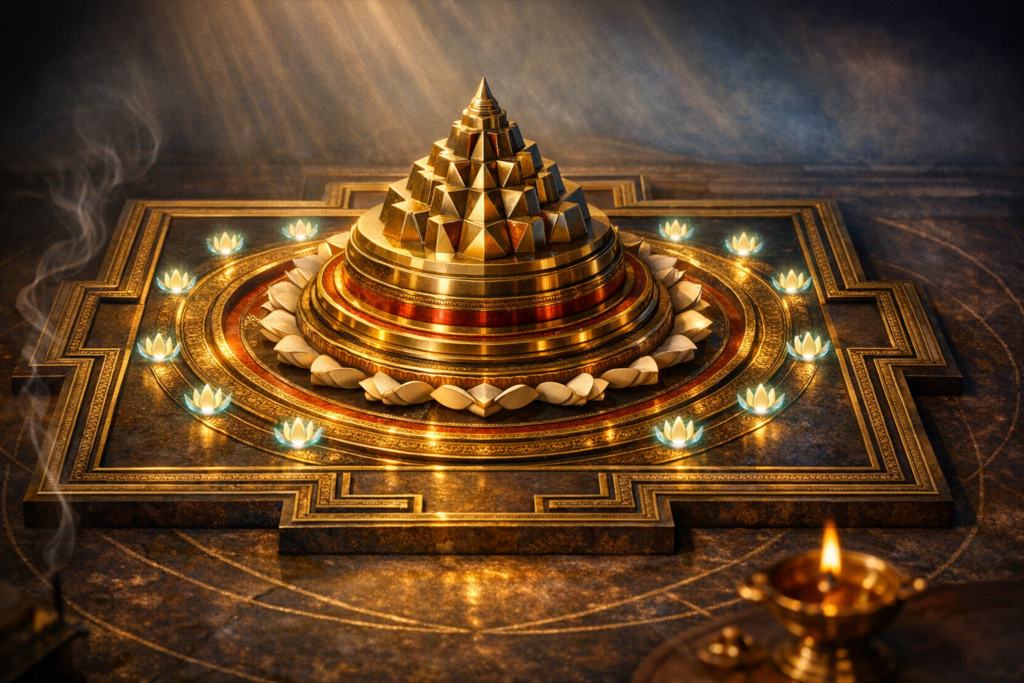
Its geometry is not incidental. Like a terrestrial mandala, the kolam mirrors cosmic order through symmetry and repetition. Interlacing loops evoke continuity; dot-grids invite precision; curving lines create a visual rhythm akin to breath. Practitioners often describe a calm alertness as hands trace arcs in sync with inhalation and exhalation—an experiential bridge between sacred geometry and contemplative focus.
The materials themselves carry ethical significance. Rice flour returns to the ecosystem, feeding ants and birds at the margin of human space. This gentle reciprocity reflects ahimsa, affirming that beauty and non-violence can share the same gesture. The kolam thus becomes an everyday offering to more-than-human neighbors and a model of ecological sensitivity in domestic ritual.
Parallels appear across the wider family of dharmic traditions. Buddhist mandalas, Jain yantras and auspicious motifs, and floral floor patterns used by Sikh households during festivals embody a shared aspiration for purity, clarity, and service. While forms and theologies differ, the underlying values—order, mindfulness, and compassion—support a spirit of interfaith harmony within the dharmic sphere.
Though often associated with women’s artistry, kolam-making today engages people across generations and genders. Children learn patience, sequencing, and spatial reasoning alongside ancestral motifs; elders transmit stories and techniques; communities converge around seasonal festivals. As a living tradition, kolam transmits intangible heritage—skills, values, and memories—through daily, embodied practice.
Thresholds are liminal zones—between street and sanctuary, public and private. In many households, the kolam is understood as a protective yet welcoming field, a yantric mesh that diffuses negativity and steadies the flow of prana. Read through the lens of vāstu and ritual aesthetics, the design holds space for sattva—clarity, calm, and benevolent intention—at the point of entry.
Contemporary life has brought adaptations: stone or chalk powders in urban settings, stencils for beginners, and a flourishing exchange of patterns across the diaspora. Despite new mediums, the core intention remains stable: to sanctify the day’s beginning with cleanliness, attentiveness, and quiet joy, aligning the home with dharma and community rhythms.
For those beginning, a simple dot-grid and a few interlinking curves suffice. Slow the breath, steady the hand, and allow the pattern to emerge. Offer rice powder where possible so that the design also nourishes small creatures. Sweep away the previous day’s kolam with gratitude, and redraw with fresh intention—transforming repetition into practice and practice into insight.
Seen in this light, the sacred kolam is more than decoration. It is living geometry at the doorstep—an art of welcome, a discipline of mind, an ecology of care, and, for many, a path of karmic purification. By honoring shared values across Hinduism, Buddhism, Jainism, and Sikhism, it affirms unity in spiritual diversity while blessing homes with order, beauty, and auspiciousness.
Inspired by this post on Hindu Blog.