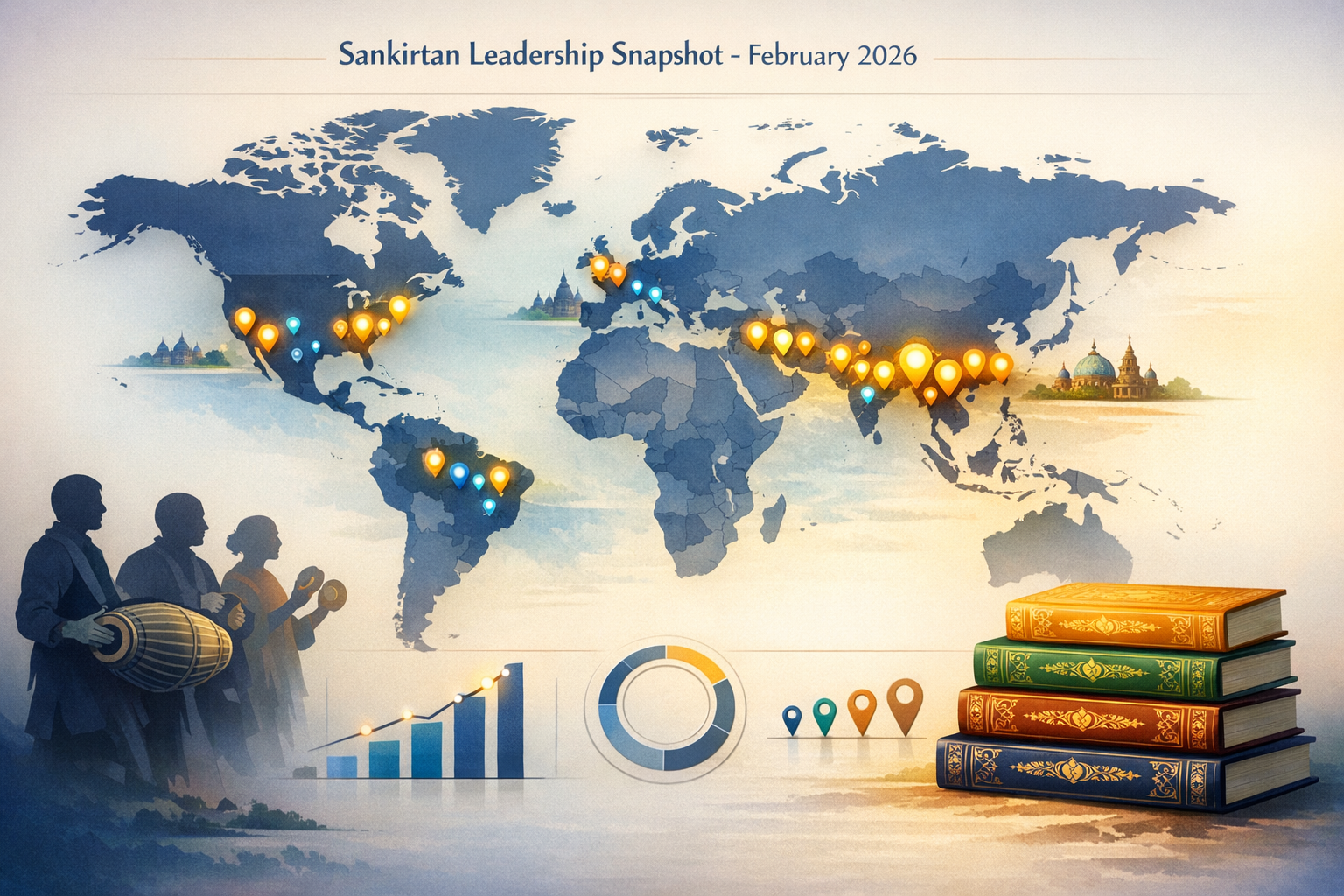
The World Sankirtan Newsletter (WSN) for February 2026 highlights a geographically diverse leadership across temple-size segments. The top large temples were Mayapur, Mumbai-Chowpatty, and Ujjain. The top medium temples were London-Soho, Bengaluru-South, and Bhopal. The top small temples were Surat, Atlanta Krishna Life, and Chandigarh. The top maha-small temples were Porto Alegre, Bologna, and Heidelberg.
These standings underscore the vitality of kirtan-led outreach and book distribution across India, Europe, and the Americas, reflecting a resilient bhakti ecosystem aligned with the service ethos cultivated within ISKCON (International Society For Krishna Consciousness) and closely connected devotional communities. The distribution of results across multiple continents indicates both the maturity of established hubs and the momentum of nimble micro-centers.
WSN aggregates monthly figures reported by participating centers and typically focuses on the measurable output of literature distributioncommonly expressed as book pointsalongside the qualitative cadence of sankirtan and related devotional services. By standardizing results, the newsletter enables leaders and volunteers to compare performance across different cities and operational conditions while identifying scalable practices.
A widely used normalizing approach is a book points methodology that weights titles by size so that totals more accurately represent field effort. In many contexts, small titles are counted at 1 point, medium at 2, big at 5, and maha-big at 10, with separate handling for multi-volume sets. While exact thresholds and classifications can vary by time and region, grouping temples as large, medium, small, and maha-small broadly reflects capacity, outreach footprint, and reporting consistency.
Among large temples, Mayapur’s leadership complements its role as a major pilgrimage destination and organizational center, where pre-festival momentum, steady footfall, and disciplined outreach teams reliably translate into strong monthly figures. Mumbai-Chowpatty’s performance reflects dense urban networks, weekday commuter flows, and structured volunteer pipelines. Ujjain’s placement points to effective coordination in a heritage-rich city with favorable pathways for pilgrim engagement.
Seasonality helps explain some patterns. February typically sits within the Magha–Phalguna window in the Hindu calendar, a period that often builds toward Gaura Purnima, allowing well-prepared teams to align literature distribution, harinam sankirtan, and community programs in a mutually reinforcing cycle. Larger hubs, with more established cadences, tend to capitalize on these rhythms.
In the medium segment, London-Soho leverages a central urban location, robust daily harinam, and a seasoned volunteer base that adapts to winter conditions while maintaining visible, respectful public outreach. Bengaluru-South benefits from a technology-corridor demographic receptive to weekend and evening engagements, while Bhopal’s results indicate a strong balance of campus-facing outreach and city-center presence.
Small-segment leaders show how compact teams can produce outsized impact through specialization. Surat’s merchant economy and family networks create fertile ground for Gujarati and bilingual literature. Atlanta Krishna Life’s nimble, diaspora-centered model demonstrates strong weekend concentration and event-based outreach. Chandigarh’s student and administrative demography supports campus-informed distribution with consistent follow-up programming.
The maha-small segmentPorto Alegre, Bologna, and Heidelbergillustrates how micro-centers compete effectively through disciplined scheduling, multi-language literature, and high-touch conversations. Latin American warmth in Porto Alegre, Italy’s university-linked audience in Bologna, and Heidelberg’s academic milieu coalesce into efficient, respectful dialogues that convert short interactions into meaningful engagements.
Geography and climate matter. European winters encourage more indoor or sheltered engagements and a heavier reliance on pre-planned touchpoints, whereas Indian cities may maintain higher street visibility across the month. Diaspora hubs in North America and Europe frequently concentrate activity into weekend peaks synchronized with community gatherings and festivals.
Operationally, high-performing teams typically display several common features: structured shift plans, route discipline, and a steady pipeline of trained volunteers. Inventory management is aligned to expected audience profiles, with balanced stocks of foundational texts such as the Bhagavad-Gita and thematic titles suitable for first-time readers or youth audiences. Language availabilityEnglish, Hindi, Bengali, Marathi, Gujarati, Kannada, German, Italian, Portuguese, and otherssubstantially increases relevance in diverse settings.
Compliance and ethics are non-negotiable. Respectful, non-coercive conversations; clear consent; and adherence to local bylaws and venue policies sustain community trust. Where regulations allow, teams increasingly accommodate contactless and cashless options for contributions toward literature distribution, alongside transparent receipts and data protection for any optional follow-up information provided by readers.
A practical measurement architecture helps leaders link inputs to outcomes. Core inputs include volunteer hours, team size, and inventory levels; primary outputs include book points and unique reader engagements; outcomes include participation in study circles, regular kirtan gatherings, and sustained community service. Leading indicatorsfirst contacts, event RSVPs, and return visitsoffer early signals of long-term impact beyond a single month’s scoreboard.
Digitization supports field efficiency where appropriate and permissible: simple route maps, geographical clustering of venues, privacy-aware follow-up workflows, and basic scheduling tools reduce friction and support volunteer well-being. Lightweight data capture helps identify what resonates with different audiences while maintaining transparency and consent.
Importantly, the devotional arts of kirtan and sacred reading resonate across the broader dharmic family. Congregational kirtan in the Hindu bhakti tradition finds kinship with Sikh shabad kirtan, while mantra contemplation is meaningful to Buddhist and Jain communities in their respective ways. Emphasizing shared valuescompassion, service, humility, and wisdominvites unity without erasing distinctive paths, aligning outreach with the ideal of harmony among Hinduism, Buddhism, Jainism, and Sikhism.
Experienced teams often describe a reliable field cadence: early coordination and inventory checks; a calm, prayerful start; short, respectful conversations in public spaces; and measured, unhurried closure to safeguard volunteer energy. These rhythms, sustained over months, steadily lift book points while deepening community relations.
Translatable best practices emerge across segments. Clear role definitions (team lead, logistics, outreach, follow-up), iterative training with scenario practice, weather-contingent routing, multi-language stocks, and ethics refreshers sustain quality. Pairing new volunteers with mentors, using short debriefs to extract lessons, and validating successesno matter how smallhelps prevent burnout and improves consistency.
Risk management further stabilizes results: advance permits where required, contingency indoor venues in winter or monsoon conditions, well-being check-ins for volunteers, and safe-transport protocols for literature. In cities with high footfall, micro-territory rotation prevents saturation and keeps interactions fresh for both residents and volunteers.
The February 2026 WSN thus offers more than a ranking; it provides a snapshot of what works across heterogeneous environments. Large hubs exemplify scale and cadence, medium centers demonstrate adaptive urban strategies, small teams show the power of specialization, and maha-small centers prove that attention to training and language tailoring can offset limited size. Together, these results embody a unifying, dharmic spiritcongregational singing and sacred reading shared with kindness and humilitythat strengthens social trust and deepens spiritual culture across regions.
Inspired by this post on Dandavats.