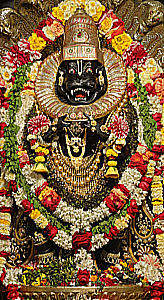
The phenomenon devotees describe as the Deity’s loving reciprocationwhere a sacred presence responds to sincere intentionhas long stood at the heart of the Bhakti Tradition in Hindu temples. Across dharmic paths, this experience is framed as grace meeting effort, anugraha answering prapatti, and seva finding its return through darshan. A brief but striking account associated with Lord Nrsimhadev offers a vivid window into how ritual practice, theological expectation, and lived emotion converge in a single transformational moment.
As recounted by Amogha das, a devotee couple offered a crystal necklace with a large pendant to Lord Nrsimhadev in His unique abode. Initially, they did not see the Deity wearing it, which is a common and entirely normal outcome given the precise schedules, protocols, and aesthetics governing alankara (sacred adornment) in Hindu temples. Desiring clarity rather than validation, the devotee’s spouse prayed simply for guidance about what offering would be pleasing to the Lord. The next day, to their astonishment, the Deity was adorned with that very crystal necklace. For those present, the sequence felt like a merciful, unmistakable acknowledgment of intention and love.
From a theological standpoint in Vaishnava traditions, such moments are often read through well-known principles articulated in scripture: divine reciprocity accords with the devotee’s approach, and the presence of Bhagavan dwells personally and relationally with those who serve. These principles do not impose a mechanistic cause-and-effect model; rather, they affirm that devotion (bhakti) transforms perception and meaning, making space for experience that is both inwardly intimate and outwardly observable.
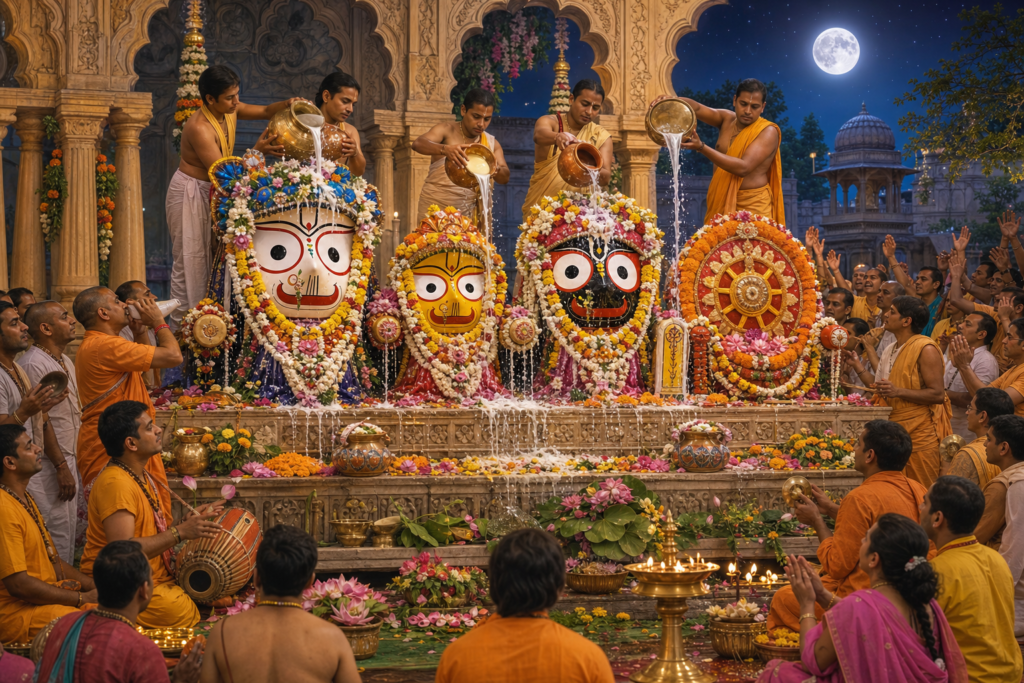
Ritually, the account aligns with the structured life of a Hindu temple (especially Vaishnava shrines guided by Vaikhanasa or Pancharatra Agamas). Each day’s nitya-seva typically unfolds in a codified arcsuprabhata (morning awakening), snana/abhisheka (ritual bathing), alankara (adornment), naivedya (offering of food), archana (recitation and worship), and darshan (audience)with seasonal, lunar, and festival calendars further modulating appearance, ornamentation, and sacred mood (bhava). Within such a framework, it is entirely plausible that an offering not immediately seen one day may be selected for a subsequent day’s srngara, rendering causality opaque but devotional meaning luminous.
There are practical reasons why ornaments are not always displayed instantly. Archakas (hereditary priests) and temple managers follow exacting guidelines for weight, material, size, iconographic harmony, and festival relevance. Offerings are logged, secured, and sometimes sanctified by touch (samskara) before integration. Adornment choices also reflect iconographic canons derived from Shilpa Shastra, Agamas, and local parampara, to preserve both ritual integrity and the aesthetic grammar of the Deity’s form.
In this narrative, the offered materialrock crystal (commonly called sphatika)is noteworthy. In many Hindu contexts, sphatika symbolizes clarity, coolness, and sattva (purity), and is used for malas, pendants, and temple ornaments. Its transparency evokes the theological idea that the Lord, while fully transcendent, is also present in a way that allows sincere hearts to “see through” convention into the play of grace. That a sphatika necklace became the chosen alankara on the very next day amplifies the experience of merciful reciprocation described by the devotees.
Equally significant is the devotional psychology involved. Acts of seva (service) and surrender often crystallize intention; prayer focuses attention; and darshan offers a shared horizon where inner longing and outer form meet. Devotees interpret the resultant convergence not as coincidence alone, but as an educative sign: love offered with humility tends to be recognized, not necessarily on demand, but at a time and in a manner that preserves the sacral dignity of the Deity and the integrity of temple practice.
The experience also harmonizes with the Ishta concept in Hinduismthe idea that sincere worship of the chosen form (Ishta) draws a deeply personal response, without negating respect for other forms or paths. This spirit of unity in diversity is a hallmark of Sanatana Dharma and resonates, in kindred ways, across Buddhism, Jainism, and Sikhism, where devotion, reverence, and seva are shaped by distinct theologies yet converge around the ethic of loving service.
Consider related practices across dharmic traditions. In many Buddhist communities, devotees respectfully offer flowers, lamps, and robes to Buddha images as expressions of gratitude and aspiration; these are not petitions to an anthropomorphic deity but embodied acts of reverence that cultivate compassion and mindfulness. In Jain temples, abhisheka and sringar of Tirthankara murtis follow strict ritual canons that similarly uphold purity and non-violence (ahimsa) while inviting contemplative participation from the laity. In Sikh gurdwaras, the central focus is the Guru Granth Sahib; seva, kirtan, chaur seva, and the respectful draping of rumalas express devotion to revealed wisdom and shared service, nurturing humility and the oneness of the sangat.
Seen through this broader lens, the account of Lord Narasimha’s adornment functions as a case study in how dharmic traditions cultivate living relationships with the sacred through disciplined practice, ethical sensitivity, and heartfelt offering. While the metaphysical commitments differ, the shared commitment to seva, reverence, and community formation produces a recognizable family resemblance among these paths.
For those wishing to make similar offerings in Hindu temples, several best practices follow from established norms. First, consult temple authorities regarding material suitability, size, and iconographic fit, especially in Vaishnava temples governed by Vaikhanasa or Pancharatra guidelines. Second, ensure high workmanship and secure clasps to protect the murti and the ornament. Third, provide documentation (e.g., a brief note of intent, materials, weight) to support transparent inventory and future alankara planning. Fourth, prepare inwardly to accept any outcomeimmediate use, later use, or ritual sanctification without public displayunderstanding that temple service prioritizes scriptural canons and safety alongside devotional feeling.
It is also helpful to recognize that an ornament’s eventual appearance may be shaped by calendrical rhythms (e.g., Navaratri, Narasimha Jayanti, Karthika masam), specific vahanas (processional contexts), or the Deity’s seasonal srngara motifs. Alankara is rarely arbitrary; it is a living iconographic language with its own semantics and syntax, which archakas steward with deep responsibility.
Beyond the specific event, the narrative underscores a central bhakti insight: devotion is relational, and relationships ripen through time. Whether one speaks of grace, prasad, or the fruit of seva, the underlying conviction is that love given in humility teaches patience, expands understanding, and builds spiritual confidence anchored in experience rather than abstraction.
From the perspective of heritage and cultural studies, such accounts are valuable ethnographic data points. They attest to how communities interpret ritual outcomes, how meaning circulates between temple protocol and personal faith, and how a single moment of “answered prayer” can invigorate collective memory. As intangible cultural heritage, these stories carry pedagogic force, transmitting norms of reverence, generosity, and unity across generations.
The account also advances a constructive interfaith ethos within the dharmic family. By foregrounding seva and reverence as shared values, it resists reductionist narratives and invites mutual appreciation: Hindus, Buddhists, Jains, and Sikhs alike can recognize in one another a disciplined love that shapes character, organizes community life, and dignifies the sacred in daily practice.
Therefore, the necklace’s sudden appearance on Lord Narasimha can be read not only as a tender sign to two devoted hearts, but also as a reminder of the careful choreography that sustains Hindu temples: Abhishekam and alankara serve theology; theology guides ethics; and ethics, returned as grace, strengthens communal bonds. In this way, the experiential and the canonical do not compete; they complete one another.
Ultimately, the narrative gently instructs practitioners to offer with both care and detachmentcare for the sanctity and safety of the Deity’s adornment, detachment from the need for immediate confirmation. When grace does manifest as a visible gesture, it becomes a shared celebration of dharmic unity: a moment in which devotion, ritual, and community quietly declare that the sacred is near, attentive, and profoundly inclusive.
Inspired by this post on Dandavats.