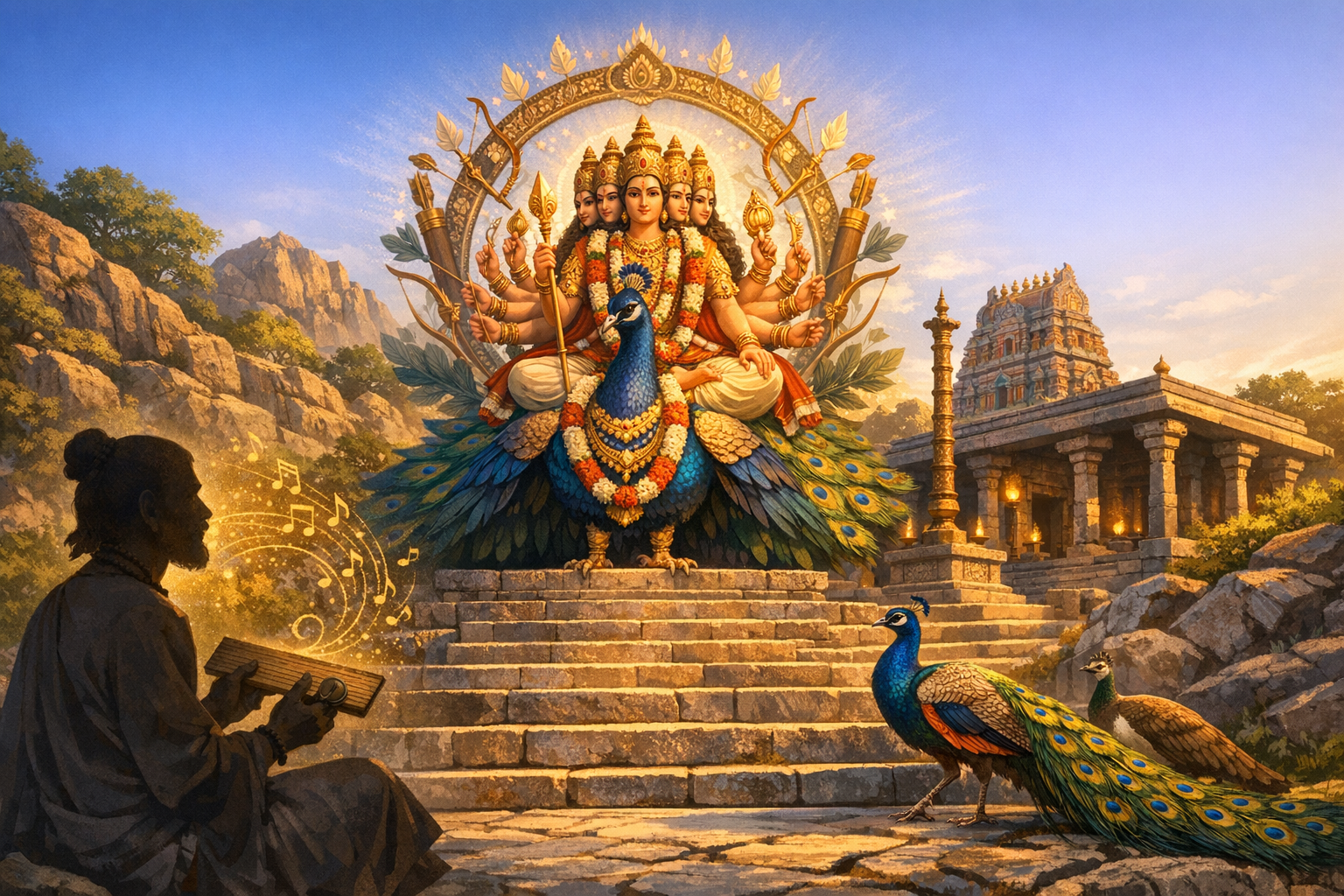
Viralimalai, a serene granite hill on the historic Madurai–Tiruchirappalli corridor in Tamil Nadu, is crowned by the Shanmuganathar Temple where Lord Murugan is enshrined as Śaṇmukha, seated upon the mayil (peacock), with six radiant faces and twelve arms. This rare seated-on-peacock icon at the Viralimalai Murugan Temple visually encodes sovereignty, insight, and protective power, aligning with classical South Indian iconography that presents Murugan as the youthful guardian of the hill landscape and patron of valour, learning, and compassion.
Historical layering at Viralimalai reflects a broader Tamil temple trajectory. Architectural vocabulary, stone workmanship, and stylistic features suggest medieval foundations with substantial renovations under later regional polities, including the Vijayanagara–Nayak era. While a detailed epigraphic census is pending comprehensive publication, the planimetric layout, granite stairway, pillared halls, and circumambulatory prakāra indicate a South Indian hill-temple typology that prioritizes processions, recitation, and festival-centric movement of devotees.
The phrase “When the Lord became the Hunter” in local oral tradition points to the Valli Kalyanam cycle, where Murugan, in the guise of a vēṭṭaikāran (hunter), seeks Valli’s hand with endearing stratagems. In Tamil sacred imagination, Murugan belongs to the kurinji (mountain) landscape—already celebrated in early works like Tirumurukāṟṟuppaṭai—where the divine assumes forms familiar to hill communities. At Viralimalai, the narrative memory of the Hunter-Lord harmonizes with the living geography: rocky outcrops, groves, and the abiding presence of peafowl around the shrine.
Arunagirinathar (15th century), the saint-poet of Tiruppugazh, is central to Viralimalai’s devotional memory. Renowned for transforming a life of anguish into radiant bhakti oriented to Subrahmanya, he journeyed across Tamil Nadu composing rhythmically intricate hymns that wove Tamil prosody with complex tāla designs. Traditional accounts hold that Viralimalai was among the Murugan sthālas he extolled, reinforcing the site’s status in the Kaumāra stream of the Śaiva-āgamic sacred geography. The sustained recitation of Tiruppugazh at Viralimalai today continues that lineage of musical worship and contemplative praise.
Iconographically, Shanmuganathar’s six faces (ṣaṇmukha) signal all-seeing wisdom and benevolence in every direction, while the twelve hands bearing the vel and other attributes emphasize protective agency and ethical vigor. The peacock mount (mayil vāhana)—a signature of Subrahmanya—symbolizes the subjugation of pride and poisonous impulses (traditionally represented by serpents). The image offers a compact theology in stone: knowledge guiding strength, beauty disciplined by virtue, and courage yoked to compassion.
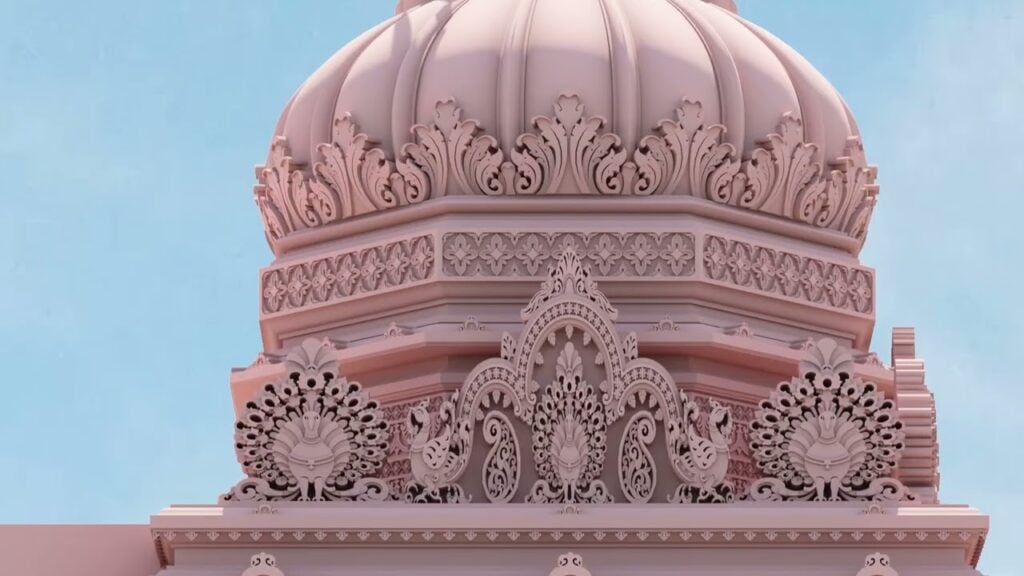
Architecturally, the Viralimalai Murugan Temple exemplifies the hill-shrine grammar of Tamil Nadu temples: a modest entrance tower leads to a sequence of mandapa spaces, a flagged courtyard with dhvajasthambha and balipīṭha, and a circumambulatory path that choreographs darśan from multiple vantage points. Granite steps hewn into the hill facilitate ascent; along the path, images of Gaṇeśa and guardians ritually prepare devotees for the sanctum. Sub-shrines for Valli and Deivayanai frame Murugan’s household divinity, while the presence of the vel—revered as an autonomous symbol of grace and discernment—anchors the site’s Kaumāra identity.
The ritual cycle follows the Tamil āgamic day with kālasaṇdhi, uchikālam, and sayaratchai pūjā, each accompanied by abhishekam, ālankāram, and hymnal recitation. Festival highlights include Skanda Ṣaṣṭi (dramatizing the ethical conquest over adharma), Karthigai Deepam (radiance as metaphysical insight), Thaipoosam (devotional endurance and vows), and Panguni Uttiram (the nuptial grace of Valli-Deivayanai Sameta Subrahmanya). The reenactment of Valli Kalyanam and community singing of Tiruppugazh embed theology into memory, music, and shared celebration.
Sound is a distinctive medium at Viralimalai. The cadence of Tiruppugazh—with its intricate yati patterns and dynamic tāla—has inspired generations of practitioners to approach Murugan through rhythm and melody. Alongside, popular recitations such as the “Skanda Ṣaṣṭi Kavacham” cultivate courage, ethical resolve, and inward clarity. The temple’s acoustic environment thus becomes a shared contemplative space where personal vows meet collective voice.
Viralimalai is also an ecological microcosm. The surrounding landscape functions as a traditional peafowl habitat; the Indian peafowl’s presence around the shrine mirrors Murugan’s mayil iconography and deepens the sense of a living sacred ecology. Local cultural forms such as Mayil Attam (the peacock dance) echo this symbiosis between devotion and biodiversity. As with many hill-temples, conservation-minded pilgrimage—mindful noise levels, respect for flora and fauna, and care for water sources—preserves the site’s sanctity for future generations.
Visitors frequently describe the ascent as a contemplative arc: the steady climb through granite steps, the intermittent shade of trees, the glimpse of peafowl in the undergrowth, and the eventual darśan of the seated Shanmuganathar. The experience synthesizes physical effort and inner stillness—an embodied reminder of Murugan’s role in Tamil tradition as a guide through the rugged paths of life, converting ordeal into insight and fear into luminous steadiness.
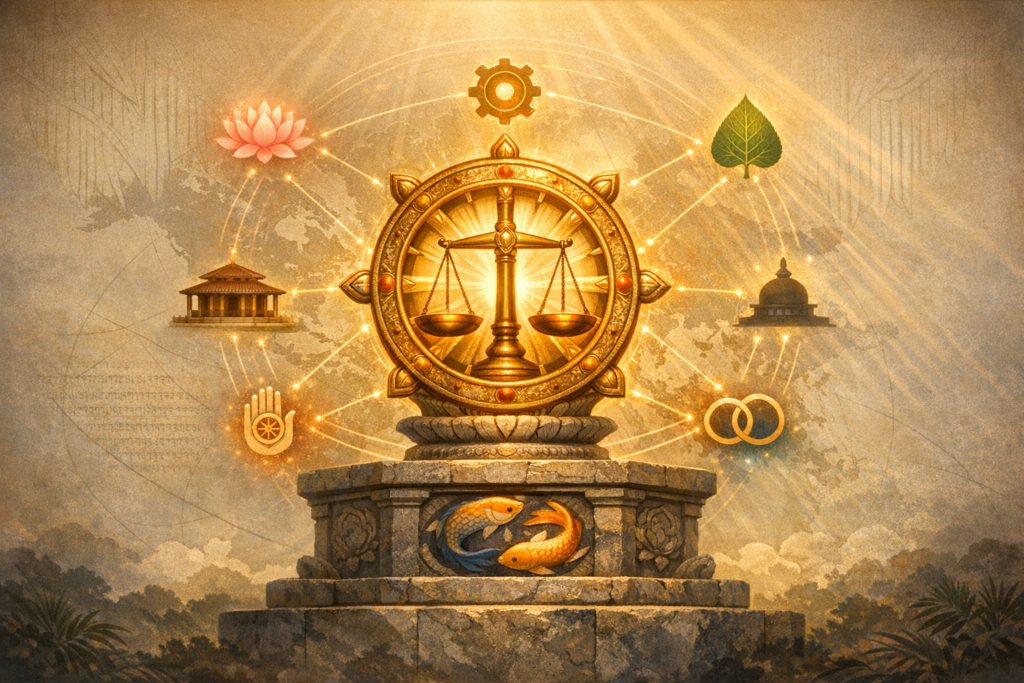
Viewed through a pan-Dharmic lens, Viralimalai’s ethos resonates across Hindu, Buddhist, Jain, and Sikh sensibilities: disciplined courage (vīrya), compassion, reverence for knowledge, and service to community. Skanda/Subrahmanya is recognized across the subcontinent (Kumāra, Kārtikeya) and beyond; notably, in Sri Lanka, Kataragama Deviyo is venerated by Buddhists and Hindus alike, illustrating a shared devotional grammar in the Indic world. Such convergences affirm that sacred geographies can nurture unity-in-diversity without erasing distinct practices.
From a technical standpoint, Shanmukha’s proportions at South Indian temples are guided by the Śilpa–Śāstra tradition and Śaiva āgamas, which specify iconometric canons (tālam), gestures (mudrā), and attributes (āyudha). The ritual life follows āgamic procedure—nyāsa, mantra, pūjā, and utsava—binding image, sound, and movement into a coherent sādhanā architecture. Scholars and practitioners studying Viralimalai will find a living laboratory where text, icon, and festival interpenetrate to transmit Kaumāra theology in a community setting.
In sum, the Viralimalai Murugan Temple integrates legend, music, architecture, and ecology into a single arc of meaning. “When the Lord became the Hunter” is more than a story of Valli Kalyanam; it is a paradigm of divine nearness—of a deity who meets seekers in their own landscape, idiom, and effort. Anchored by Arunagirinathar’s Tiruppugazh and nourished by the rhythms of Tamil āgamic worship, Viralimalai stands as a hill of grace where devotion becomes knowledge, and knowledge becomes compassion in action.
Inspired by this post on Hindu Blog.