Veenadhara Dakshinamurthy, also known as Gana Dakshinamurthy, presents Shiva as the consummate musician and teachera serene, south-facing presence whose veena embodies the doctrine of sound as wisdom. Within the broader Shaiva tradition, Dakshinamurthy is the guru in whom knowledge, silence, and revelation converge; as Veenadhara, that revelation becomes audible as nāda, the sacred vibration that binds cosmos, mind, and ritual.
Two principal iconographic variations recur across South Indian temple art: the sitting (aasana) posture and the standing (sthanaka) posture. The sitting type emphasizes contemplative instruction and quiet absorption, whereas the standing type, often attributed to the early Pallava period, accentuates dynamic grace, rhythmic poise, and the performative vigor of sacred music.
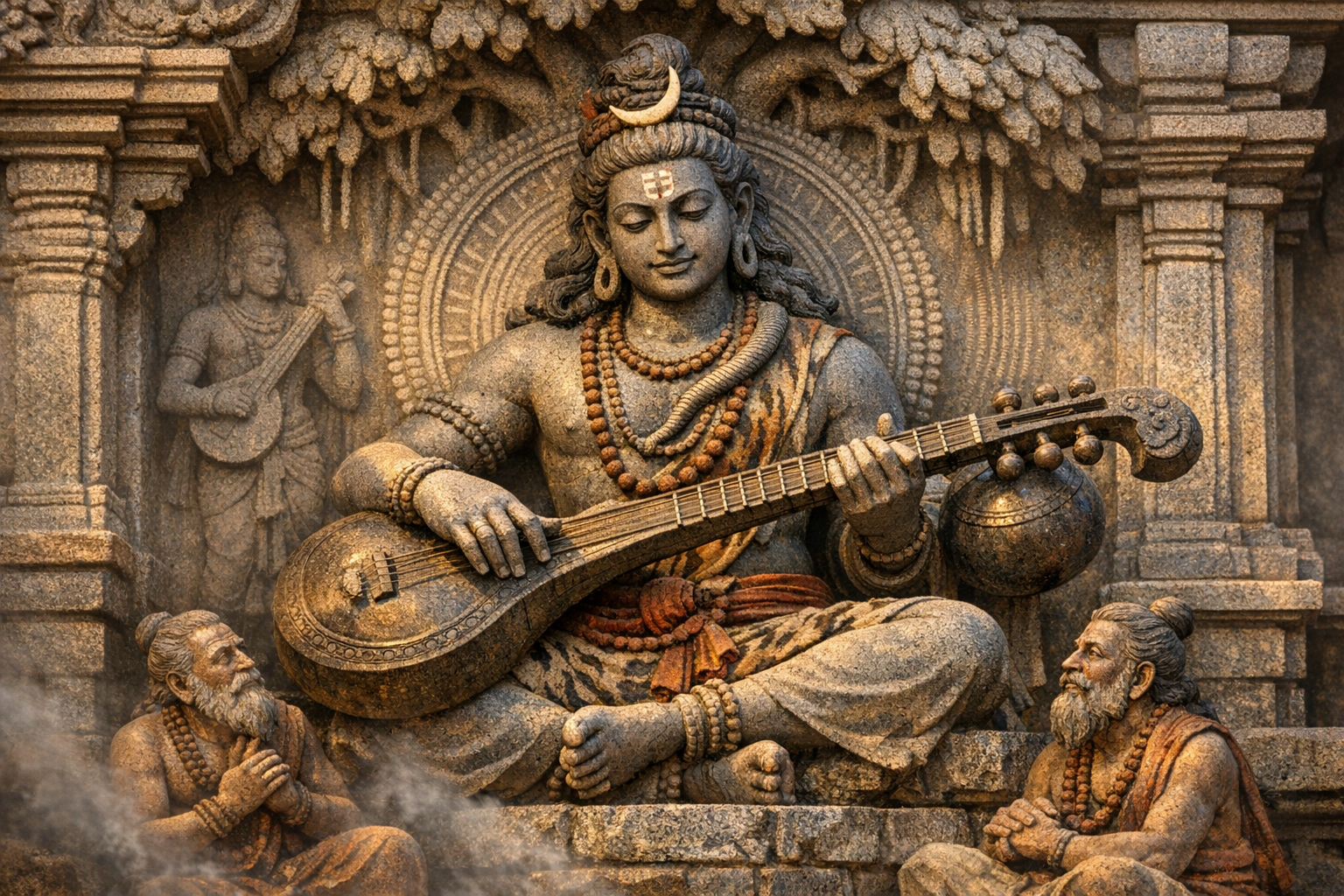
In the aasana variant, Veenadhara Dakshinamurthy is typically shown under a symbolic banyan canopy, attended by rishis or ganas, with the veena held across the lap. The visage is tranquil, the glance downward and southward, and the teaching remains implicit in the stillness of form. This configuration aligns closely with the wider Dakshinamurthy vocabularymeditative poise and didactic presencewhile transmuting the guru’s “silent sermon” into the language of strings and resonance.
The sthanaka form, stylistically linked by scholars to early Pallava ateliers (7th–8th centuries CE), often adopts a subtle tribhanga. Here, Shiva’s body becomes a rhythmic axis: the veena may be cradled, slung, or supported so that both hands can articulate an imagined melody. The standing figure evokes performance and procession, consistent with Pallava stonework that frequently favors vivacity, narrative movement, and the kinetic suggestion of sound.
Across both types, the veena is not mere ornament. Iconographic traditions understand it as a diagram of order: the gourd and resonator suggest the cosmic womb of sound; the neck aligns with the channel of prana; the strings mirror the senses and their disciplined harmonization. When plucked by the guru, the instrument becomes a pedagogical toolknowledge conveyed not by text alone but through listening (shravanam) and attunement, an approach integral to Indian music and spiritual practice.
Attributes vary regionally and across periods. Two-armed images devote both hands to the veena, while four-armed forms may assign the upper hands to emblematic objects (such as akshamala, pustaka, or a small flame) that signal time, scripture, and inner illumination. Jata-makuta (matted locks), the crescent, the serpentine sacred thread, and the tiger-skin garment appear with characteristic Shaiva consistency. In Veenadhara expressions, these markers frame, but never eclipse, the central symbolism of music as embodied wisdom.
Temple placement follows the Dakshinamurthy canon: the image typically occupies the south (dakshina) niche of the sanctum’s outer wall (dakshina koshta). The south-facing orientation literalizes the name “Dakshinamurthy” and aligns with long-standing ritual geography in Shaiva temples. Devotees commonly associate Thursdays (Guru-vāra) with the guru’s worship, and in many shrines, musician-gurus and students alike approach this niche seeking clarity of mind, mastery of art, and stability in practice.
Historically, art-historical studies point to Pallava innovation for standing musician forms and to Chola refinement for seated varieties. Pallava centers such as Kanchipuram document early explorations of Shiva-as-musician in relief and sculpture, while the Chola idiom (10th–12th centuries CE) matures the meditative seated type with sumptuous detailing and controlled dynamism. Across Tamil Nadu, and into parts of Karnataka and Kerala, workshop lineages (sthapati parampara) preserved and localized these patterns, ensuring the continuity and diversity of Veenadhara Dakshinamurthy within South Indian temple architecture.
The epithet Gana Dakshinamurthy underscores a complementary emphasis: Shiva as leader and inspirer of ganas, guiding rhythmic order among celestial ensembles. Where Nataraja articulates the metaphysics of rhythm through dance, Veenadhara Dakshinamurthy renders its melodic counterpartteaching that the universe is not only choreographed but also tuned. Together, these Shaiva archetypes frame a unified doctrine of nāda-brahman, the absolute apprehended as sound.
From a ritual-theological standpoint, Veenadhara Dakshinamurthy encodes a pedagogy of integration. Knowledge (jnana) advances not in isolation from aesthetics, but through them; the arts are sadhana. The guru-musician harmonizes breath, mind, and sense, mirroring the veena’s balancing of tension and resonance. This insight has shaped the ethos of classical performance in South India, where mastery of raga and tala is inseparable from discipline, humility, and the pursuit of inner stillness.
Comparative perspectives across dharmic traditions further illuminate the figure’s inclusive message. Hindu bhakti foregrounds kirtan and instrumental devotion; Buddhist, Jain, and Sikh lineages equally elevate sung scripture, recitation, and contemplative soundranging from mantra and stotra to shabad kirtan. Across these paths, music remains a refined vehicle of ethical cultivation and contemplative insight. In this sense, Veenadhara Dakshinamurthy offers a unifying archetype: wisdom transmitted through compassionate sound that honors diversity in practice while pointing to a shared horizon of truth.
Field identification in temples follows a practical checklist. First, locate the south-facing niche of the main sanctum. Second, confirm Shaiva identifiers (matted locks, crescent, serpent-thread, tiger-skin, ganas or rishis in attendance). Third, note the veena’s prominence. If the figure is seated with the instrument across the lap and flanked by attentive sages, the aasana variant is likely. If the figure stands with a rhythmic bend and a poised instrument, the sthanaka idiomechoing early Pallava preferencesis probable.
Stylistic cues help with more precise dating. Pallava stone favors slender limbs, restrained ornament, and a sense of movement that animates drapery and stance; Chola work often deepens plasticity, emphasizes anatomical clarity, and perfects the serene gravitas of the seated teacher. Later regional idioms may amplify ornamentation, develop distinct veena types, or adjust the balance between didactic calm and musical elan.
Thematically, the veena signals the convergence of text and tone. Where some Dakshinamurthy forms display pustaka (scripture) to represent articulated doctrine, the Veenadhara type places hearing, memory, and embodied practice at the forefront. Sound becomes scripture; the disciplined ear an interpretive intelligence. This is not a rejection of text, but a reminder that scriptural insight ripens fully when internalized as living rhythm and intoned meaning.
Iconographic manuals and temple-building traditions consistently allow for variation in hand-attributes and number of arms, reflecting the pragmatic creativity of sthapatis who worked within, and thoughtfully expanded, canonical guidance. This explains why the veena may occasionally be accompanied by akshamala or flame, or why ganas and rishis might be interchanged as attendant figures. The constancy lies in the core sign: Shiva as guru whose knowledge pours forth as music.
The cultural resonance of Veenadhara Dakshinamurthy extends into pedagogy and performance. For students of Carnatic music, the image quietly codifies a curriculum: breath control, attentive listening, calibrated tension, and inner composure. For teachers, it models a compassionate rigor that meets the student where they are and invites them, string by string, into maturity of craft and character.
Heritage sites across South India preserve this iconography with regional accents. In Pallava centers (notably Kanchipuram), early renderings of Shiva with a veena contextualize the standing Dakshinamurthy type; in Chola heartlands of the Kaveri delta, seated musician-gurus achieve a meditative refinement that became authoritative for later ateliers. Even where exact identifications of sculptural programs vary, the musician-guru theme is unmistakablean enduring testament to the civilizational esteem for music as a path to liberation.
For contemporary visitors, the encounter remains immediate. Many pause before the south niche and notice how the carved fingers almost seem to hover above silent strings, how the stone imparts a hush that heightens listening. That momenthalf art history, half devotionoften lingers long after leaving the temple courtyard, becoming part of an inner repertoire of memory, rhythm, and calm.
Taken together, the aasana and sthanaka forms narrate a complete pedagogy. The seated variant teaches receptivity, patience, and interiorization; the standing variant teaches expression, courage, and the rightful joy of sharing what is known. In the presence of Veenadhara Dakshinamurthy, these modes are not opposites but phases of a single training: to learn, to become, and to give.
As scholarship continues to document Pallava and Chola contributions to South Indian temple architecture, Veenadhara Dakshinamurthy remains a vital case study in how visual form, ritual function, and aesthetic theory interpenetrate. It is art as argument, theology as sound design, and pedagogy as embodied gracean image that invites all seekers, across the dharmic spectrum, to listen for truth and to tune the mind toward unity, compassion, and clarity.
Ultimately, Veenadhara Dakshinamurthy affirms a civilizational ideal: that wisdom is audible, sharable, and healing. Whether approached as art history, temple architecture, or spiritual practice, the musician-guru of Shiva standsliterally and figurativelyat the confluence of knowledge and beauty, guiding communities toward harmony within and across traditions.
Inspired by this post on Hindu Blog.