Ultimate Journey to Gangotri & Gaumukh: Discover the Transformative Hindu Himalaya

Snow-capped Himalayan peaks tower over a deep, forested valley beneath a bright blue sky, suggesting the Gangotri–Gaumukh trek in the Hindu Himalaya, with rugged cliffs and distant glacial ridges.

The ascent into the upper Ganga valley unfolds through a deep and dramatic gorge lined with sacred deodar cedars. Their resinous, turpentine-like fragrance—a scent widely regarded as beneficial for respiratory health—permeates the air. Local traditions speak of devas moving as bands of colored light among these dark-green deodars, a poetic way to express the numinous presence felt across the Hindu Himalaya.

As elevation increases, the trail reveals snow-clad summits in ever-closer relief. The transition from dense forest to high mountain vistas signals the approach toward Gangotri and the heart of Uttarakhand’s sacred landscape.

Illuminated Gangotri Temple at night in the Himalaya, with pilgrims seated in the courtyard for evening aarti, bundled in warm layers, against mountain shadows and guesthouses in the background.
Under starlit skies at Gangotri Temple, devotees gather for the evening aarti before journeys toward Gaumukh. The crisp Himalayan air, ringing bells, and colorful shawls evoke Living Dharma on this high-altitude travel tale.

Arrival in Gangotri, often described as one of the most beloved places in the region, comes with crisp, penetrating cold—especially for those who choose to walk barefoot as an act of mindful simplicity. Evening darshan at the Gangotri Temple during aarti immerses pilgrims in fervent bhakti, where cymbals, conches, and chants rise in unison along the Ganga’s flow.
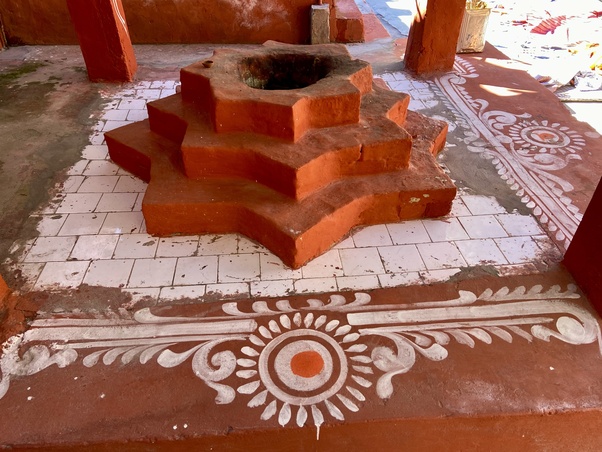
Stepped, star-shaped terracotta havan kund on a tiled courtyard with white rangoli borders, seen during travel through Gangotri in the Himalaya en route to Gaumukh, reflecting Living Dharma in practice.
An ochre fire altar rises in star-stepped tiers, edged by sunburst rangoli on worn tiles. In Gangotri, where the Bhagirathi flows toward Gaumukh, such havan kunds keep Living Dharma alive for travelers in the high Himalaya.

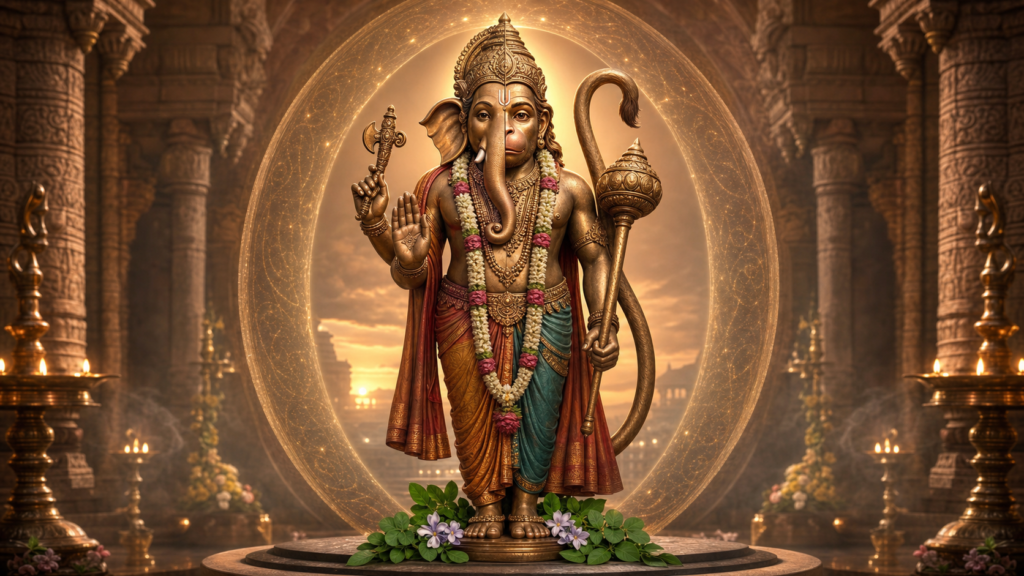
Dandi Ashram provides lodging on a donation basis in an atmosphere of integrity, simplicity, and traditional hospitality. Conditions are austere—unheated rooms, minimal electricity, and doors without locks—yet the environment is deeply spiritual. Bathing often involves a bucket of warmed river water from the kitchen, a surprisingly restorative experience in the crisp Himalayan air. Primarily a residence and food source for sadhus, the ashram features a well-tended Homa Kund for Yagnyas and a modest Ganesha–Hanuman shrine, creating a living ecosystem of ritual, study, and service.
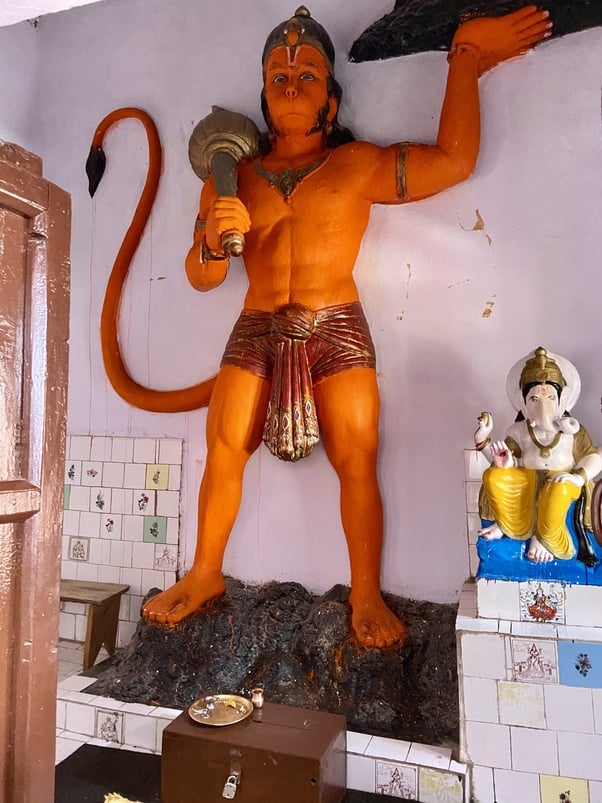
Interior of a Himalayan shrine: a tall orange Hanuman statue holds a mace and raises one hand, tail curled behind. A smaller white-and-gold Ganesha sits on a tiled altar; offerings and a donation box below.
On our Living Dharma journey toward Gangotri and Gaumukh, we pause in a quiet Himalayan temple where Hanuman stands sentinel beside Ganesha. These sacred icons bless the path with courage, clarity, and safe travel.

Within the town, Suryakund waterfall offers a powerful focal point for contemplation. Sitting on sun-warmed rocks above the cataract, visitors often report a palpable sensation of prana in the high-altitude air. Nearby, the elegant spire of Sudarshan Peak pierces the skyline, sharpening the sense of sacred geography that defines the Gangotri valley.

Bhagirathi River torrent plunges through sculpted golden-brown granite at Surya Kund near Gangotri, showing twin cascades and smooth glacier-polished rock gleaming in bright Himalayan light.
Glacial melt from Gaumukh carves the Bhagirathi at Gangotri, slicing twin waterfalls through honey-colored stone. A pulse of raw Himalayan energy on our Living Dharma journey to India’s sacred headwaters.

Ritual life along the river remains central. On clear mornings, some pilgrims undertake snanam in the Ganga—water only barely above freezing—followed by a full Ganga Puja performed with a local priest. The confluence of personal discipline, communal ritual, and the elemental force of the river leaves an enduring imprint.
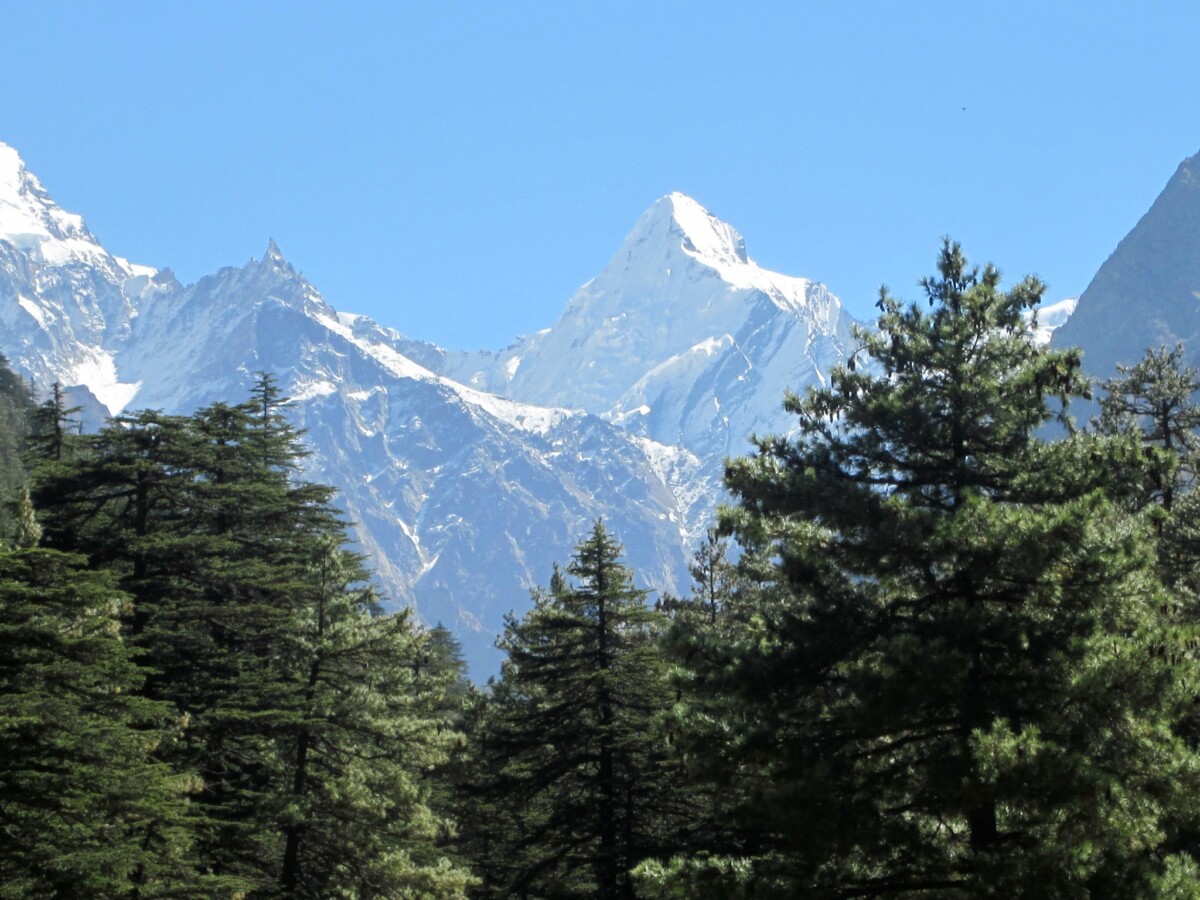
Snow-clad Himalayan peaks rise above a dark green pine forest under a clear blue sky near Gangotri on the trail to Gaumukh, capturing the serene, high-altitude landscape of the Hindu Himalaya.
A view from the cedar and pine forests above Gangotri, where the path to Gaumukh reveals shimmering Himalayan summits. This Living Dharma journey invites mindful travel, honoring the source of the Ganga and the mountain silence.

A barefoot forest path leads to Pandava Gupha, a cave sanctum associated with epic-era memory. Along the way, a lone dog appears and vanishes as a quiet guide—an image as old as the mountains themselves. Within the cave, a resident Ramanandi Vaishnava monk maintains year-round practice, including through the snow-bound winter, offering visitors insight grounded in devotion, continuity, and compassion.

Pilgrims on a boulder-strewn bank of the Bhagirathi River in Gangotri, turquoise glacial water flowing past pine trees and village buildings, with snow-capped Himalaya peaks beneath a clear blue sky.
Gangotri’s rocky banks meet the rush of the Bhagirathi as pilgrims and trekkers rest beneath snow-lit Himalayan peaks—an entry point to Gaumukh and a Living Dharma journey that invites slow, respectful travel in sacred terrain.

Across this terrain, the dharmic ethos resonates broadly. The Himalaya’s sanctity is affirmed not only in Hindu tirtha-yatra but in the contemplative lineages of Buddhism, the ahiṁsa-centered disciplines of Jainism, and the seva-infused spirituality of Sikhism. The shared values of inner refinement, restraint, and reverence for nature cultivate unity among these traditions, enriching the journey for all who walk this path with sincerity.
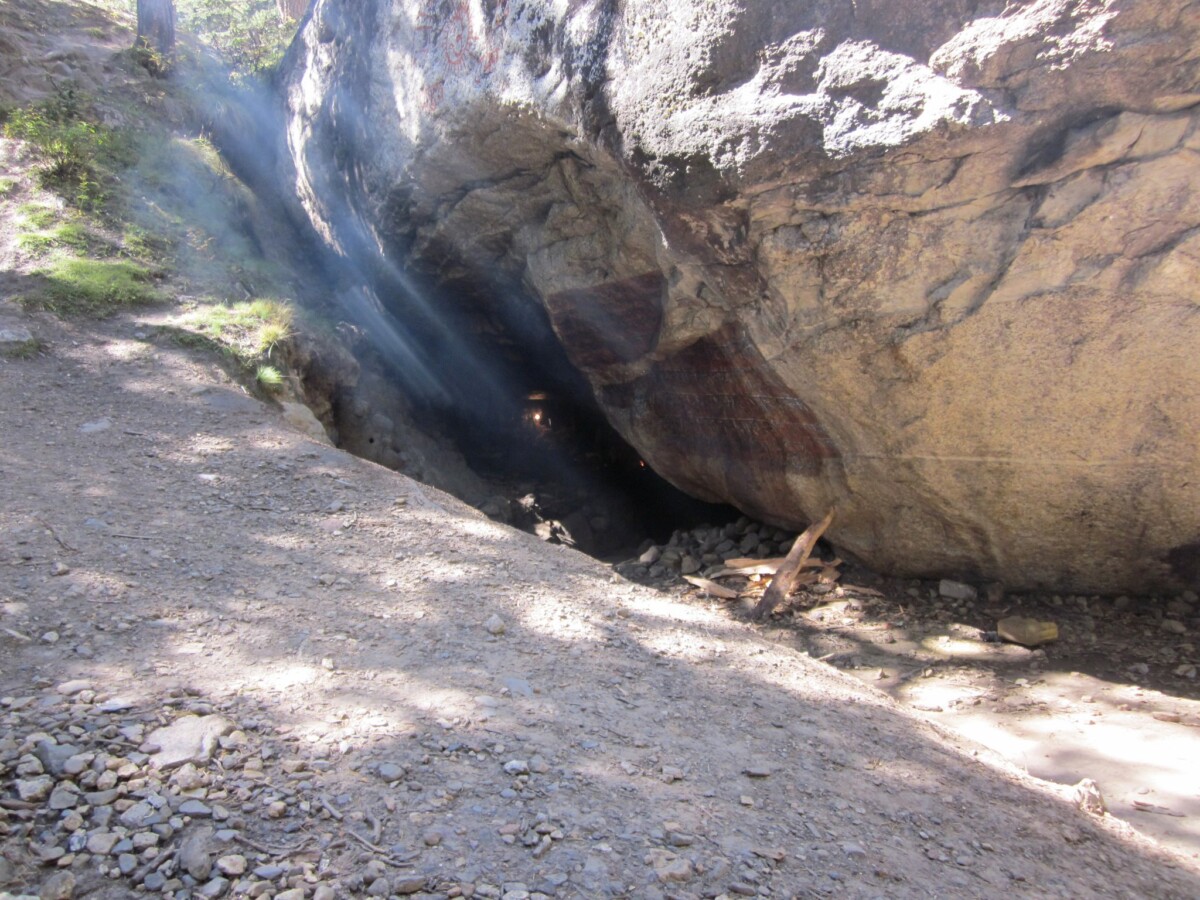
Sunlight slants into a small cave beneath a massive boulder beside a rocky footpath on the Gangotri–Gaumukh trek in the Himalaya, revealing rugged textures and quiet stillness.
On the trail from Gangotri toward Gaumukh, morning rays pierce a boulder cave and light the stony path. This quiet pause in the Himalaya invites reflection and the spirit of Living Dharma in travel.

On October 17, the trek to Gaumukh begins at first light, before the sun crests the eastern ramparts. The initial section passes through an exquisite autumnal forest before rising above treeline toward the snow-bound Bhagirathi peaks. The shift from gold-leafed groves to tundra signals entry into a high, glacial world.

Golden autumn leaves fill a mountain forest as sunlight filters through branches above a stone-lined path carpeted with leaves, evoking a serene Himalaya trek from Gangotri toward Gaumukh.
A canopy of gold lights our steps along a leaf-soft path by a stone wall. On this Himalaya travel day from Gangotri toward Gaumukh, we pause to breathe and let Living Dharma unfold in the mountain quiet.

That night is spent at the seasonal Bhojbasa camp, where mountain goats occasionally graze across the scree. By morning, the trail arcs gently around the iconic Mount Shivling, its profile anchoring the landscape as the route approaches the Gaumukh glacier—the visible source of the Ganga.

Snow-laced Himalayan peaks rise over pine-studded slopes as a pale glacial river winds through boulders near Gangotri, on the route toward Gaumukh in the Indian Himalaya—Living Dharma travel in nature.
Jagged Himalaya tower above pine-dotted hills and a glacial river near Gangotri, guiding the path toward Gaumukh, source of the Ganga. A quiet moment of Living Dharma for mindful travel and mountain reflection.

As temperatures drop, small stream crossings freeze solid, and modest Shaiva shrines appear along the path, reminding travelers of a long continuity of devotion. By 9 a.m., Gaumukh comes into view: a cavernous mouth at the glacier’s edge, the birthplace of a river that nourishes half a subcontinent.

Snow-clad Himalayan peak rising above the Gangotri region, with rocky moraine in the foreground and wisps of cloud wrapping the summit under a clear blue sky near Gaumukh.
Approaching Gaumukh above Gangotri, the trail opens to this dazzling Himalayan giant, its snow-bright ridges cutting a cobalt sky. A moment where travel meets Living Dharma, inviting quiet, breath, and reverence.

Here, sacred acts take on elemental clarity. A new moonstone mala is consecrated; bottles are filled with pristine Gangajal to carry home; and full snanam is performed in the icy current. The encounter with Gaumukh synthesizes physical endurance, ritual precision, and the moral imagination that dharma cultivates—an experience that many regard as transformative.
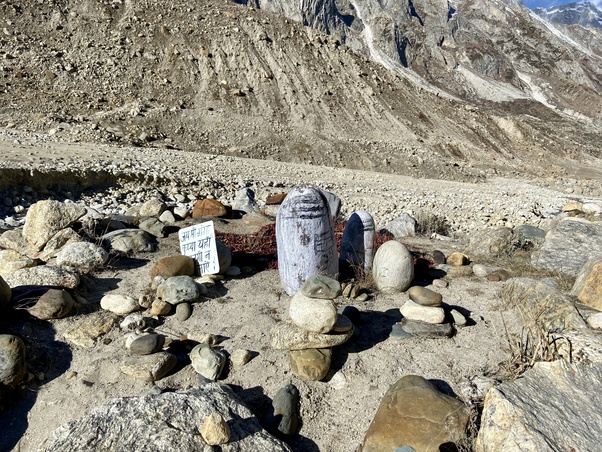
Stone Shiva lingam shrine with cairns and a small Hindi sign on the rocky riverbed near the Gangotri–Gaumukh trail in the high Himalaya, framed by barren slopes and glacier-scarred mountains.
Along the trek from Gangotri to Gaumukh, a simple Shiva lingam ringed with river stones rests beneath vast Himalayan cliffs—a quiet sign of Living Dharma guiding mindful travel and pilgrimage.

Note on timing and logistics: The journey described took place in autumn 2022. Temple information and place details remain current as of mid-2025, but transport and local logistics in Uttarakhand can change rapidly; current conditions should be verified with multiple sources prior to travel. All photos referenced in this narrative are © Devala Rees.


Inspired by this post on Hindu America.


Support Dharma Renaissance

What is the focus of the journey described in the post?

It follows a quiet, reflective trek from Gangotri to Gaumukh in the Hindu Himalaya. The narrative blends spirituality, culture, and mountain trekking.

Which sites are highlighted along the Gangotri to Gaumukh trek?

Key sites include Gangotri Temple with evening aarti, Suryakund waterfall, Pandava Gupha cave, Bhojbasa camp, Mount Shivling, and Gaumukh. The journey weaves ritual practice with high-altitude ecology.

What rituals and practices are mentioned in the journey?

The post describes evening darshan and Ganga Puja at Gangotri, followed by snanam in the icy river. It also notes the consecration of a moonstone mala at Gaumukh and the presence of a Homa Kund for Yagnyas at Dandi Ashram.

How does the post portray interfaith dharma?

It emphasizes shared values across Hinduism, Buddhism, Jainism, and Sikhism. The emphasis is on unity through inner refinement, restraint, and reverence for nature.

Are there notes about timing and logistics for travelers?

The journey took place in autumn 2022, and temple information remains current through mid-2025; transport and local logistics in Uttarakhand can change, so conditions should be verified before travel.