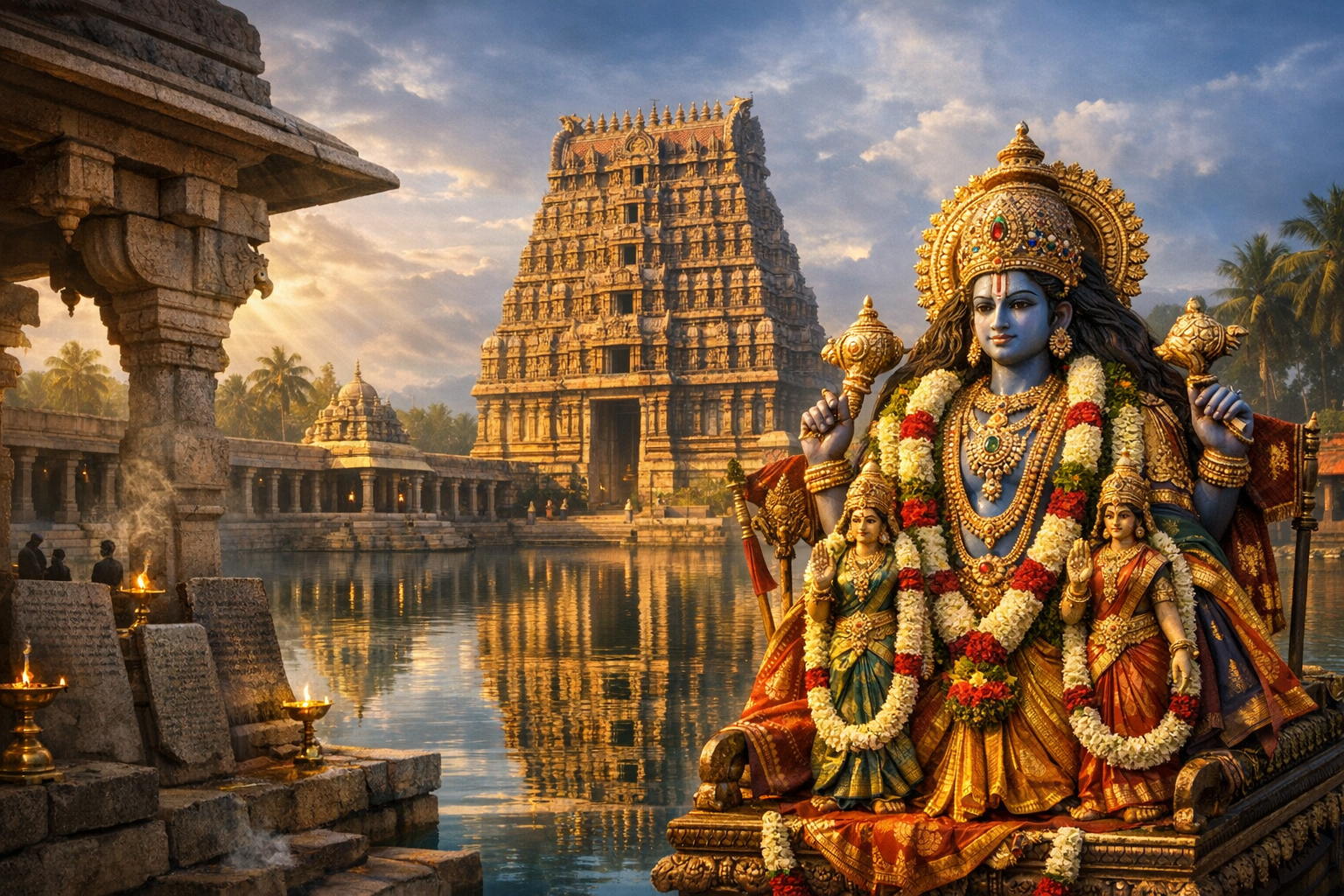
Thirukannapuram, one of the 108 Divya Desam shrines celebrated in the Nalayira Divya Prabandham, venerates Lord Vishnu as Sowriraja Perumal (also known as Neelamegha Perumal). Situated near the Kaveri delta in coastal Tamil Nadu, the temple’s reputation rests on a profound theological message: the deity’s boundless compassion and readiness to transform for the protection of dharma and the welfare of devotees. As a living center of Vaishnavism and Tamil cultural heritage, it integrates sacred narrative, liturgy, and Dravidian temple architecture into a coherent sacred landscape.
The epithet “Sowriraja” derives from sowri (locks of hair) and raja (lord/sovereign), an appellation rooted in the temple’s sthala-purana. Local tradition narrates that the Lord, in His arca form, manifested with flowing hair to uphold a devotee’s word before temporal authority. This miracle, understood not as spectacle but as ethical intervention, communicates a core Vaishnava teaching: divine presence actively safeguards truth (satya) and compassion (anukampa), particularly when sincere bhakti is tested by worldly doubt.
Interpreted theologically, the title Sowriraja emphasizes the arca-avatara doctrine, wherein the Supreme becomes tangibly accessible in consecrated images without diminishing transcendence. In this framework, the Lord’s assumption of visible hair is not mere form but functionsignaling a response to the devotee’s predicament. The narrative resonates across the broader dharmic universeJainism’s emphasis on daya and satya, Buddhism’s karuna, and Sikhism’s seva and sachaffirming a shared ethical grammar that values protection of the vulnerable and integrity of promise.
Thirukannapuram occupies a notable place in Tamil Vaishnava memory through the hymns of the Alwars, especially Thirumangai Alwar, whose poetic geography binds rivers, fields, and sanctums into a cartography of devotion. The Divya Prabandham’s Tamil verses elevate the site’s sanctity, locating it within a pan-Indian pilgrimage grid while preserving regional idiom and affect. In this way, the temple stands as both a node in the Divya Desam network and a distinct expression of Tamil sacred culture.
The presiding moolavar, Neelamegha Perumal, alludes to the rain-laden, blue-hued form invoked in Sri Vaishnava theology. Devotees encounter the utsava murti as Sowriraja Perumal, whose characteristic locks evoke the legendary intervention for the devotee’s sake. The iconographic ensemble commonly includes Sridevi and Bhudevi, Garuda, and shrines of Alwars and acharyas, reflecting a complete liturgical ecosystem in which Tamil hymns, Vedic chant, and temple ritual converge.
Architecturally, Thirukannapuram manifests the Dravidian idiom shaped by the Chola Dynasty and subsequently refined under later patrons. The multi-tiered rajagopuram, granite prakarams, and proportionate vimana align with regional canons of temple architecture. A substantial temple tank anchors the precinct’s sacred hydrology, while sequence and scale inside the mandapams facilitate ritual movement, recitation, and communal gathering. Inscriptions typical of the Kaveri delta region attest to patronage, land grants, and periodic renovations, underscoring the site’s sustained civic and economic interlinkages.
The temple’s ritual life follows Vaishnava Agamic traditions (Vaikhanasa or Pancharatra as locally followed), structuring daily worship into alankaram (adorning), neivedyam (offering), and deepa aradhana (lamps) across prescribed kala-puja cycles. Liturgical recitations from the Nalayira Divya Prabandham, alongside Vedic chanting and use of tulasi, foreground the synthesis of Sanskritic and Tamil strands that define Sri Vaishnava practice. This disciplined cadence grounds the living heritage of the shrine in both text and praxis.
Festivals amplify the temple’s theological motifs and community participation. Vaikunta Ekadashi draws devotees who seek the symbolic passage through the Parama-pada Vasal, while Brahmotsavam typically includes processions in which Sowriraja Perumal’s compassionate sovereignty is enacted through public darshan. Seasonal observances during Margazhi and other auspicious periods extend these rhythms, linking agricultural time, lunar calendars, and the devotional calendar in a seamless civilizational continuum.
The devotee experience at Thirukannapuram is consistently described in sensory and affective terms: the first glimpse of the Lord’s serene visage, the cadence of Tamil pasurams resonating against stone, the fragrance of sacred smoke, and the mirrored stillness of the temple tank. For many visitors, the legend of the Lord’s locks becomes a lens to reflect on trust, duty, and the sanctity of given word. Such affective encounters, while personal, are supported by a robust ritual and textual tradition that lends the experience both authenticity and depth.
From a literary perspective, Thirukannapuram’s prominence in Divya Prabandham hymns illustrates how Tamil poetics articulate theological nuance. Alwar verses do not merely praise; they interpret. The epithet “Neelamegha” encodes metaphors of fertility, mercy, and reliefqualities that map onto the agrarian ecology of the Kaveri deltawhile “Sowriraja” channels the ethical power of divine testimony in the mortal world.
Historically, the temple’s fortunes align with the ebb and flow of regional polities and maritime exchange along the Coromandel coast. Donations recorded in epigraphy reflect a pattern of endowments for lamps, recitation, and maintenance, demonstrating the temple’s role as both spiritual and social institution. Renovations across centuries point to an unbroken chain of stewardship in which artisanship, community patronage, and devotional continuity reinforce one another.
As cultural heritage, Thirukannapuram synthesizes tangible and intangible dimensions: stone and story, ritual grammar and lived memory. It affirms that the unity of dharmic traditionsHinduism, Buddhism, Jainism, and Sikhismemerges through shared commitments to compassion, truth, and ethical action. The legend of Sowriraja Perumal is thus not sectarian triumphalism but a parable of responsibility, echoing values honored across the dharmic family.
For contemporary pilgrims and heritage travelers, Thirukannapuram is accessible from hubs such as Thiruvarur, Nagapattinam, and Kumbakonam. The temperate months and major festival seasons typically offer the most immersive experience, though the shrine’s daily rhythm provides meaningful darshan year-round. As with many Hindu temples in Tamil Nadu, local customs of dress and decorum are observed, and visitors often combine the visit with nearby Divya Desam sites to understand the regional devotional tapestry in context.
In summary, Thirukannapuram’s Sowriraja Perumal embodies the gracious agency central to Vaishnavism: the Lord who not only receives devotion but actively upholds the devotee. Through its architecture, liturgy, and storied epithet, the temple teaches that compassion and truth are not abstractions; they are enacted realities. This is why Thirukannapuram remains a beacon among the 108 Divya Desamsan enduring testament to living faith, ethical witness, and the shared dharmic vision of a just, compassionate world.
Inspired by this post on Hindu Blog.