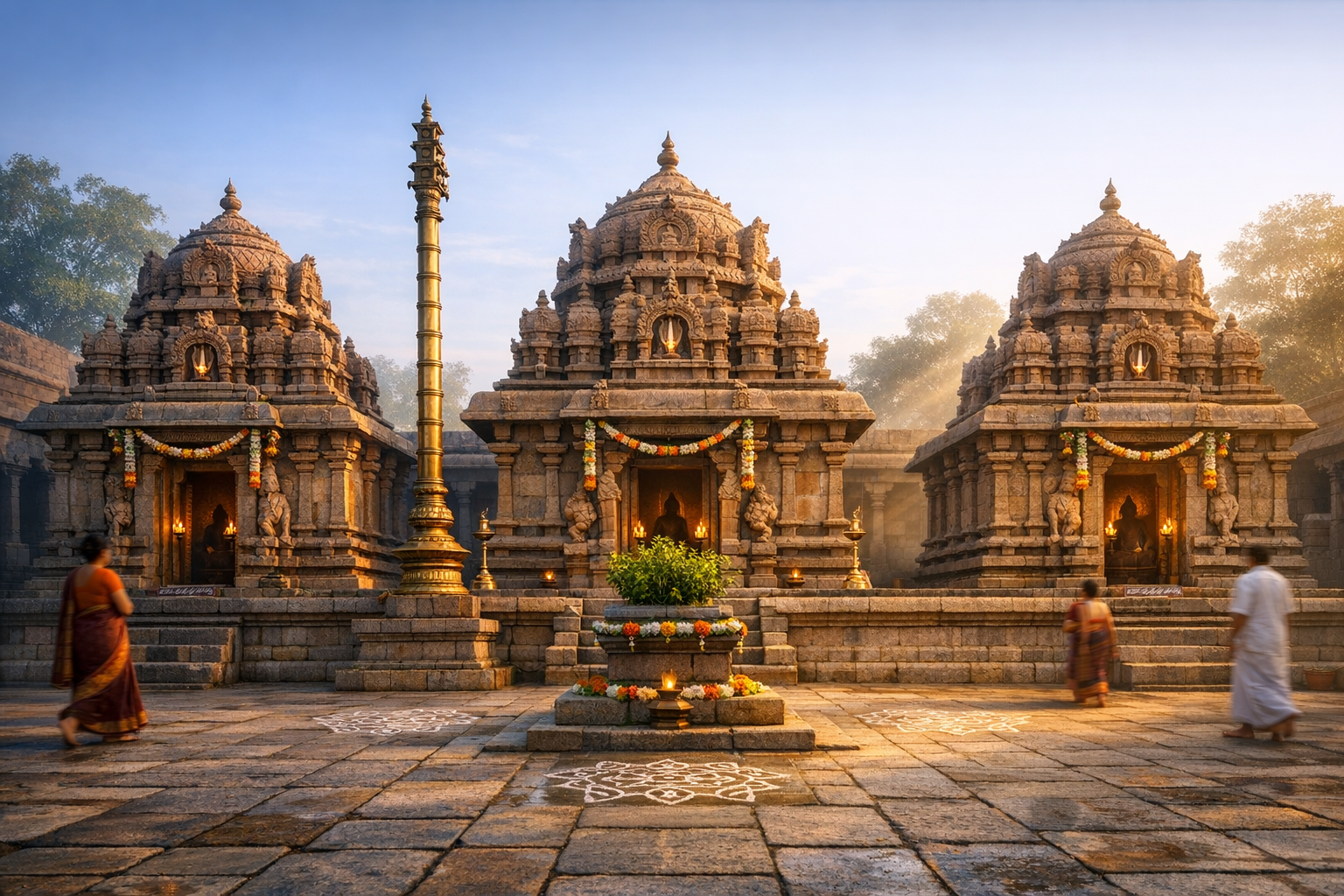
Thanjai Mamani Koil, also known as Thirutanjai or Thanjavur Perumal Temple, is a rare and revered triadic complex of three adjacent Vishnu shrines situated within a single sacred compound in Thanjavur, Tamil Nadu. Counted among the 108 Divya Desams praised by the Alvars in the Naalayira Divya Prabandham, this site holds distinctive theological, architectural, and ritual significance in the Kaveri delta’s temple network.
Set in the historic urban fabric of Thanjavurcelebrated for its Chola-era monumental architecturethe complex integrates regional devotional currents with classical Dravida temple forms. The setting provides a compelling lens through which to understand how Vaishnava worship traditions matured alongside Shaiva, Shakta, and broader dharmic currents, sustaining a plural spiritual culture that has defined South India for over a millennium.
Nomenclature across oral and textual sources recognizes the triad as a single pilgrimage destination under the name Thanjai Mamani Koil, while each shrine retains its own identity. The complex is often introduced in regional tradition simply as Thirutanjai, a usage that emphasizes the layered sanctity of place rather than the separateness of each garbhagriha.
Devotional literature situates the site within the pan-Indian Vaishnava canon. Pasurams in the Naalayira Divya Prabandham acclaim the kshetra’s sanctity and experiential rasa: the cooling grace of the Lord’s presence, the protective assurance felt by devotees, and the contemplative quiet that envelopes the pradakshina path. This literary framing ties the local to the universal, positioning the triad as a living theater of bhakti.
The sthala-purana narrated at Thirutanjai preserves a core idea that Vishnu manifests here in three complementary forms to guide, protect, and grant refuge. The very toponym evokes “thanja”refuge or protectionsignaling the site’s pastoral ethos of sheltering grace. For many pilgrims, moving from one sanctum to the next feels like walking through a living commentary on Vaishnava theology, where compassion, justice, and cosmic order converge.
Within the compound, the deities are widely identified as Neelamegha Perumal, Manikundra Perumal, and Veera Narasimha Perumal. Each sanctum enshrines a distinct murti and iconographic emphasis, enabling devotees to engage different facets of Vishnu’s naturefrom serene benevolence to dynamic protection. The triadic arrangement deepens darshan by inviting reflective progression rather than a single, punctuated encounter.
Philosophically, the triple temple can be read as a synoptic map of Vaishnava thought: the Lord as the ground of sustenance (sthiti), the force that dispels adharma (raksha), and the source of auspicious well-being (shreyas). While interpretations vary across sampradayas, the shared thread is experiential bhaktidevotion that integrates ethics, metaphysics, and daily life.
Architecturally, Thanjai Mamani Koil exhibits characteristic elements of Dravida vocabulary: granite adhisthana, proportioned pilasters with kumbha and kalasa motifs, well-ordered prastara, and a vimana profile that speaks to regional canons refined between the late Chola and post-Chola periods. Later Nayak and Maratha-era interventions are legible in stucco program, mandapa enlargements, and occasional yali-bearing columns, reflecting centuries of living patronage.
The plan concentrates ritual movement within a compact prakara, encouraging measured circumambulation between the three garbhagrihas. Spatially, the compound prioritizes clarity of processional flowdevotees naturally complete darshan in a calibrated sequence, reinforcing the triadic pedagogy of the site through embodied practice.
Epigraphic patterns in the Kaveri delta suggest that patronage for such Vaishnava shrines often began under the later Cholas and continued under Thanjavur Nayaks and Maratha rulers. While inscriptional specifics vary from site to site, the broader regional picture confirms a persistent civic-devotional ecosystem: royal, mercantile, and agrarian endowments supported utsavams, daily naivedyam, and structural upkeep across centuries.
Worship today follows established Agamic procedures (Pancharatra or Vaikhanasa as per local tradition), with nitya-archana cycles that include suprabhatam, alankaram, naivedyam, and deepa aradhana. Temple timekeeping aligns with lunar tithis and Vaishnava festival markers, embedding the complex within the larger calendrical rhythm of Tamil Nadu’s sacred year.
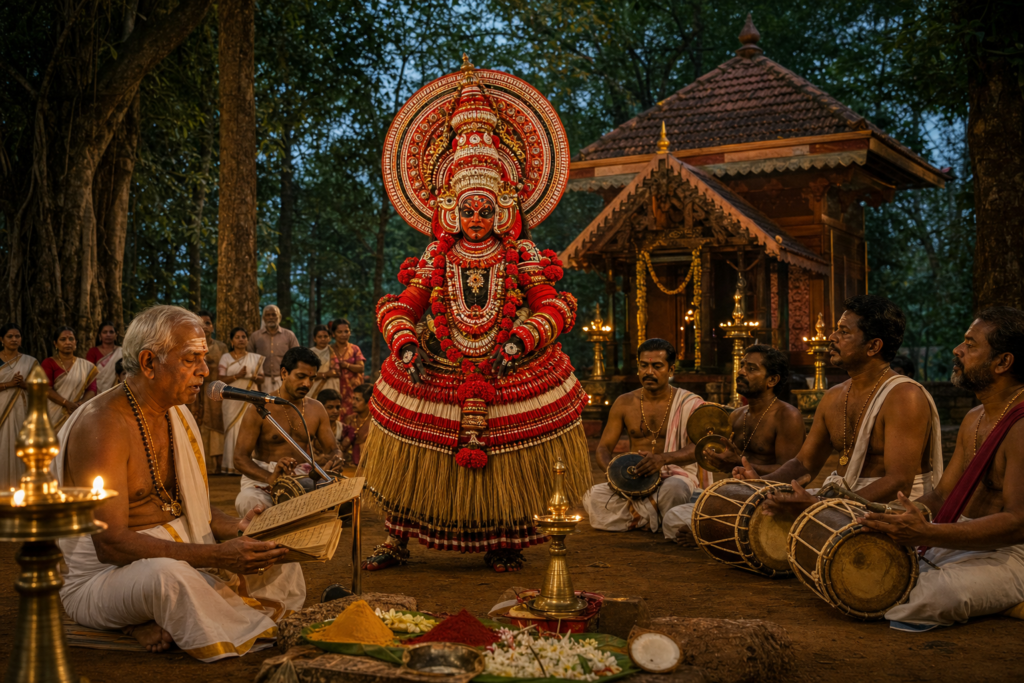
Among the major utsavams, Vaikuntha Ekadashi draws large congregations, as do Brahmotsavam and Narasimha Jayanti. Andal’s Tiruvadippuram and Krishna-centric janotsavams further knit Thanjai Mamani Koil to the emotive spectrum of Alvar bhakti, where music, flowers, light, and community service become vehicles of theological expression.
Iconographically, the murtis foreground classical Vaishnava identifiers: Sudarshana Chakra and Panchajanya Shankha, the vanamala garland, and the Kaustubha-like chest jewel. The alankara repertoire changes with the liturgical calendar, allowing devotees to experience the deities’ anubhava through seasonal decoration, fragrance palettes, and musical ragas aligned to specific times of day.
Pilgrims commonly adopt a disciplined darshan sequenceoften beginning with Neelamegha Perumal, proceeding to Manikundra Perumal, and concluding with Veera Narasimha Perumalframing the visit as a contemplative arc from reposeful grace to protective assurance. The emotional texture is frequently described as cooling (shitala), a quality the Alvars prize when narrating divine compassion that soothes existential heat.
In the larger Thanjavur milieu, Thanjai Mamani Koil exemplifies how Vaishnava, Shaiva, and Shakta traditions historically coexisted and mutually enriched each other. This interdependence mirrors the dharmic principle of unity-in-diversity also cherished by Buddhism, Jainism, and Sikhisman inclusive civilizational ethic that values compassion (karuna), non-harm (ahimsa), service (seva), and truth (satya) as shared social goods.
From a heritage perspective, the compound stands as a layered archive of sacred art, community memory, and continuing ritual. Conservation priorities typically include stabilizing substructures, managing water ingress during monsoon, protecting sculptural surfaces from bio-growth, and ensuring that modern utilities are sensitively integrated without compromising the sacral geometry of the site.
For visitors, early morning or late evening provides the most contemplative ambience, with softer light revealing stone texture and sculptural detail. Observing local customsmodest attire, maintaining silence near the sanctum, and respecting photography normssupports the temple’s devotional ethos and contributes to a serene collective experience.
Scholars and students of religion will find Thanjai Mamani Koil a compelling case study in how theology, space, and performance intertwine. The triadic plan offers a ready framework for analyzing processions, soundscapes, food offerings, and congregational movement as parts of a coherent ritual system that educates through participation rather than abstraction.
In terms of regional networks, the temple aligns with other Kaveri delta Vishnu kshetras in sustaining a pilgrimage circuit that blends literary remembrance (through Alvar hymns) and lived devotion (through daily seva). This continuity preserves not merely monuments, but the relational lifeworlds that give them meaningfamilies, artisans, musicians, archakas, and devotees who together keep the shrine’s pulse steady.
Ultimately, Thanjai Mamani Koil communicates a simple, enduring proposition: divine refuge is manifold, yet integrative. The three sanctums invite the heart to slow down, the mind to clarify, and the community to coherereminding all who enter that the many paths within Sanatana Dharma converge toward mutual respect, inner steadiness, and compassionate service.
Inspired by this post on Hindu Blog.