Across the dharmic world, certain natural forms are revered as divinity manifest. The sacred triad of Shaligram Shila, Shankha (conch), and Tulsi (Ocimum tenuiflorum) stands out as a comprehensive, living mode of Vishnu worshipuniting stone, sound, and sacred botany into a single, harmonious sādhana. This triune practice blends scriptural authority, geological and biological realities, and centuries of household devotion into a lucid path that is at once contemplative, ethical, and accessible.
A Shaligram is a naturally occurring, often black, fossil stone found predominantly in the Kali Gandaki (Gandaki) River basin of Nepal, especially around the sacred region of Muktinath. Venerated as a self-manifest (svayambhū) form of Bhagavan Vishnu, the Shaligram requires no formal prāṇa-pratiṣṭhā; its natural form is regarded as intrinsically divine. This recognition is grounded not merely in sentiment, but in a deep scriptural lineage that frames Shaligram worship as an authentic axis of Vaishnava practice.
Geologically, most Shaligrams are ammonite fossilsancient marine cephalopods preserved within Himalayan strata uplifted over millions of years. Their spiral forms and distinctive suture-line patterns often present as natural chakra-like markings, traditionally associated with Vishnu’s Sudarshana Chakra. The material itself is typically dense and dark, and genuine specimens exhibit no signs of carving or artificial enhancement, a point emphasized across Vaishnava traditions to preserve both sanctity and authenticity.
References to Shaligram worship are found in the Padma Purana, the Skanda Purana (notably the Shalagrama Mahatmya), the Brahma Vaivarta Purana, and allied Vaishnava sources, with procedural details echoed in the Pancharatra Agamas and elaborated in texts such as the Hari-bhakti-vilasa. These sources consistently position the Shaligram as a direct focus of Vishnu-bhakti, one that sanctifies domestic space and condenses temple metaphysics into a daily, intimate ritual discipline.
The geography of Shaligram is itself a lesson in dharmic unity. Muktinathknown to Buddhists as Chumig Gyatsais a famed Himalayan tirtha honored by Hindus and Buddhists alike. The Kali Gandaki, where Shaligrams are found, is a shared sacred landscape that quietly demonstrates the deep resonances among India’s dharmic traditions. While historical commerce spread Shaligrams widely, contemporary devotees increasingly emphasize responsible, lawful, and ethical acquisition that respects Nepal’s heritage regulations and the riverine ecosystem.
In lived practice, Shaligram worship is both simple and profound. A common nitya-vidhi (daily method) includes gentle rinsing with clean water, Panchamrita abhishekam (milk, curd, ghee, honey, and sugar, where tradition permits), and archana with Tulsi leaves while chanting names of Vishnuespecially Om Namo Narayanaya or Om Namo Bhagavate Vasudevaya. Many practitioners place the Shaligram on a dedicated peetha, keep it dry after worship, and avoid chemical cleansers, preserving both the fossil’s integrity and the ritual’s purity. Even a minimal Panchopachara (offerings of gandha, pushpa, dhupa, dīpa, and naivedya) conducted with care is regarded as spiritually complete.
The Shankha (conch) is the second pillar of this triad. Biologically, the principal sacred conch of the Indian Ocean littoral is Turbinella pyrum, a heavy, lustrous shell with a short spire and robust body. Two primary morphological orientations are recognized: the common left-spiraling (vāmavarti) and the rare right-spiraling (dakṣiṇāvarti), the latter traditionally associated with auspiciousness and prosperity. In iconography, Vishnu’s ShankhaPañchajanyasignifies the propagation of dharma through sacred sound (śabda).
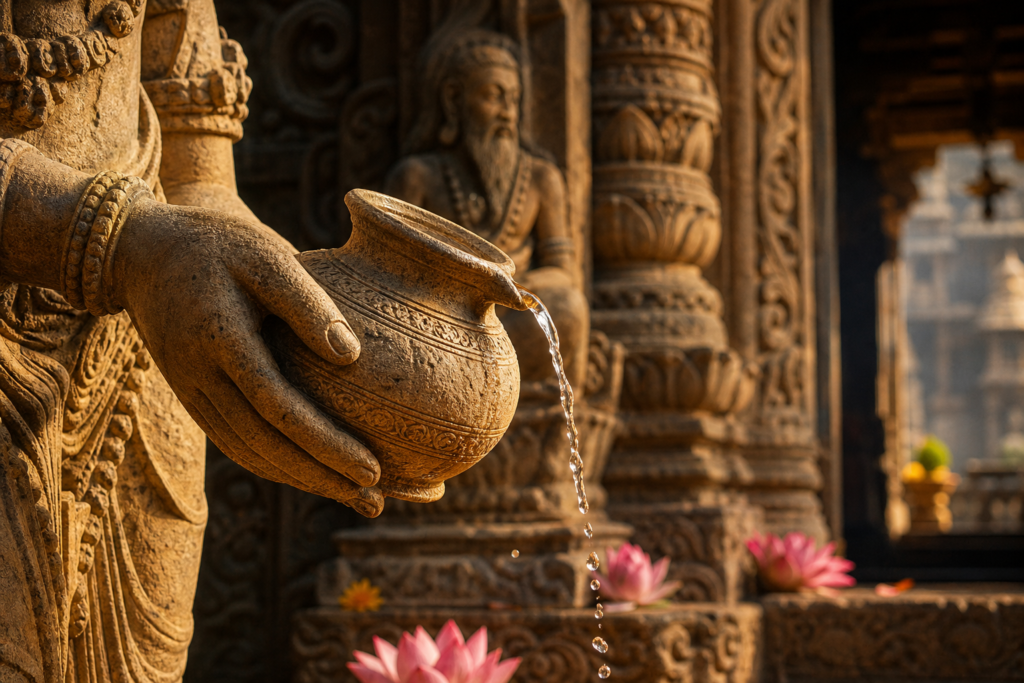
Ritually, the Shankha serves multiple functions. One conch is reserved for blowing during ārati and sankirtana, while a separate conch is used for storing and pouring sanctified water for abhiṣeka, arghya, and prokṣaṇa, a distinction maintained to preserve hygienic and ritual standards. The sonorous call of the conch, associated in tradition with the cosmic syllable and Nāda-Brahman, gathers attention, clears distraction, and sanctifies the ritual space, allowing the mind to turn inward with clarity and devotion.
This symbolism of the conch is not limited to one sampradāya. The white conch appears among the Aṣṭamaṅgala (Eight Auspicious Symbols) in both Buddhist and Jain traditions, where it represents the far-reaching sound of truth and ethical victory. The shared esteem for the conch as a carrier of sacred sound highlights a civilizational ethos: diverse dharmic paths have long recognized sound as a bridge between practice and realization, even where liturgical details differ.
Tulsialso known as Tulasi or Vrindaforms the triad’s living heart. Botanically identified as Ocimum tenuiflorum (syn. Ocimum sanctum), Tulsi is cherished for its fragrance, resilience, and the serene presence it brings to a home altar. In Vaishnava literature, Tulsi is beloved of Vishnu; her leaves and manjaris (flowering tops) are offered as the most intimate expression of bhakti, and simple Tulsi archana has long been considered spiritually sufficing when performed with sincerity.
Scripturally and ritually, Tulsi’s inseparability from Shaligram is epitomized in Tulsi Vivahcelebrated in the month of Kartika (commonly on Ekadashi or Dwadashi)where the Shaligram is ceremonially united with Tulsi as Vishnu-Lakshmi. This rite encapsulates a core Vaishnava insight: devotion elevates nature into a living sacrament. Households often maintain a Tulsi vrindavan (raised planter), integrating ecological care with daily worship, and thereby turning domestic space into a sanctified grove.
Traditional Ayurveda venerates Tulsi for its supportive qualities in daily well-being, describing attributes such as upliftment and clarity. While these references are embedded in classical health literature, ritual usage centers on sanctity, not medicine; devotees generally regard Tulsi primarily as a sacred companion in worship, with any health applications considered a matter for qualified guidance and personal discretion.
Taken together, Shaligram, Shankha, and Tulsi form a precise spiritual grammar. Shaligram provides the divine form (mūrti), Shankha contributes consecrated sound (śabda) and ritual water, and Tulsi offers living fragrance and devotion (gandha and bhakti). This triad gently harmonizes matter, vibration, and lifethree axes through which Vaishnava theology approaches the presence of Vishnu in the worldand nurtures a sattvic ambience conducive to meditation, study, and service.
For daily worship, many households adopt a succinct nitya-vidhi shaped by the Pancharatra and supported by traditions such as Sri Vaishnavism and Gaudiya Vaishnavism. A typical sequence includes ācamanam and saṅkalpa; gentle cleansing of the Shaligram; application of Panchamrita and pure water poured from the abhiṣeka Shankha; offering of gandha, pushpa, and deepa; archana with Tulsi leaves while reciting Vishnu-nāma; naivedya; and ārati with the blowing Shankha. Practices vary across sampradāyas, yet the shared intentclarity of mind, steadiness of heart, and loving remembrance of Vishnuremains constant.
Festivals further enrich this triad. Ekadashi observances emphasize simplicity and inner focus; Kartika deepens the bond between Shaligram and Tulsi through Tulsi Vivah; and special days dedicated to Vishnu’s avatāras prompt distinct forms of archana and study. In many regions, seasonal rhythms and agricultural cycles are integrated into worship, reflecting a broader dharmic sense that sacred time, natural time, and human time are woven together.
Ethical sourcing and ecological care are integral to contemporary practice. Devotees increasingly verify that Shaligrams are acquired in ways consistent with local laws and cultural stewardship, that conches are obtained without harming marine ecosystems, and that Tulsi cultivation is respectful of soil and water. Such considerations uphold a fundamental dharmic principle: worship should never come at the expense of life and land from which sacred forms arise.
The triad’s deeper relevance extends beyond a single tradition. Muktinath’s shared sanctity highlights Hindu–Buddhist kinship around sacred geography; the conch’s place in the Aṣṭamaṅgala resonates with Buddhist and Jain symbolism; and the reverence for living plantsthough expressed differently across Hinduism, Buddhism, Jainism, and Sikhismaffirms a civilizational ethos of care, non-violence, and gratitude to nature. These convergences reinforce unity in diversity, inviting mutual respect among kindred paths.
For countless families, the day’s most luminous moments have been shaped by this triad: the cool feel of a naturally formed Shaligram in hand, the clarion call of the Shankha gathering the mind, and the gentle fragrance of Tulsi evoking the presence of Vishnu. Such experiences, quietly repeated across generations, anchor a scholarly tradition in daily life, turning homes into sanctuaries where wisdom is not only studied but also lovingly practiced.
In sum, Shaligram, Shankha, and Tulsi offer a complete, elegant, and time-tested framework for Vishnu worshipscripturally grounded, ritually coherent, ecologically sensitive, and deeply unifying across the dharmic spectrum. Approached with respect and responsibility, this triad becomes more than ritual: it becomes a living education in harmony, gratitude, and enduring grace.
Inspired by this post on Hindu Blog.