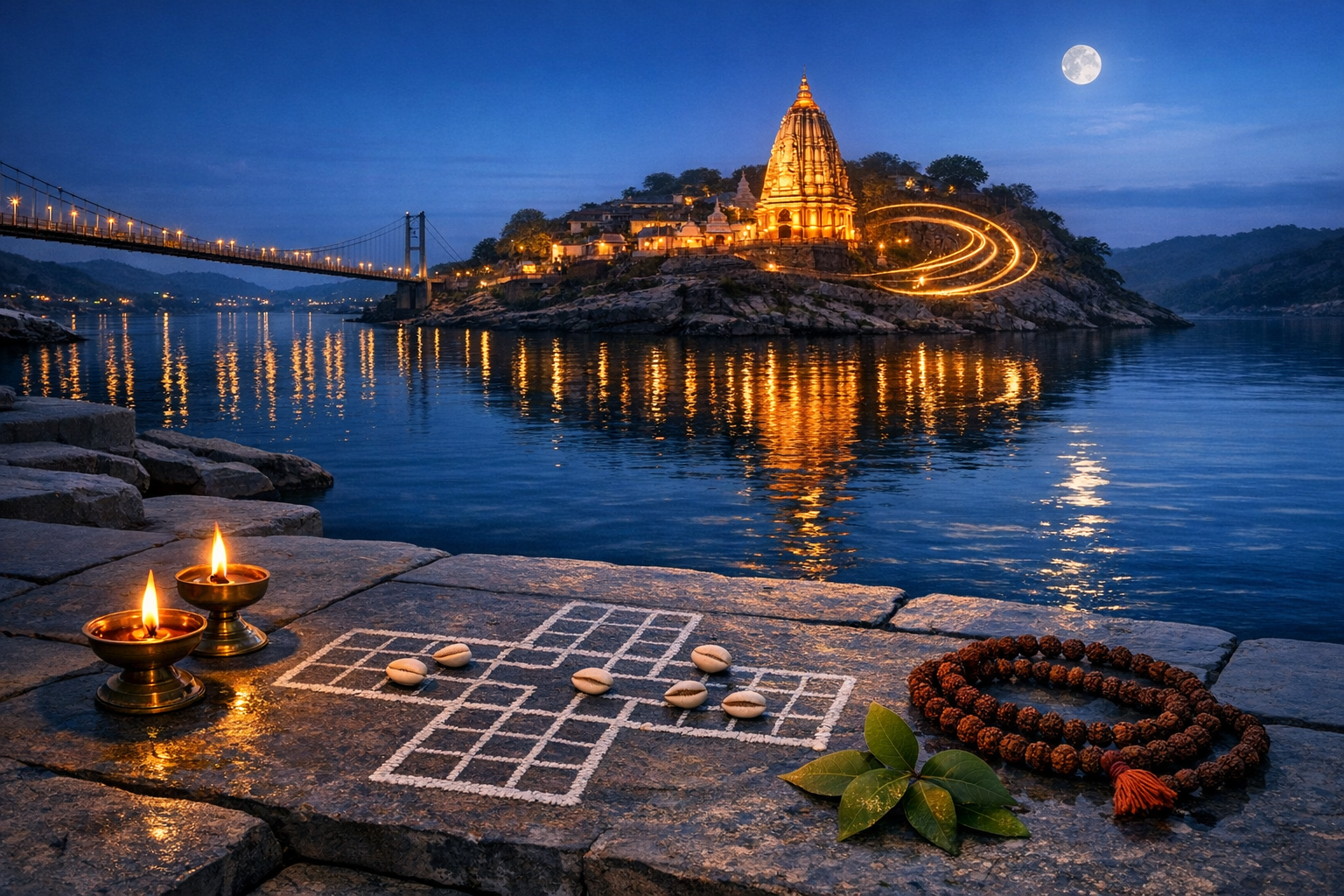
At Omkareshwar, one of the twelve revered Jyotirlinga shrines of Lord Shiva, a living legend endures: after nightfall, Shiva is believed to arrive, engage in a game of Chausar (Pachisi), and then sleep within the sanctum. More than charming folklore, this narrative animates ritual life and shapes devotional perception—presenting divinity as immediate, relational, and tenderly near.
Set upon Mandhata (Shivapuri) Island—an islet in the Narmada River whose contours are traditionally likened to the sacred syllable ॐ—Omkareshwar Temple anchors a dense sacred geography in Khandwa district, Madhya Pradesh. The paired shrine of Amareshwar (Mamleshwar) on the mainland, suspension bridges linking island and shore, and the quiet sangam where the Narmada meets a local Kaveri stream together create an immersive tirtha-scape of pilgrimage, parikrama, and darshan.
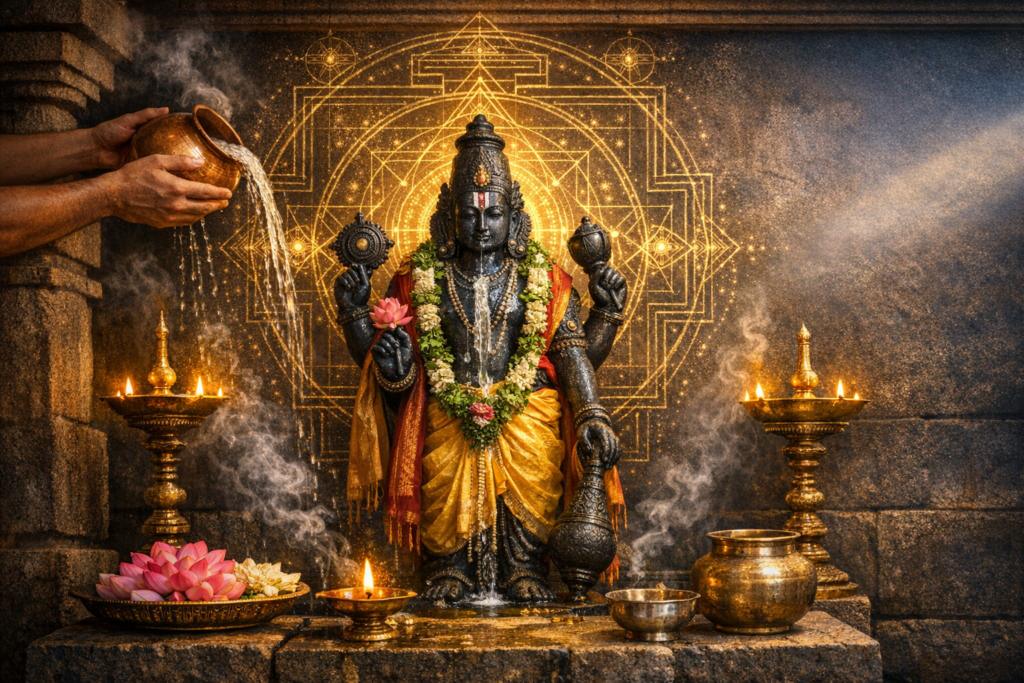
Hindu temple practice treats the murti as a living deity after prana-pratishtha (enshrinement). Daily upacharas (services) unfold with liturgical precision—awakening, bathing (abhisheka), adornment, feeding, procession, and finally the shayana aarti that symbolically invites the deity to rest. Within this theological frame, Omkareshwar’s night-time narrative is not an anomaly but an intensification of a pan-Indic idea: divinity participates in human rhythms of play, work, and sleep.
Local oral tradition describes that, after the final rites and the ebbing of crowds, Shiva arrives incognito to play Chausar or Pachisi—sometimes said to be with Pārvatī, sometimes with the gaṇas—and then reclines in the garbhagriha. The account is preserved through priestly memory and community storytelling rather than dated inscriptions, situating it squarely within the domain of intangible cultural heritage.
Theologically, play (lila) and rest (yoga-nidra or shayana) form a fertile dialectic in Hindu thought. Lila conveys creation as effortless sport—dynamic, emergent, and free—while shayana evokes cosmic repose, the return to stillness out of which new cycles arise. Read through this lens, Omkareshwar’s nocturnal tale becomes a contemplative teaching on alternation: movement and quiet, chance and order, nearness and transcendence.
Historically and technically, Chausar/Pachisi is a cross-shaped race game played with cowrie shells and counters that move along the four arms of a board. The stochasticity introduced by cowrie throws creates a simple probability space that, in practice, feels closer to fate than arithmetic—an apt metaphor for karma’s contingencies moderated by dharma-guided choice. While gambling (dyuta) carries cautionary overtones in the epics, divine play in Shaiva narratives is framed not as vice but as pedagogy: a dramatization of uncertainty to cultivate equanimity and discernment.
Omkareshwar’s current architectural profile showcases a northern (Nagara) idiom: a curvilinear shikhara crowning the sanctum, mandapas articulated by pillars, and subsidiary shrines woven into a compact hill-temple plan. Like many Narmada shrines, the complex reveals layers of patronage and repair, with medieval substrata and significant Maratha-period support; regional memory consistently recalls the broader Narmada revitalization associated with Maharani Ahilyabai Holkar.
Sacred geography intensifies the devotional experience. Pilgrims often undertake the Omkareshwar parikrama circuit around Mandhata Island, circumambulating the living waters of the Narmada while passing ghats, mathas, and satellite shrines. The journey folds landscape into liturgy, teaching through footsteps as much as through scripture.
Ritual observances at Omkareshwar are structured through the day: jalabhisheka and Rudrabhishek sequences, periodic aartis, and darshan windows that regulate flow within the garbhagriha. The concluding shayana aarti, offered at night, marks the deity’s repose and, in local understanding, frames the liminal interval to which the Chausar episode belongs.
Devotees describe the temple’s late-night ambience with careful reverence: the river’s low murmur, the fading resonance of bells, the fragrance of bilva and ghee-lamps lingering in stone corridors. Even among those who approach the narrative symbolically, the sensorial field often evokes a distinct expectancy, as though architecture, ritual, and river together disclose a presence best met in silence.
Across dharmic traditions, the intuition of “living presence” assumes cognate forms. Jain communities tend the pratima with a care that presumes sentience-in-relation; Buddhist practice treats the stupa and image as loci where awakened qualities are immediately accessible; Sikh maryada ritually enacts the sukhasan (repose) of the Guru Granth Sahib at day’s end. These parallels—distinct yet harmonious—underscore a shared civilizational ethic in which the sacred is intimate, ethically formative, and woven into daily time.
Read as intangible cultural heritage, Omkareshwar’s legend performs social work. It binds generations through storytelling, aligns household routines with temple time, and orients pilgrims toward humility, non-violence, and service. In an age of extraction and speed, such narratives protect contemplative space and sustain communities in ways conventional metrics rarely capture.
For those planning a yatra, Omkareshwar lies roughly 80 km from Indore and is served by road connections to Khandwa and Ujjain; the nearest railhead is Omkareshwar Road (Mortakka), with broader connectivity via Indore and Khandwa. Approaches typically include a footbridge to Mandhata Island, and many pilgrims combine darshan with the parikrama path. Temple timings and special-seva schedules vary seasonally; consulting the local administration at arrival supports respectful participation in abhisheka or aarti.
Pilgrimage etiquette preserves the sanctity that the legend presupposes: maintain quiet near the garbhagriha, follow queue protocols, avoid intrusive photography, and refrain from touching the linga unless explicitly permitted during designated rites. Offerings of bilva, water, and simple flowers align with Shaiva practice and minimize environmental impact along the Narmada ghats.
Textual memory situates Omkareshwar within broader puranic cartographies; regional recensions of the Skanda Purana (notably the Narmada-mahatmya) extol the river’s sanctity and enumerate shrines along its banks. While these texts do not adjudicate modern oral specifics such as the nightly Chausar motif, they provide the cosmological and ritual grammar in which such narratives take root and endure.
Whether approached as history, hermeneutic symbol, or living faith, the Omkareshwar tradition invites a generous reading: the divine is near, participates in play, and rests among people. That conviction—shared in spirit across Hindu, Buddhist, Jain, and Sikh communities—cultivates ethical kinship and reminds society that the most enduring architecture is built from attention, compassion, and a willingness to let sacred time reorder ordinary life.
Inspired by this post on Hindu Blog.