Nemili Sri Bala Tripurasundari Peetam in the Vellore region (present-day Ranipet district), Tamil Nadu, is a distinctive house-temple where devotees experience the living presence of a small, powerful, and ever-youthful Goddess revered simply as Sri Bala. Situated about 20 km from Kaveripakkam, this intimate peetam has, over decades, evolved into a deeply loved space of Shakta worship, drawing pilgrims who value quiet devotion, precise ritual, and the felt grace of a child-deity.
The setting is striking in its simplicity: a modest residence adapted into a sanctified space. Devotees regard the home itself as a temple, with a compact sanctum and a close-knit ritual routine. This environment promotes unhurried darshan and a palpable sense of nearness to the deityan experience many associate with traditional village shrines before large-scale temple complexes became the norm.
As per local oral tradition, Sri Bala chose to reside here through a series of promptings felt by a devout family, leading to the establishment of the peetam within a private home. Over time, word of the child-goddess’s grace spread organically. The temple’s reputation rests not on monumental architecture but on the continuity of household pietyregular puja, devotion to the Sri Chakra, and a community of visitors who treat the Goddess as a divinely radiant child.
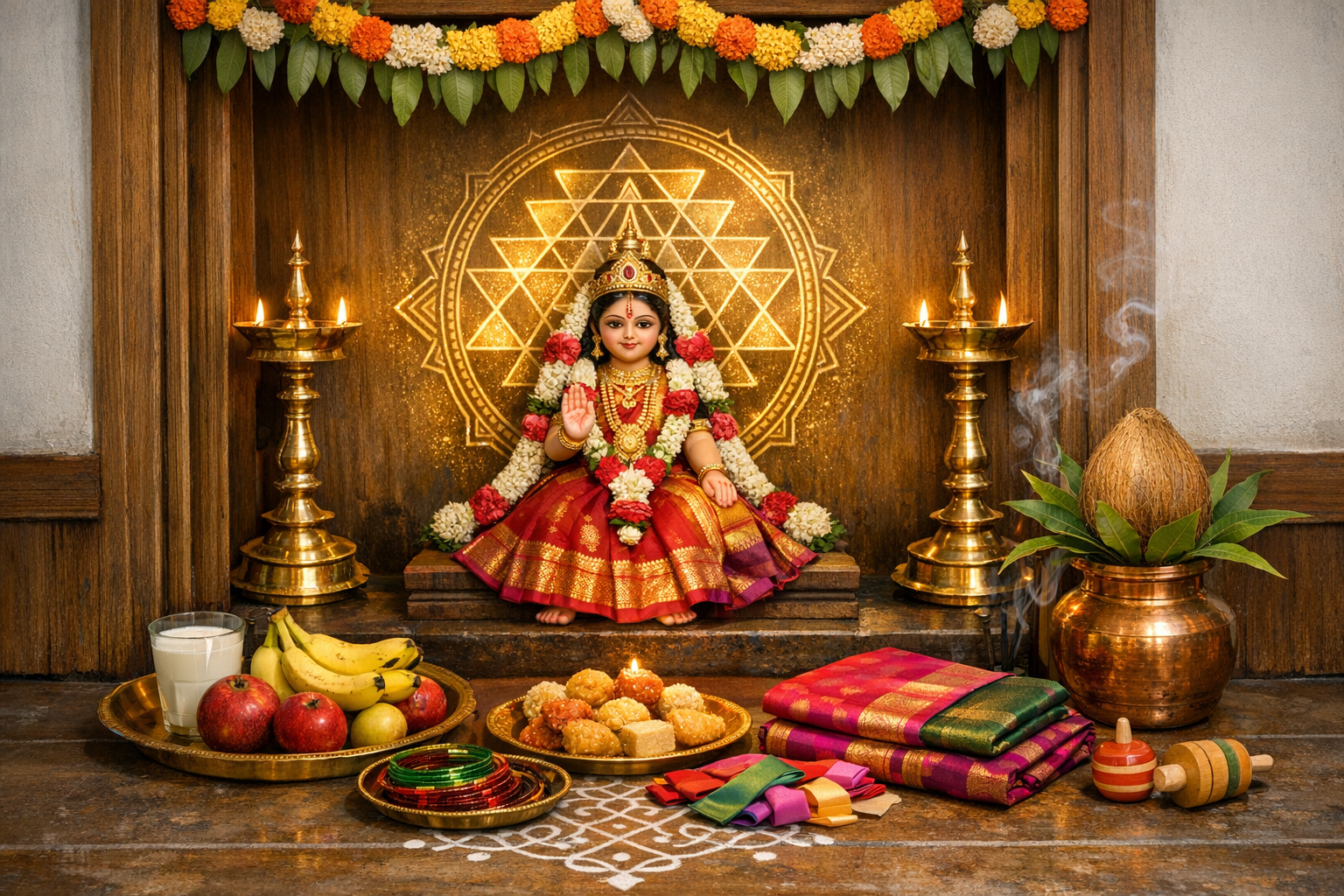
Within the wider Shakta framework, Bala Tripurasundari is the child-form of Lalita Tripurasundari. Theological texts position Bala as the tender but potent embodiment of Vidya (sacred knowledge) and Karuna (compassion). In Sri Vidya practice, the Sri Chakra (or Sri Yantra)a complex geometric diagram of nine interlocking triangles forming 43 smaller trianglesserves as a potent symbol and ritual focus. Devotees often associate Bala with the fundamental seed-syllables aim, klim, and sauh in Sri Vidya traditions, recognizing that mantra practice should be undertaken carefully and, where required, under qualified guidance.
Iconographically, Bala expresses the paradox of innocence and supremacy: the unassuming presence of a child-form united with the sovereignty of the Supreme Devi. Alankarams (sacred adornments) emphasize youthful graceflowers, simple jewels, childlike garmentsand the sanctum ambience accentuates warmth and nearness. The symbolism is pedagogic as well as devotional: spiritual power need not appear imposing to be transformative.
Daily worship at Nemili Sri Bala Peetam typically features abhishekam, alankaram, and archana, accompanied by recitations such as Lalita Sahasranama and hymns to Bala. The rhythm is gentle yet meticulous, reflecting the house-temple ethos. Fridays are especially significant in Tamil Nadu’s Shakta practice, and attendance often rises on these days. Full-moon observances and the season of Aadi also witness enhanced ritual intensity.
Navaratri is the principal festival, with daily alankarams and extended chanting. The peetam’s scale allows nuanced ritual focuskolu arrangements, attentive mantra recitations, and a devotional cadence aligned to Sri Vidya. Many pilgrims plan visits specifically for Navaratri at Nemili to experience a Shakti celebration where the line between homely intimacy and scriptural rigor is delicately balanced.
Offerings reflect the child-goddess orientation. Devotees bring milk, fruits, sweets, bangles, ribbons, toys, and pattu pavadai (silk skirt) sets as symbolic expressions of care. These gestures strengthen the relational bond central to Bala worship: the deity is approached with tenderness, and devotion is enacted as loving service to a divine child.
The inward experience many report at Nemili is a softening of mental agitation and an increase in clarity. The small sanctum, repetition of sacred names, and the contemplative geometry of the Sri Chakra together foster one-pointedness. In a cultural landscape with many grand temples, the peetam offers a complementary modality: less spectacle, more inwardness.
Nemili Sri Bala Tripurasundari Peetam also resonates with the broader Dharmic appreciation of the sacred feminine. The Shakti ideal of compassion and wisdom finds kinship with the reverence for Tara in Buddhism and protective goddesses such as Padmavati and Ambika in Jain traditions. The emphasis on humility, seva, and inner transformation reflects values cherished across Hindu, Buddhist, Jain, and Sikh thought, encouraging a spirit of mutual respect and unity in diversity.
How to reach: Nemili lies roughly 20 km from Kaveripakkam on the Chennai–Bengaluru corridor (NH 48). From Chennai, many travelers exit near Kaveripakkam or Walajah Road and proceed by local road to Nemili. The nearest major railway nodes are Arakkonam and Walajah Road Junction, with last-mile access by bus or auto/taxi. Chennai International Airport (MAA) is the primary air gateway. Because this is a residential locality, parking is limited; planning for short walks from nearby lanes helps.
Timings and darshan: As a house-temple, timings can vary by season and festival. In general, morning and evening darshan windows are followed, with Fridays and Navaratri drawing higher footfall. It is advisable to verify local timings before travel, arrive early, and allow for unhurried participation in the puja cycle.
Etiquette and dress: Modest attire is recommended for all visitors. Footwear is left outside. Photography may be restricted in or near the sanctum; permission should be sought before taking any images. Given the intimate premises, maintaining silence, keeping mobile phones on silent mode, and being mindful of neighbors are appreciated.
Visitor profile and accessibility: The peetam’s compact layout requires mindful movement, especially on crowded days. Elder visitors typically manage with assistance; bringing a light shawl or sitting cloth helps during longer recitations. Volunteers and regulars often guide first-time pilgrims with gentle clarity.
Suggested pilgrimage circuit: Many travelers combine Nemili Sri Bala Tripurasundari Peetam with Kanchipuram temples (notably Kamakshi Amman), nearby shrines in the Vellore region, and heritage stops such as Vellore Fort. The combination provides a rich encounter with Tamil Nadu’s Shakta devotion and historical artistry within a manageable travel radius.
Language and local support: Tamil is the primary language, with basic English or Hindi assistance commonly available through fellow pilgrims. Carrying written addresses in Tamil benefits taxi or auto engagements. Local eateries serve typical vegetarian fare; on festival days, prasadam availability is greater but crowds are denser.
Seasonal considerations: The months of Aadi and the Navaratri season are spiritually vibrant and climatically warm. Hydration, light cotton clothing, and early arrivals are practical measures. During monsoon spells, small lanes may be slick; suitable footwear is recommended.
Ritual and geometrytechnical note: In Sri Vidya, the Sri Chakra’s nine avaranas (enclosures) each symbolize progressive unfoldments of consciousness and devotion. Bala is intimately connected with the cultivation of Vidya; the seed-syllables aim, klim, and sauh are doctrinally linked with knowledge, love/attraction, and the fullness of Shakti, respectively. While these elements inform the peetam’s spiritual grammar, formal mantra initiation, where applicable, remains the preserve of traditional guidance.
Acoustics and meditative effect: Repetitive nama-japa and stotra recitation, especially in a small sanctum, create a coherent sonic field that supports concentration. Devotees often report that even short periods of stillness after archana deepen the assimilation of the ritual experience.
Living heritage significance: Nemili Sri Bala Peetam exemplifies Tamil Nadu’s living temple heritage beyond large complexeshousehold piety, continuous daily worship, and the fusion of domestic and sacred space. Such shrines preserve community memory, ritual precision, and intergenerational continuity through direct participation rather than spectacle.
Community and learning: Because the deity is a child, the peetam organically becomes a space where families introduce children to puja etiquette and the values of care, humility, and gratitude. This educational dimensionlearning by seeing and servingaligns with the Dharmic emphasis on experiential transmission of wisdom.
Key questions answeredbest time, offerings, and stay: Fridays and Navaratri offer heightened ritual energy, while weekdays outside festival seasons provide quieter darshan. Offerings apt for a child-goddessmilk, fruits, sweets, toys, bangles, pattu pavadaiare welcomed. Accommodation is best arranged in Kanchipuram, Vellore, or Arakkonam, from where day trips to Nemili are feasible.
Responsible pilgrimage: The residential context calls for considerate conductavoid littering, respect queue discipline, and adapt to the peetam’s constraints with patience. Simple, attentive participation enhances the experience for all.
In sum, Nemili Sri Bala Tripurasundari Peetam offers a rare, deeply personal encounter with Shakti as a childintimate, rigorous in its Sri Vidya cadence, and rooted in living tradition. For seekers interested in Shakta tantra’s devotional heart, Tamil Nadu’s house-temple culture, and a pilgrimage that nurtures quiet interiority, this peetam in the Vellore region stands out as both a sanctuary and a school of the spirit.
Inspired by this post on Hindu Pad.