
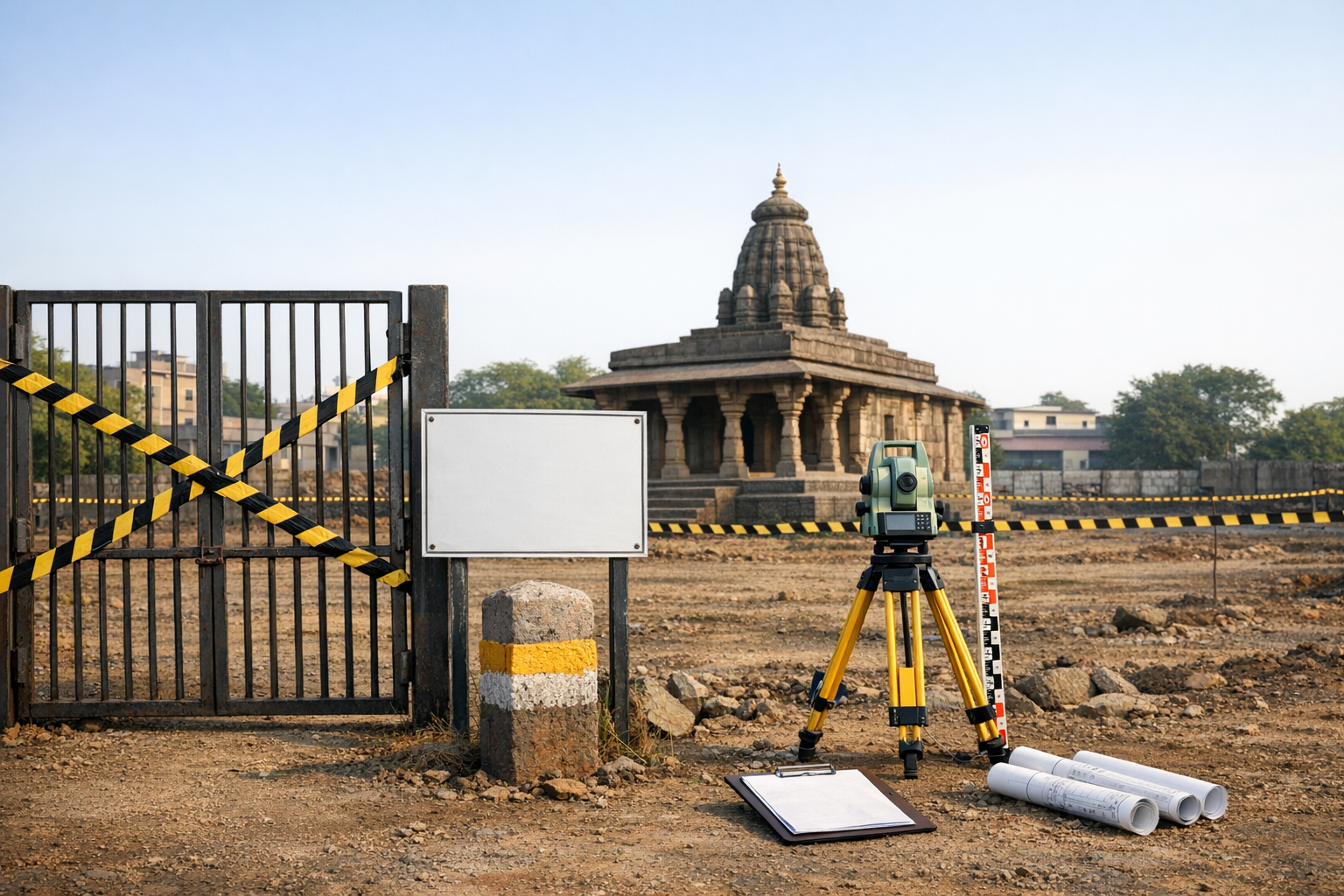
Administrative intervention in Miraj, Maharashtra, has halted ongoing illegal construction on Shri Dnyangiri Swami Maharaj Trust land, and the site has been formally sealed to prevent further activity. Community representatives and devotees have called for the complete removal of the encroachment within 30 days, emphasizing a peaceful, lawful, and transparent process that safeguards both heritage and public order.
The governance framework applicable to religious trust properties in Maharashtra is clear: under Article 26 of the Constitution of India, religious denominations have the right to manage their own affairs in matters of religion, including the administration of property. Operationally, the Bombay Public Trusts Act, 1950 (as applicable in Maharashtra), entrusts oversight of public trust property to the Charity Commissioner, while unauthorized construction is typically addressed through the Maharashtra Regional and Town Planning Act, 1966. Together, these instruments enable authorities to issue stop-work notices, seal sites, and, where warranted, order demolition of unauthorized structures following due process.
In cases of alleged encroachment on public trust land, the standard administrative sequence generally includes: (i) receipt of a complaint or suo motu cognizance; (ii) verification of title and boundaries using land records (such as 7/12 or City Survey/CTS extracts and approved development plans); (iii) joint site inspection and demarcation by revenue and urban planning officials; (iv) issuance of notices and an opportunity for hearing; and (v) a speaking order determining the legality of construction. If found unauthorized, authorities may proceed to remove the structure, with rights of appeal preserved under the relevant statutes.
The significance of this episode extends beyond the immediate dispute. Temple trust lands embody ritual continuity, cultural memory, and community serviceoften supporting annadanam, education, and social welfare. For devotees, boundary stones and title entries are not merely technicalities; they symbolize stewardship of a living heritage. Framing such disputes as questions of heritage preservation and rule of lawrather than as communal contestshelps uphold social harmony and aligns with the shared civilizational ethos of Hinduism, Buddhism, Jainism, and Sikhism.
Civic groups and devotees in Miraj have urged the complete clearing of the site within 30 days. Administratively, such timelines are most effective when synchronized with procedural safeguards: a fresh demarcation if required, documented hearings, and an unambiguous order that cites the legal basis for action. Timely, well-reasoned decisions deter further unauthorized activity and reduce the likelihood of prolonged litigation.
Technically robust land-governance practices can prevent similar disputes. Trusts benefit from regularly updated land records, digitized title documentation, clear boundary demarcation with authenticated pillars, and signage indicating ownership and permitted land use. Coordination with municipal planners to verify development permissions before any activity, periodic GIS or drone-based monitoring (consistent with local regulations), and a public grievance mechanism streamline detection and resolution of infractions.
Inter-agency coordination is decisive. Charity Commissioner offices, the Revenue Department, municipal planning authorities, and local law enforcement should operate on a shared evidence baseharmonizing survey data, approved plans, and court directions where applicable. An even-handed, fact-driven approach ensures that enforcement is firm yet fair, and that all parties are heard within the contours of due process.
Public communication also matters. Using precise legal terminology“unauthorized development,” “encroachment,” and “public trust land”and avoiding incendiary rhetoric lowers social temperature and preserves space for dialogue. Language that privileges legality over identity advances the core constitutional values of equality before law and freedom of religion.
Comparable precedents across Indian cities suggest that orders grounded in authoritative survey records and transparent reasoning are more likely to withstand judicial scrutiny. Early mediationanchored in verified recordscan de-escalate tensions, minimize economic loss from stalled construction, and reinforce the credibility of administrative action.
In the present matter, a constructive way forward over the next 30 days would include: a final, recorded demarcation with participation from stakeholders; publication of a speaking order indicating the exact violations, if any, under the MRTP framework; and a calibrated removal plan if encroachment is confirmed. Conversely, if the structure is found to be compliant, a reasoned closure order should be issued and communicated to all stakeholders to prevent rumor and recrimination.
Ultimately, protection of public trust lands is not a zero-sum proposition. It is about safeguarding dharmic heritage, ensuring civic order, and preserving the rights guaranteed to every community under the Constitution. An outcome in Miraj that is lawful, measured, and transparent will strengthen institutional trust, set a credible precedent for temple protection and heritage preservation, and model the unity and mutual respect that sustain India’s diverse dharmic traditions.
Inspired by this post on Hindu Jagruti Samiti.
