When Bhagavan Sri Krishna withdrew from the visible stage of history, he is not remembered for leaving palaces, armies, or treasure. What endured, according to sacred narrative and regional memory, was more intimate and more powerful: his heart. This living essence, revered in the Odia tradition as the Brahma Padartha, is enshrined within the wooden form of Lord Jagannath at Puri. The Skanda Purana (Purushottama-khanda) anchors this understanding, presenting Purushottama-kshetra as the chosen refuge of the Supreme in Kali Yuga, where compassion and accessibility become the foremost hallmarks of the divine.
The Skanda Purana’s Purushottama-khanda narrates the arc that links Krishna to Jagannath: after Krishna’s departure (as remembered in post-Mahabharata lore), a divinely charged log (daru) drifted to the shores of the eastern sea. King Indradyumna, guided by visions of Nila Madhava and by sages, established the sanctum at Puri. The images of Jagannath, Balabhadra, and Subhadra were fashioned to house the most secret essence, the Brahma Padartha, widely identified in living temple tradition as Krishna’s own heart. As a theological statement, this asserts that the most accessible form of the Supreme in Kali Yuga is not martial sovereignty but compassionate presence.
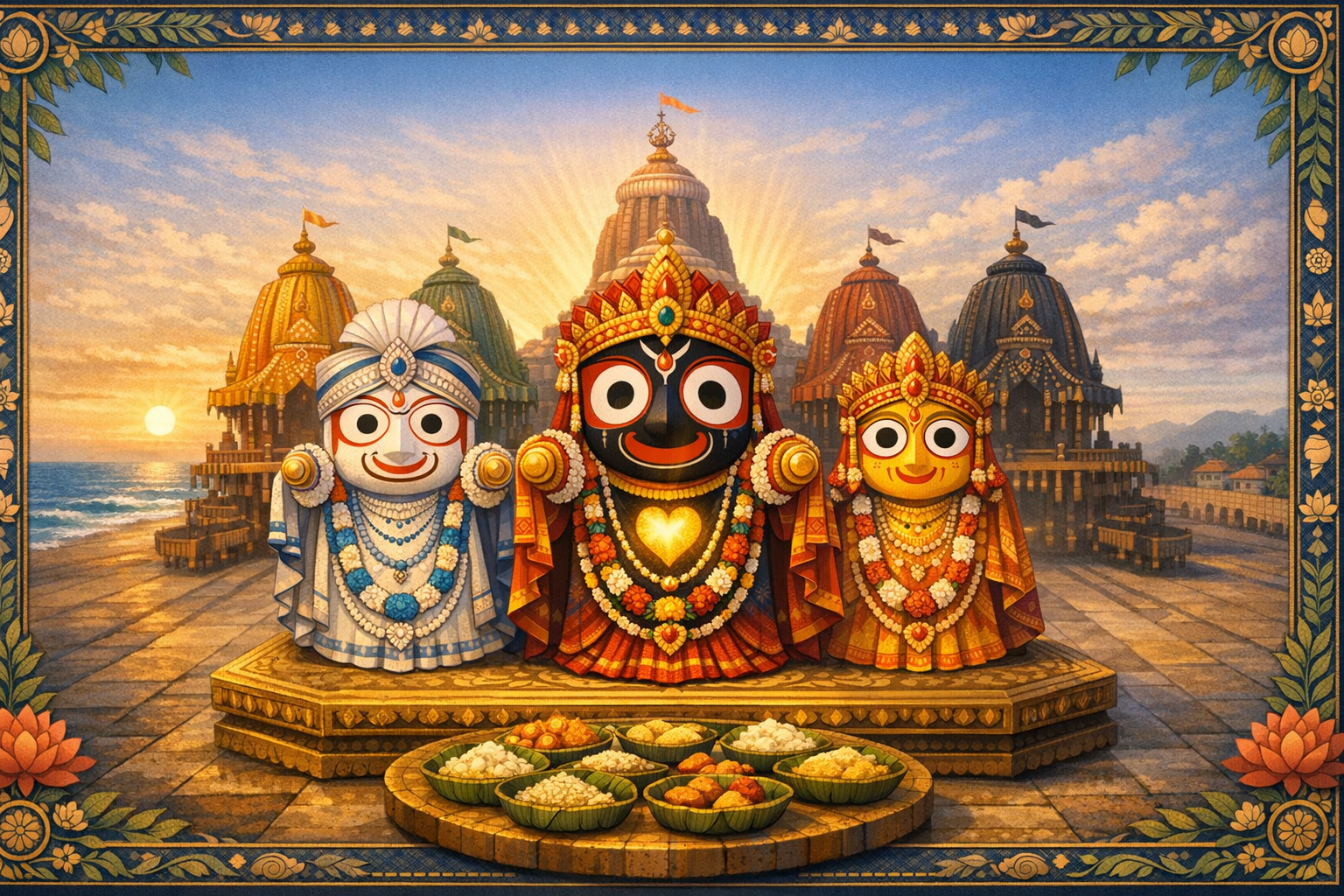
Jagannathliterally “Lord of the Universe”presides on the Ratnavedi alongside Balabhadra and Subhadra. The distinctive, iconic forms with wide, all-seeing eyes and the triadic arrangement signal an inclusive theology: Jagannath is Sarvadevamaya, the indwelling One present for all beings. Within Vaishnava theology, this is Krishna in his universal, public embrace; within broader Hindu Dharma, it is the Supreme whose grace does not discriminate by sect, status, or stage of life.
The inner core, named variously as the Brahma Padartha, Brahma bija, or Daru Brahma, is held to be the ineffable remnant of Krishna’s heartan essence beyond words and form. Temple servitors (Daitapati sevayats), who preserve the hereditary rites, tend this mystery with disciplined anonymity. The language of the tradition is careful: the core is unseen, unexhibited, and transferred only under strict ritual protocols. In this restraint lies a theological precisionwhat is most sacred is not objectified; it is safeguarded as presence.
This safeguarding is most visible during Nabakalebara (“new body”), when the wood-born murtis are ritually renewed in years marked by an Adhika Ashadha (a lunar intercalary month). The Banajaga Yatra, a forest quest led by the Daitapatis, seeks sacred neem trees that bear specific, highly technical signs preserved in oral-ritual canons. After consecration and carving, the Brahma Parivartana (transfer of the Brahma Padartha) is performed at night in solemn secrecy. Devotees describe the atmosphere as saturated with awe; priests move blindfolded and with covered hands, symbolizing that what is essential is known not by sight but by sanctified responsibility.
The ritual year at Puri further encodes the compassion-first theology of Kali Yuga. On Snana Purnima, the deities are ceremonially bathed; during the subsequent Anasara (period of seclusion), they are tended as if convalescingan intimate sign of care for the divine as the divine cares for all. The Netrotsava (“festival of the eyes”) reopens the gaze that meets every pilgrim as equal. Mahaprasad, shared in Anandabazar, dissolves social barriers; partaking together becomes a lived lesson in non-separation.
Ratha Yatra, the grand public procession, dramatizes Jagannath’s movement toward all beings. The three chariotsNandighosha (Jagannath), Taladhwaja (Balabhadra), and Darpadalana (Subhadra)roll along the Bada Danda to Gundicha Temple, where the Lord “visits” the people. The Chhera Pahanra, in which the Gajapati King sweeps the chariots, affirms the primacy of seva over status. Devotees frequently speak of an uncanny nearness during the procession; the divine heart, they say, comes into the street.
In the hermeneutics of Kali Yuga, accessibility is the soteriological key. The Skanda Purana’s Purushottama-khanda pairs this age with Purushottama-kshetra to teach that darshan, nama-sankirtana, and prasada become reliable bridges to the Supreme. The bhakti tradition at Purideepened by the presence and practice of Sri Chaitanya Mahaprabhuelevates rasa (devotional flavor) as the experiential language of truth. Pilgrims often report tears, spontaneous singing, and a sense that “Jagannath sees before one sees,” an affective testimony consistent with bhakti’s psychology of grace.
Historically and culturally, Jagannath integrates multiple streams. The remembrance of Nila Madhava honors the indigenous, adivasi roots of the region’s sacred geography. Scholarly discussions also note resonances with Buddhist karuna (compassion) and Jain anekantavada (the many-sidedness of truth), values that align with Jagannath’s non-exclusivist embrace. Sikh Janamsakhi traditions recount Guru Nanak’s visit to Puri, where communal singing before the Lord modeled the harmony of bhakti, seva, and equality. Each dharmic pathway thus recognizes in Jagannath a mirror of its highest idealscompassion, non-violence, shared truth-seeking, and servicewithout erasing distinct practices.
These convergences are not accidental; they emerge from the temple’s lived commitments. Mahaprasad is for all; the Lord’s title Patitapaban (“savior of those fallen or left out”) makes inclusion a theological principle rather than social afterthought. Even the craft logic of the murtisthe choice of living wood, the periodic renewal of formconveys that divinity in Kali Yuga prefers nearness over distance, tenderness over grandeur, renewal over rigidity.
Understanding the Brahma Padartha as Krishna’s heart clarifies why Puri is frequently called the spiritual “pulse” of Kali Yuga. If the Supreme leaves behind a heart, the proper response is to become heartful: to cultivate hospitality across sampradayas, to honor diverse sadhanas within Hindu Dharma, and to recognize shared ethical ground with Buddhism, Jainism, and Sikhism. The heart in Puri teaches that unity is not uniformity; it is a disciplined willingness to serve and to see the same divinity in different sanctuaries and different songs.
Thus, the legacy of Bhagavan Sri Krishna for this age is not a relic to be guarded but a mercy to be lived. In Jagannath’s city, compassion is structured into ritual, equality is enacted in food, and unity is taught on wheels that carry the Lord to everyone. For many pilgrims, this is why the soul of Kali Yuga is said to beat in Puri: because there, the heart that was left behind still movesquietly, steadily, and for all.
Inspired by this post on Hindu Blog.