
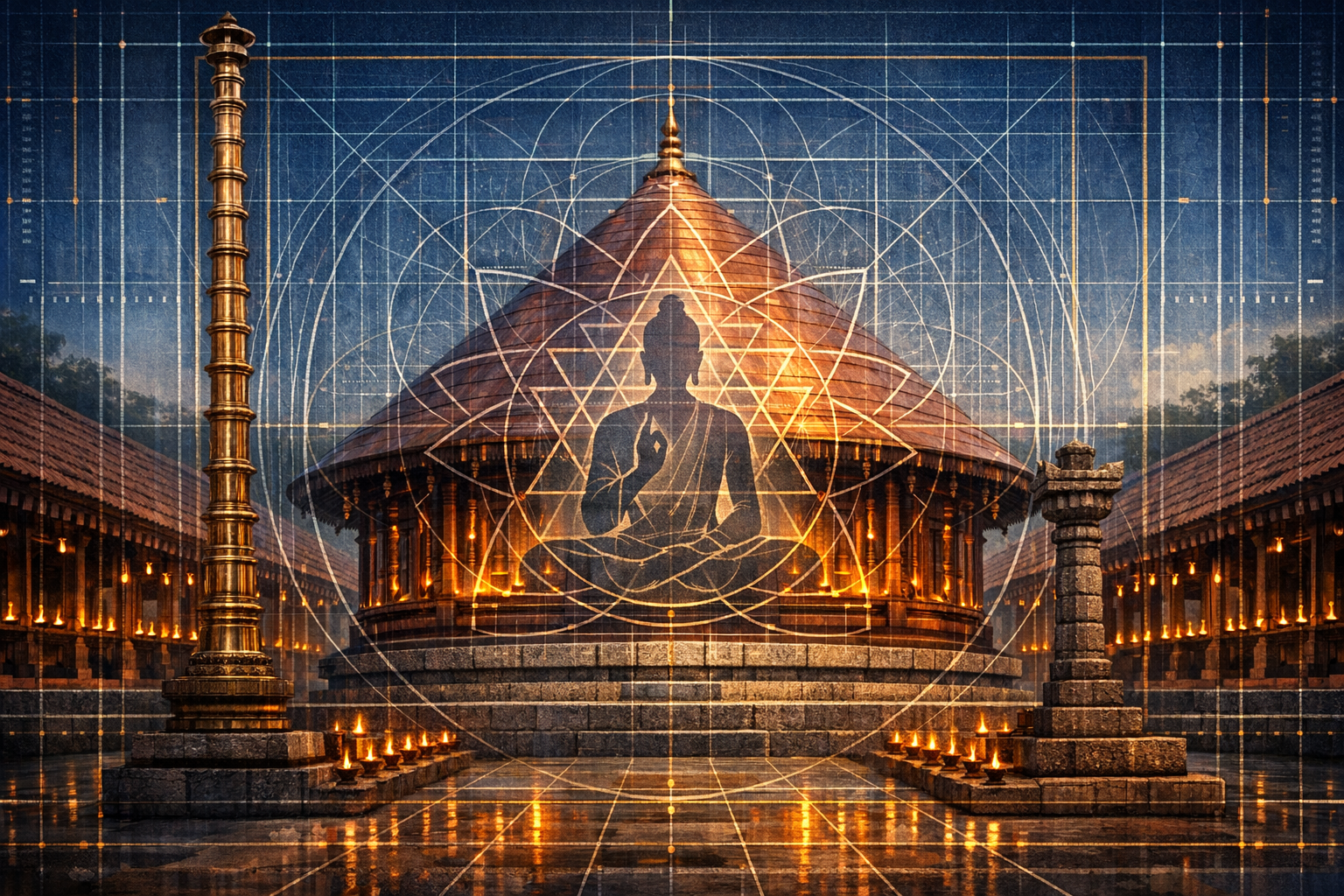
Kerala’s temple sculpture is not merely an art of stone and wood; it is a disciplined science of sacred geometry and a theology of presence. Each curve, gesture, and ornament is governed by textual canons that translate metaphysical vision into visible form. Within this living tradition, tantric literature serves as the bridge between abstract divinity and sculptural embodiment, ensuring that Hindu divine imagery remains simultaneously precise, resonant, and experientially transformative.
Across Kerala’s Hindu temples, the language of form is codified through a confluence of Tantra, Āgama, and Śilpa-śāstra. Texts transmitted in Sanskrit manuscriptsmost notably the Kerala-centered Tantrasamuccayaarticulate how mantra, mandala, and murti interact. These sources calibrate everything from ground plans to iconographic proportions, embedding theological meaning into the very measurements of a deity’s body and the spatial grammar of the shrine.
From vision to form is not a poetic claim but a procedural reality. The tantric foundation of Kerala’s sculptural tradition prescribes the movement from sound (mantra) and diagram (yantra/mandala) to sanctified image (murti). The precision of this movement guarantees that what devotees behold is not an artist’s improvisation but a revealed archetype materialized through disciplined craft.
Sacred geometry underlies the temple at every scale. Site selection, orientation, and layout are mapped to the vastu-puruṣa-maṇḍala, a cosmogram that apportions the ground into a geometric grid of energy seats (padas). Kerala temples align sancta to the cardinal axes and modulate circulation through concentric enclosures, translating cosmology into spatial experience. The result is not simply symmetry, but a geometry of sanctification that conditions how devotees move, see, and feel the presence of the divine.
The inner sanctum (śrīkoṇḍ or śrīkoḷ, often called śrīkoḷam/śrīkoḷvil or śrīkoḷ in regional usage) in Kerala takes distinctive typologiessquare (catura), circular (vṛtta), and apsidal (gajapṛṣṭha). Materials such as laterite, polished granite, teak, and copper sheeted roofs collaborate with geometry to create a climate-adapted sacred envelope. This synergy of Hindu architecture and ritual science shapes light, ventilation, and acoustics, making the space itself a disciplined instrument of worship.
Canonical measures anchor the deity’s body. Proportion systems reference angula (finger breadth), hasta (cubit), and tala (a canon of vertical measure) to classify images into pramāṇa types. These calibrated ratios determine stance, limb lengths, and facial features, ensuring that the deity’s presence communicates precise bhāva (mood) and rasa (aesthetic savor). Such codification distinguishes a meditative Śiva from a protective Viṣṇu, or a benign Lalitā from a fierce Bhadrakālī, not by guesswork but by rule.
Mudra and āyudha (hand gesture and attribute) complete the icon. Abhaya and varada confer fearlessness and boon; śaṅkha and cakra index Viṣṇu’s cosmic order; triśūla and ḍamaru evoke Śiva’s transformative power; and the many-armed iconographies of Devī articulate a spectrum of śakti, from nurturing to protective. Kerala’s sculptors follow mudra-śāstra prescriptions so that the deity’s hands, gaze, and posture cohere with the theological intent expressed in the mantra.
Tantric installation (prāṇa-pratiṣṭhā) reveals how sound and space interlock with form. Through nyāsa, mantras are ritually placed on the murti, mapping seed syllables to limbs and senses; through bhūta-śuddhi, the space is ritually purified; through netronmīlana, the eyes are ritually opened to establish darśana. Such rites do not decorate an imagethey activate it, turning icon into embodiment and temple into a living field of presence.
Yantrasgeometric diagrams inscribed on copper plates or embedded beneath pedestalsare integral to this activation, especially for Śākta and certain Śaiva forms. While details remain restricted to initiated ritual authorities (tantris), texts consistently treat yantras as power-diagrams that harmonize the deity’s energy with the site’s vastu. The geometry below the visible statue thus mirrors and supports the icon above it.
Kerala’s temple typology further integrates chuttambalam (enclosed ambulatory), namaskāra-maṇḍapa (ritual hall), bali-stambha (offering altar), and dhvaja-stambha (sacred flag-mast) into a sequenced procession of meaning. Each element is positioned by rule and purpose, guiding devotees from the outer world to the sanctum’s still point. The journey becomes pedagogy: architecture instructs perception, and geometry tutors devotion.
Artisans and ritual authorities collaborate within this framework. The sthapati (architect-sculptor) executes canonical proportions and ornament grounded in śilpa-śāstra, while the tantri (chief ritual authority)a role distinctive in Keralaensures tantric and āgamika concordance throughout consecration cycles. Between them, craft and liturgy become one discipline aimed at sustaining a deity’s presence over centuries.
Kerala’s sculptural surfaces leverage ornament as theology. Kīrtimukha, yali-vyāla friezes, lotus bands, and pearl strings do more than beautify; they encode cosmological and ethical meanings. In many sancta, a restrained exterior culminates in a concentrically ornamented garbha-gṛha, aligning visual density with metaphysical focusan intentional movement from multiplicity to unity in the devotee’s field of vision.
Certain deities crystallize Kerala’s iconographic specificity. At Sabarimala, Śrī Ayyappa’s yogapattāsanaseated with a yoga-band and hands in contemplative mudraepitomizes tantric stillness embodied in form. At Guruvayur, Kṛṣṇa’s navanīta-cora motif communicates childlike intimacy, while retaining canonical pramāṇa and gesture. In Thrissur’s Vadakkumnathan, the aniconic liṅga focuses worship beyond anthropomorphism, affirming that form and formlessness can be ritually equivalent gateways to the same reality.
Scale and sightlines are equally intentional. Proportioning systems ensure that a deity’s eyes meet the devotee at appropriate vantage points, and that lamplight accentuates key features during dīpārādhana. Kerala’s copper-clad roofs and deep eaves modulate daylight so that the sanctum’s glow becomes palpably otherworldly. Visitors often report that, upon stepping across the threshold, time seems to slowthe intended outcome of architecture calibrated to contemplative experience.
Ritual adornment (ālāṅkāra) extends the icon’s semantic range across the liturgical calendar. Garlands, textiles, weapons, crowns, and seasonal attributes are not decorative excess; they are textually sanctioned states through which the same deity communicates different bhāvas. This dynamic vocabulary sustains a living relationship with the murtidevotees encounter a protector at dawn, a sovereign at noon, and a benign parent at night, each disposition affirming the fullness of divinity.
Foundation and bonding materials, too, follow śāstra. Ashtabandha (a traditional compound) secures the image to its pedestal, and garbha-nyāsa depositsmetals, minerals, and gemssanctify the base with cosmological correspondences. These understructures extend sacred geometry into the unseen, so that the deity’s body stands upon a literal matrix of meaning.
Inscriptions and traditional manuals document the careful sequencing of construction and consecration: site selection, maṇḍala layout, excavation, foundation rites, superstructure raising, image carving, installation, and finally, prāṇa-pratiṣṭhā. Kerala’s adherence to these cycles ensures that a temple is never only built; it is born through layered acts that synchronize matter and mantra. Continuity of practice sustains continuity of presence.
This tantric-architectural grammar does not isolate Kerala from the wider Indic world; it situates Kerala within it. Śaiva, Vaiṣṇava, and Śākta āgamas interface with regional craft lineages to produce a vernacular that is at once local and universal. The broader Dharmic family recognizes these geometries as shared knowledgeBuddhist maṇḍalas, Jain cosmographs, and the proportional canons echoed in Sikh architectural planning all affirm a civilizational consensus: geometry is a language of the sacred that welcomes multiple paths to the same summit.
Kerala’s performing arts further confirm the unity of form and meaning. Kathakali, Koodiyattam, and Mohiniyattam deploy codified mudras and body geometry that mirror sculptural canons. The human body becomes a kinetic murti, and the stage a moving maṇḍala. Such congruence across temple, sculpture, and performance reflects a single pedagogical aim: to make the invisible intelligence of dharma visibly and emotionally knowable.
For contemporary artists, architects, and conservators, these canons offer a robust design method. Vastu grids organize space; pramāṇa calibrates human scale; mudra and āyudha supply semantic clarity; and ālāṅkāra cycles introduce temporal variation without sacrificing identity. Far from constraining creativity, Kerala’s textual matrix channels it, enabling innovation that remains legible to devotees and faithful to tradition.
For pilgrims and casual visitors alike, a few experiential cues open this world. Notice how one moves from sunlit courtyards into progressively dimmer precincts; how lamps orchestrate attention; how fragrance, chant, and bell synchronize with sight at the moment of dīpārādhana. Each sense is geometrically and ritually choreographed. What feels like beauty is in fact a designed ascent from dispersion to concentration.
Academic inquiry benefits by reading images with their texts. The Tantrasamuccaya and allied āgamas articulate why a specific mudra or weapon appears, why a sanctum is circular rather than square, and how ritual establishes the deity’s presence. Cross-referencing sculptures with Sanskrit manuscripts and Kerala’s temple handbooks makes interpretation accountable to the tradition’s own categories rather than to modern projection.
Ethically, such reading nurtures unity rather than competition among Dharmic traditions. When sacred geometry is understood as a shared civilizational grammaracross Hinduism, Buddhism, Jainism, and Sikh heritagedifferences become specializations rather than divisions. The same commitment to proportion, orientation, and symbol yields many valid windows onto a single light.
Kerala’s sculptural canon is thus a disciplined conversation between vision and verification. Geometry verifies theology in space; proportion verifies meaning in form; ritual verifies presence in time. The cumulative result is a temple culture where images do not merely represent the divinethey realize it, for those who see with eyes trained by tradition and hearts attuned to the cadence of mantra.
Understanding this system deepens engagement. Devotees discover why darśana feels different in Kerala; students grasp how śilpa-śāstra and āgama cohere; designers find a time-tested toolkit for sacred architecture; and all who enter the temple precinct learn to read sacred symbols with empathy and precision. In Kerala’s tantric blueprints, sacred geometry is not a mystery to admire from afar but a method to inhabit, one measured step and mindful glance at a time.
Inspired by this post on Hindu Blog.








