Across the living landscape of Hindu temple sculpture, certain details carry an outsized share of meaning. Among them, the feet of GaruḍaVishnu’s mighty vāhanaoffer a compelling key to devotional iconography. Read closely, Garuḍa’s distinctive footwork reveals humility, poised service, protective power over nāgas, and a carefully engineered visual grammar developed by temple architects and image-makers guided by the Śilpa-śāstras. This study follows those clues to unpack why Garuḍa’s feet look the way they do, and how their form, posture, and placement communicate layers of theology, ritual, and aesthetics within Hindu temples.
Garuḍa (also called Suparṇa or Garutman in Vedic and Purāṇic literature) stands as the emblem of speed, fearlessness, and steadfast bhakti. In Hindu art and architecture, he appears as an anthropo-avian beingwinged, beaked, and powerfulyet often adopting humanlike legs and knees in temple sculpture. Whether kneeling in añjali-mudrā before Viṣṇu or expanding into a full-bodied vāhana beneath the deity during processions, his body language is never casual; every line serves narrative, theology, and ritual sightlines. The iconography of the feet is especially telling.
Workshop canons recorded in the Śilpa-śāstra corpus (including texts such as the Mānasāra, Mayamata, Śilparatna, and Viśvakarma-prakāśa) do not merely give measurements; they encode a performance language shared with the Nāṭya-śāstra. Sculptors internalized padabheda (codified foot positions) and the energy of karaṇas to “freeze” dynamic motion in stone and bronze. Consequently, Garuḍa’s feet rarely appear inert. Even when kneeling, they signal readiness: heels lifted, toes gripping the plinth, or talons stylized to suggest imminent flight or protective intervention.
In many Vaiṣṇava shrines, a dedicated Garuḍa figure sits or kneels in the axial line facing the garbhagṛha (sanctum), often at or near the Garuḍa-stambha between the dhvaja-stambha and the bali-pīṭha. Here the feet typically articulate humility and service. The pose frequently pairs folded or semi-folded knees with soles angled to convey weight shifting forwardthe body’s subtle lean translating as unwavering attention to the Lord. Though regional workshops vary, this devotional “readiness” is remarkably consistent across time and geography.
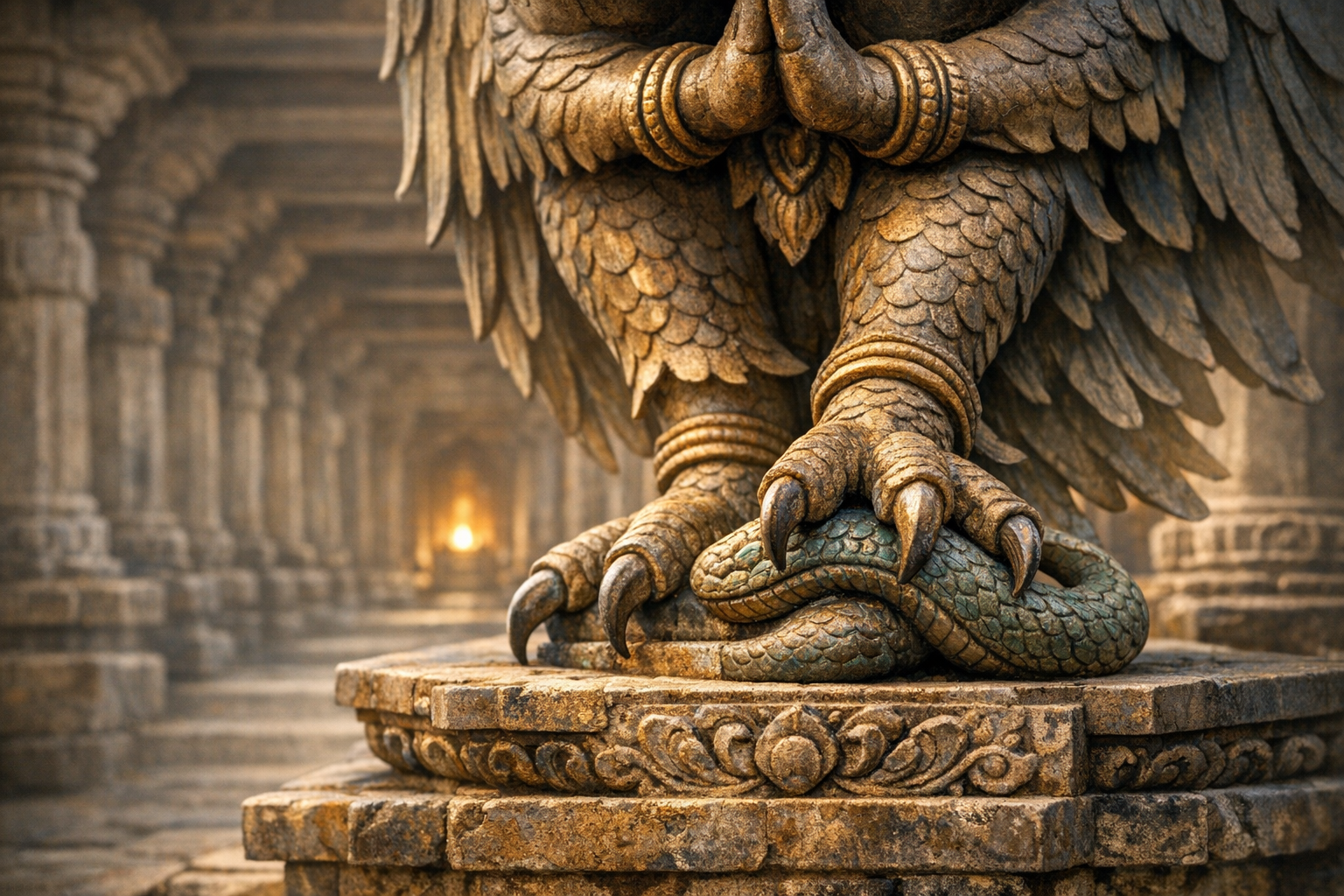
When sculpted as a combatant or protector, Garuḍa’s avian morphology becomes more explicit. Talons are emphasized, the toes splay with avian anisodactyl logic (three forward, one to the rear), and the feet may clamp a coiling nāga. This visual trope, widespread in India and Southeast Asia, literalizes the well-known theological theme: Garuḍa’s conquest of serpents signifies the subjugation of fear, venom, and bondagetheir transformation under Viṣṇu’s aegis into safeguarded cosmic order. The feet, in effect, become instruments of dharma.
Symbolically, Garuḍa’s footwork encodes a threefold message. First, humility: kneeling feet and bent knees perform bhakti, an embodied namaskāra to the deity’s “lotus feet.” Second, vigilance: the poised angle of the soles and toes implies that service is immediate and unhesitating. Third, protection: taloned grip over nāgas evokes śaurya (valor) ordered by compassion, a defense of devotees and of sacred space. Together these cues position Garuḍa not merely as a carrier but as the archetype of ready service grounded in devotion.
Architecturally, the orientation of Garuḍa’s feet along the temple’s ritual axis is deliberate. Temple plans choreograph a devotee’s movement (pradakṣiṇā), sightlines (darśana), and thresholds of sanctity. Placed squarely on this axis, Garuḍa’s feet appear to “root” the horizontal world of pilgrims to the vertical ascent of the sanctum’s superstructure. Feet engage the earthly pedestal (pṛthvī-tattva), while wings and beak gesture skyward (dyu), making Garuḍa a living bridge between realms.
Regional workshops nuance these essentials with distinctive craftsmanship. In Tamil and Karnataka traditions influenced by the Chola, Hoysala, and Vijayanagara ateliers, kneeling Garuḍas before Viṣṇu often display highly refined feet: toes articulated sharply, toenails rendered as tiny crescents, and ankles subtly flexed. The stance is devotional, but the musculature and plantar tension convey coiled energythe art of suggesting motion within stillness.
Odishan (Kalinga) sculpture, with its bold planes and rhythmic carving, commonly heightens avian traits. Claws bite into the stone of narrative friezes where Garuḍa wrests nāgas from watery realms. Pāla–Sena bronzes and stone panels from eastern India similarly dramatize talons and toe spread to heighten narrative tension. In these idioms, the feet read almost like calligraphycompressed signifiers of motion and meaning.
South Indian bronze traditions, especially Chola and post-Chola, translate this language into ritual mobility. Processional bronzes of Viṣṇu on Garuḍa (Garuda-sevā) often show the vāhana’s feet in a forward-driving attitude to stabilize the deity’s movement through crowds. Even here, the grammar holds: toes and arches take on a kinetic slant, communicating that Garuḍa is both bearer and guardian in the flux of festival motion.
Beyond the subcontinent, Angkor’s causeways famously flank temple approaches with nāga balustrades punctuated by Garuḍas whose splayed feet and grasping talons subdue serpent bodies. The same vocabulary appears in Java, Thailand, and other Southeast Asian centers of Hindu-Buddhist art. The cross-regional consistency suggests a robust, traveling visual lexicon: wherever Nāga and Garuḍa appear together, the feet advertise sovereignty over chaos and the restoration of balance.
This shared lexicon also links dharmic traditions. In Buddhist art, the Garuḍa (Tibetan: khyung) stands or flies in similarly assertive foot postures, pinning nāgas or hovering in protective attitudes over sacred beings. The moral is akin to Vaiṣṇava readings: wisdom and compassion pacify venom and fear. Jain art, while generally averse to violent dramaturgy around tīrthaṅkaras, nonetheless adopts humble, service-oriented foot postures for attendant deities and donors; the visual ethic of reverent stance, calm soles, and respectful approach parallels the bhakti semantics seen around Viṣṇu’s Garuḍa.
Sikh memory adds another resonant thread through the baaj (falcon) closely associated with Guru Gobind Singh. While distinct from Garuḍa, the bird-of-prey motif in Sikh tradition similarly encodes fearlessness, dignity, and readiness in righteous service (seva). Read together, these dharmic strands reveal a convergent symbolism: grounded feet and soaring intent unified by moral courage.
From a technical standpoint, the tala-māna (proportional canons) of the Śilpa-śāstras guide scale relationships between principal deities and attendant icons. Even when texts do not prescribe a single, exclusive foot formula for Garuḍa, workshop practice integrates dance-derived padabheda to achieve clarity: sama for dignified stillness, āyata and (by extension from Nāṭya) aleeḍha/pratyaleeḍha to suggest forward drive or countermotion. Sculpted soles, heels, and toe clusters thus become the sculptor’s most economical tools for narrating state of mindcalm devotion, poised action, or assertive protection.
Ritually, devotees frequently meet Garuḍa first, long before the sanctum. Feet angled toward the garbhagṛha encourage the body to align with temple axis; a visitor, almost unconsciously, straightens posture, slows breath, and readies the mind. Many report that the kneeling stancegrounded toes, lifted archesquietly invites reciprocity: still the feet, steady the gaze, and allow devotion to become embodied. In this sense, Garuḍa’s footwork is pedagogical; it teaches how to stand before the sacred.
The combat iconography likewise carries practical lessons. Talons pinning nāgas remind viewers that fear is mastered not by flight but by disciplined grounding. The compositional weight placed through Garuḍa’s feetthe way the claws “bite” the plinthmodels ethical traction in a world of flux. Even in narrative friezes whirling with motion, the feet remain points of moral purchase.
Reading style by footprint can aid dating and regional attribution. Crisp, beak-like toenails and deeply undercut arches may suggest Chola or post-Chola bronzes; tight, graphic claw clusters gripping coiled nāgas align with Kalinga stone reliefs; hefty, diamond-planed toes are comfortable in Hoysala and Vijayanagara idioms. Such diagnostics never replace epigraphy or stylistic comparanda, but they frequently offer the first, reliable hints for field identification in temple surveys and conservation work.
Conservation practice benefits from attending to contact surfaces. The extremities most exposed to touch and weathernoses, fingers, and especially toeserode first. Where Garuḍa’s feet are ritual touchpoints, polish and rounding alter the original padabheda. Recording these wear patterns not only assists in restoration but becomes a valuable archive of lived devotion: the way communities have engaged Garuḍa’s protective presence over centuries.
Ultimately, Garuḍa’s distinctive feet distill a comprehensive theology of service. Firmly placed on earth yet signaling flight, they reconcile two impulses central to dharmic traditions: to be grounded in humility and to rise in courage. Whether in Hindu, Buddhist, Jain, or Sikh resonances, the lesson convergesright stance leads to right action. In temple sculpture, that lesson is not a metaphor alone; it is literally underfoot, articulated in stone and bronze for all who enter to see.
Inspired by this post on Hindu Blog.