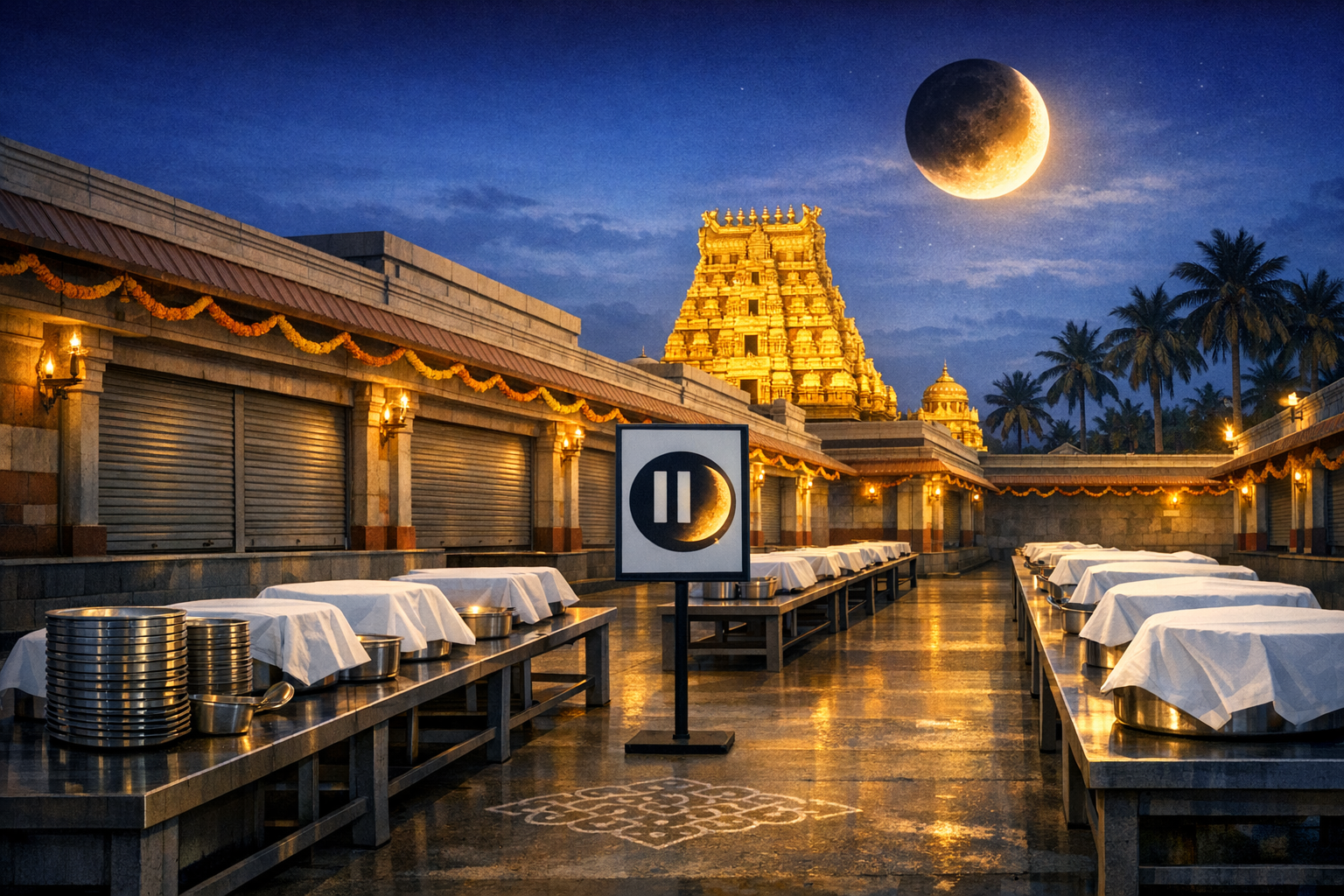
On Tuesday, 3 March 2026, Tirumala Tirupati Devasthanams (TTD) will suspend Annaprasadam services in select facilities at Tirupati and Tiruchanoor in observance of the Chandra Grahan (lunar eclipse). This is a routine, policy-driven pause grounded in established temple protocol for eclipse days and is intended to uphold ritual purity standards prescribed for food preparation and distribution during the Grahan period.
The temporary closure covers the SV Nitya Annaprasadam building at Thollappa Gardens in Tiruchanoor, the employees’ canteen in the TTD Administrative Building at Tirupati, and the canteen at Sri Padmavathi Rest facilities. All TTD-run annadāna counters in these specific locations will remain closed for the Grahan day, with services resuming after the prescribed post-eclipse purification and operational checks.
AnnaprasadamTTD’s free, sattvik meal serviceforms a pivotal part of the pilgrim experience in the Tirupati region, sustaining large numbers of devotees and support staff each day. Within the broader dharmic framework, annadāna is considered a supreme act of charity, and TTD’s Annaprasadam is designed to embody that ethos with care, cleanliness, and dignity. The pause on eclipse days does not diminish this commitment; rather, it reflects a conscientious application of time-bound religious observances.
The operational decision aligns with Dharmaśāstra and Āgama guidance that treat eclipses as periods requiring heightened ritual restraint. Traditional injunctions specify that during Grahan, cooking and the consumption of cooked food are to be avoided. Many temples governed by Vaikhanasa and Pancharatra traditions observe a Sutak (ritual inauspiciousness) window before and during the eclipse. As a general norm, Sutak is reckoned for lunar eclipses prior to first contact, and kitchens, naivedya offerings, and annadāna are paused accordingly. TTD’s policy mirrors these long-standing standards.
Following the eclipse, temple and kitchen areas undergo shuddhi (ritual purification). Procedures typically include Punyahavachanam and related cleansing rites before resuming nitya-kainkaryams (daily services). In kitchen operations, best practice calls for discarding food prepared before Sutak, thoroughly washing utensils and preparation surfaces, replacing stored water, and restarting cooking only after the prescribed purification. This ensures that Annaprasadam distribution restarts under conditions consistent with both hygiene and religious protocol.
From an astronomical standpoint, the 3 March 2026 event is a notable lunar eclipse widely visible across India during the evening-night window. Because the eclipse is observable in the region, the associated Sutak and Grahan procedures are in force, and TTD’s Annaprasadam services in the listed facilities will be suspended for the duration of the observance and the immediate purification period that follows.
For many devotees, a warm meal at an Annaprasadam counter is woven into the rhythm of a pilgrimage day. A brief pause on Chandra Grahan can feel disruptive, especially for families with young children or the elderly. In practice, devotees often plan meals ahead of the Sutak window, observe upavāsa (fasting) or phalāhāra (fruit-and-milk intake) where appropriate, or carry dry, pre-arranged items prepared before Sutak begins. The intent is to respect religious timing while safeguarding personal well-being.
The same eclipse-day sensitivity appears across India’s dharmic traditions. In many Hindu communities, devotees engage in japa, snāna, and dāna around the eclipse, emphasizing inner discipline and compassion. Jain communities are known for diligent fasting and refraining from cooking during Grahan. Several Buddhist sanghas organize collective chanting and meditation focused on karuṇā (compassion) and mettā (loving-kindness). Sikh sadhana centers on simran and seva, with service to humanity remaining paramount at all times. Together, these practices illustrate a shared ethical coreself-restraint, purity, and care for othersthat fosters unity among Hindu, Buddhist, Jain, and Sikh traditions.
Historically, authoritative sources such as Nirnaya Sindhu and Dharmasindhu, along with South Indian temple-paddhatis, have provided procedural clarity on Grahan observances. Vaishnava temples in the South, including those following Vaikhanasa Āgama, maintain a consistent framework: suspend naivedya and food distribution during the eclipse and resume after mandated purification. Contemporary institutions like TTD uphold these guidelines to ensure continuity, integrity, and community trust.
It is important to note that this communication pertains specifically to Annaprasadam facilities in Tirupati and Tiruchanoor. Other TTD services follow their own schedules, and where darshan or sevas intersect with the eclipse window, separate notifications are typically issued by the administration. Devotees are advised to rely on official TTD updates posted locally on notice boards and through standard administrative channels on the day of the event.
In summary, the 3 March 2026 Chandra Grahan prompts a carefully bounded, ritual-observant suspension of Annaprasadam services in designated TTD facilities. The measure safeguards the sanctity of naivedya and annadāna while aligning with long-established Āgama and Dharmaśāstra norms. Operations are slated to resume promptly after post-eclipse purification, reaffirming the centrality of annadāna to the TTD ecosystem and the wider dharmic commitment to nourishing both body and spirit.
Inspired by this post on Hindu Pad.