The bahubandha, a sacred tied armlet, occupies a distinctive place in the vocabulary of Hindu sculptures and Indian art history. Recognized by its flexible, corded construction that binds the upper arm above the elbow, it stands apart from rigid circlets and bangles. In temple sculptures across regions and centuries, this tied ornament serves both as an elegant aesthetic device and a bearer of meaning—articulating power, grace, protection, and auspiciousness in the iconographic tradition.
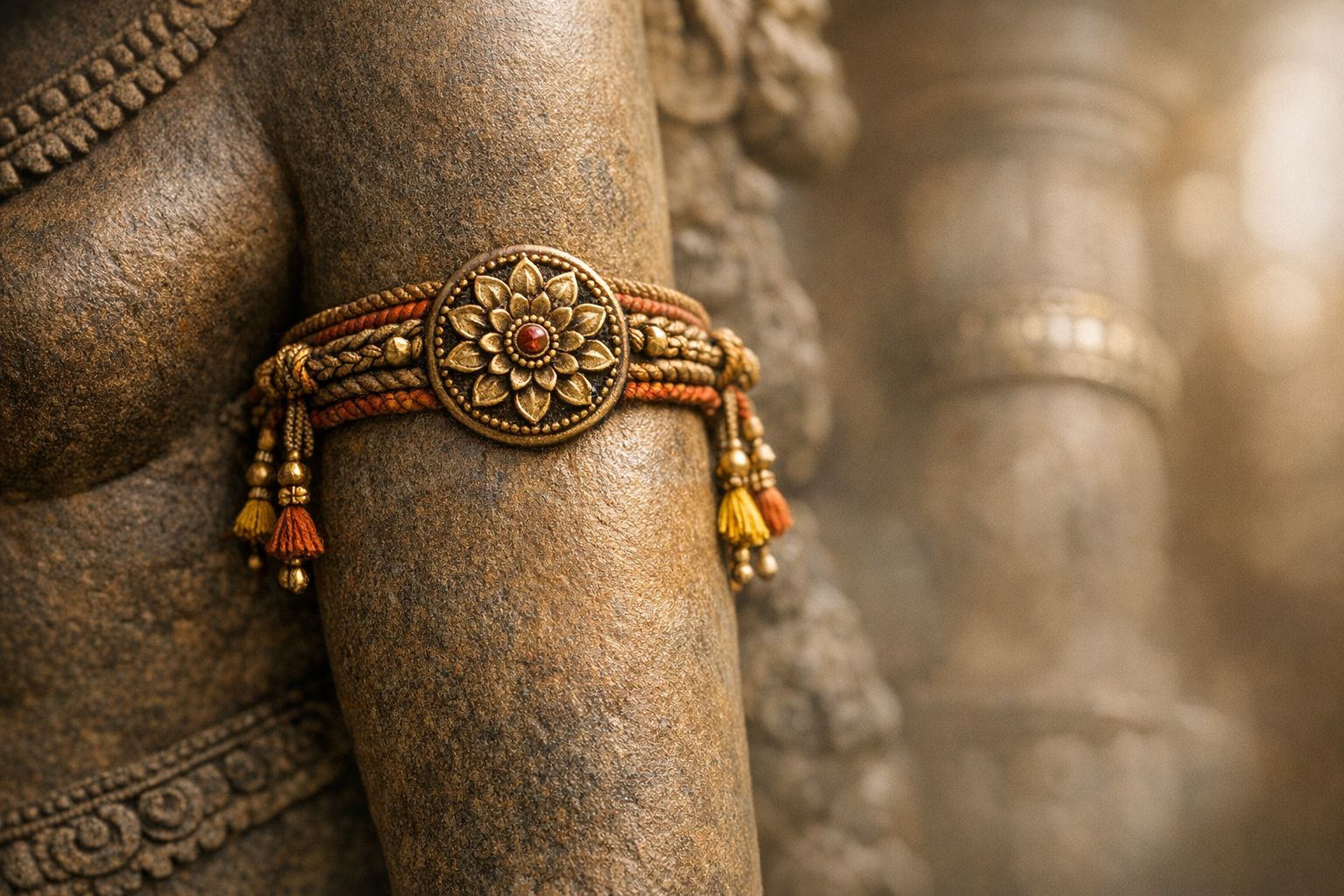
Within the iconographic taxonomy of ornaments, the bahubandha contrasts with rigid armlets such as the bahuvalaya or keyura and differs from bracelets and wrist ornaments like valaya and kankana. The bahubandha’s defining feature is its system of bands and bindings—often layered or braided—that are cinched and secured on the upper arm. In sculptural representation, this “tied” character is indicated through cords, knots, small pendants or rosettes, and sometimes a central medallion resting against the biceps.
Classical treatises on aesthetics and sculpture (silpa-sastra) enumerate arm ornaments for deities and royal figures, including keyura, angada, valaya, and bhujabandha (closely related to bahubandha). While terminology can vary by period and region, the tied armlet appears consistently in the broader canon of aharya (costume and ornamentation) that informs Hindu temple art. These textual frameworks establish where arm ornaments sit on the body, which deities wear them, and the principles of proportion and design that sculptors and metalworkers are expected to observe.
Constructionally, the bahubandha is conceived as a flexible structure: twisted cords, textile bands, braided threads, or fine chains are drawn around the arm, knotted or fastened with toggles, and sometimes weighted with a central rosette or lotus-shaped plaque. Materials historically include silk cords, cotton, thin metallic chains, and precious metals such as gold and silver. When metal is used in a tied idiom, artists emulate the softness of textiles by carving or casting bead-like strings, rope motifs, and tassels to preserve the visual language of binding.
Several morphological types appear in Hindu sculptures: a double- or triple-cord configuration with a central medallion; woven or beaded cords terminating in tassel-like ends; corded bands punctuated by small floral rosettes; and hybrid versions where a thin rigid plaque is visually “tied” by incised cords. In each, the armlet’s flexible identity is emphasized—the viewer perceives the sensation of a band cinched to living flesh, which animates the sculpture’s bodily realism.
Compared to bahuvalaya and keyura—both typically rigid rings or circlets—the bahubandha introduces visual softness and kinetic suggestion. Rigid armlets state rank and stability through unbroken circular lines and polished planes; tied armlets, by contrast, communicate tactility and immediacy through strands, knots, and pendants. Sculptors exploit these contrasts to balance a deity’s majesty (rigid ornaments) with vivifying detail (tied ornaments), achieving both iconographic correctness and optical vitality.
Regionally and chronologically, the bahubandha is well attested. Gupta and early medieval sculptures favor elegantly restrained tied bands with rosette-like plaques. Chola bronzes in Tamil Nadu—such as depictions of Shiva Nataraja and various devis—often render slender corded armlets with delicately modeled knots, achieved through masterful lost-wax casting. Hoysala stone sculpture in Karnataka delights in multiplying beaded cords and minute tassels, demonstrating maximal surface elaboration. Odisha temples (for example, at Bhubaneswar and Konark) display tied armlets with lotus rosettes and bead strings, while Central Indian ensembles, including Khajuraho, juxtapose rigid and tied types to orchestrate rhythmic patterning along the limbs.
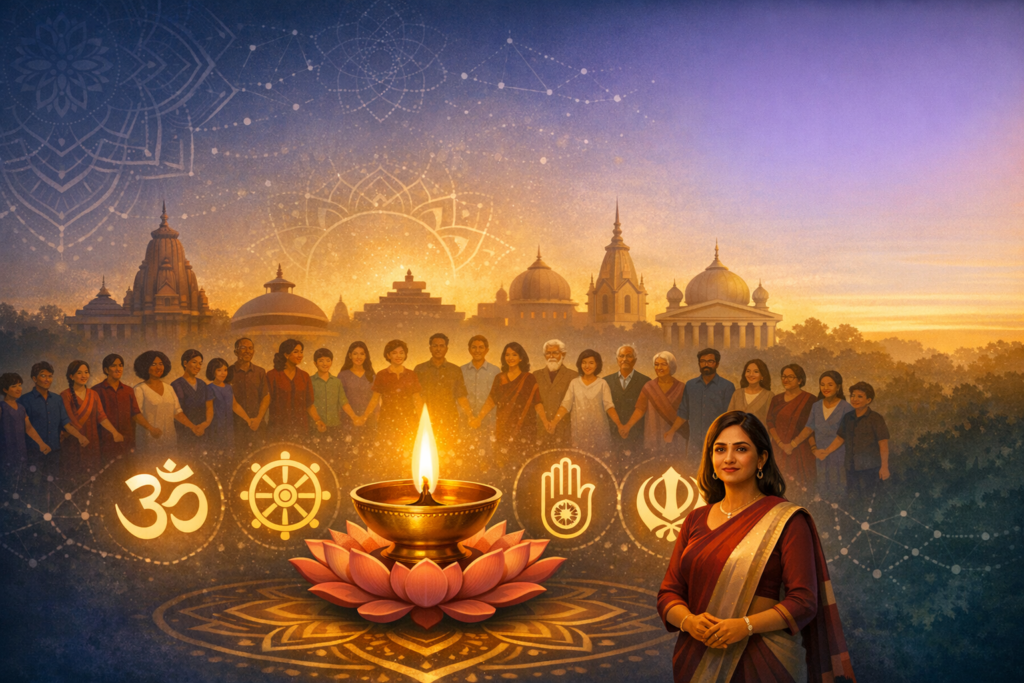
A cross-dharmic lens reveals a wider South Asian aesthetic conversation. In Buddhist art, bodhisattvas such as Avalokiteshvara and Maitreya are adorned with princely ornaments that frequently include tied upper-arm bands, especially in murals and stucco or bronze images. In Jain traditions, Tirthankaras are typically unadorned to express renunciation, yet attendant yakshas, yakshis, and courtly devotees often wear armlets, including tied variants. Historical courtly and warrior cultures across the subcontinent—including Rajput and other kshatra lineages—also prized the bajuband (vernacular of bahubandha), sustaining continuity between sculptural representation and lived adornment. This shared ornament vocabulary across Hinduism, Buddhism, and Jainism underscores a civilizational unity grounded in beauty, virtue, and dharmic ideals, while acknowledging differences in theological emphasis.
Iconographic prescriptions determine which deities wear armlets and in what combinations. Vishnu, Shiva, and Skanda commonly bear upper-arm ornaments, with variations correlating to martial, regal, or ascetic manifestations. Devi icons, ranging from benign goddess forms to martial Mahishasuramardini, often display symmetrical bahubandha complementing necklaces (hara), waistbands (mekhala), and anklets (nupura). The overall ornament set communicates mood (rasa), role (such as protector or benefactor), and cosmic status; the tied armlet contributes a distinct note of immediacy and embodied strength.
Symbolically, the bahubandha encircles the seat of bahu-bala (arm strength), evoking valour (kshatra), protection, and auspicious restraint. As a binding, it recalls protective cords (raksha-sutra) and talismanic kavacha—objects whose sanctity is carried on the body. The act of tying itself is meaningful: the transformation of loose strands into an ordered band connotes discipline channeling raw energy into dharmic action. In temple sculpture, this symbolism complements weapons, attributes, and hand gestures (mudras) to articulate a deity’s protective presence and benevolent power.
Reading the bahubandha in stone and bronze rewards close looking. Flexible bands are signaled by incised rope textures, beaded strings, fine tassels, and a slight, believable compression against the arm. Rigid armlets, in contrast, present clean circular outlines and planar rims. A small central plaque—often a lotus, kirtimukha, or rosette—may stabilize the cords visually while drawing the eye to the biceps. By distributing such accents along the limbs, artists create a cadence of highlights that guides devotional attention and accentuates bodily grace.
In performance traditions, the tied armlet has a living legacy. Dancers in Bharatanatyam, Odissi, Kuchipudi, Kathakali, and Yakshagana frequently adopt bajuband to echo classical iconography (aharya), translating sculptural ideals into moving form. The tactile presence of a tied band enhances the silhouette of adavus (basic steps) and mudras, allowing performers and audiences to sense an unbroken lineage from temple sculpture to stage.
As a craft object, the bahubandha showcases the ingenuity of goldsmiths and casters. Metal versions employ lost-wax casting to achieve supple strands, followed by chasing and engraving to pick out beading and twist. Textile exemplars exhibit braiding, knotting, and tassel-making techniques akin to cordage and sash manufacture. Where central medallions appear, repoussé and filigree articulate lotus petals, makara scrolls, or geometric rosettes, all scaled to the curvature of the upper arm.
Modern communities maintain the bajuband as festive and bridal jewelry, particularly in North and Western India, keeping alive the aesthetic associations visible in medieval sculpture. Contemporary designers often blend metal plaques with fabric or corded ties, implicitly honoring the historical principle that a bahubandha is not merely an arm ring but a sacred binding—flexible, cinched, and purposeful.
Conservation and documentation of bahubandha in museum collections and temple sites benefit from macro photography and 3D scanning, which can reveal worn tassel ends, cord textures, and knot forms otherwise lost to time. Understanding these subtle features aids in dating, regional attribution, and workshop identification, and it helps curators narrate the continuity between sacred use, artistic technique, and cultural meaning within India’s Cultural Heritage.
Visitors frequently remark on the quiet intimacy of the bahubandha: amid the grandeur of crowns and necklaces, a simple tied band evokes nearness, almost a tactile memory of thread on skin. Devotees and connoisseurs alike sense how such details humanize the divine, bridging transcendence and presence. That shared, felt response—across Hindu, Buddhist, and Jain contexts—cements the ornament’s cultural unity even as each tradition expresses it in ways true to its vision of the sacred.
A practical, field-friendly cue for identification is to look for signs of “tie logic”: cords that seem to originate, cross or overlap, and terminate in a knot or tassel; a central rosette that looks “pinned” by tension rather than enclosed by a rigid hoop; and a subtle impression on the modeled flesh. When these cues converge, the sculpture is likely showing a bahubandha rather than a rigid keyura or bahuvalaya.
In sum, the bahubandha is more than an accessory in Hindu temple sculpture: it is a structural and symbolic device that binds aesthetics to meaning. By conveying power with restraint, protection with grace, and flexibility with order, the sacred tied armlet unifies an art-historical spectrum that extends into Buddhist bodhisattva imagery, Jain attendant figures, and living performance and jewelry traditions. Its enduring presence across time and traditions attests to a shared civilizational language of beauty and dharma.
Inspired by this post on Hindu Blog.