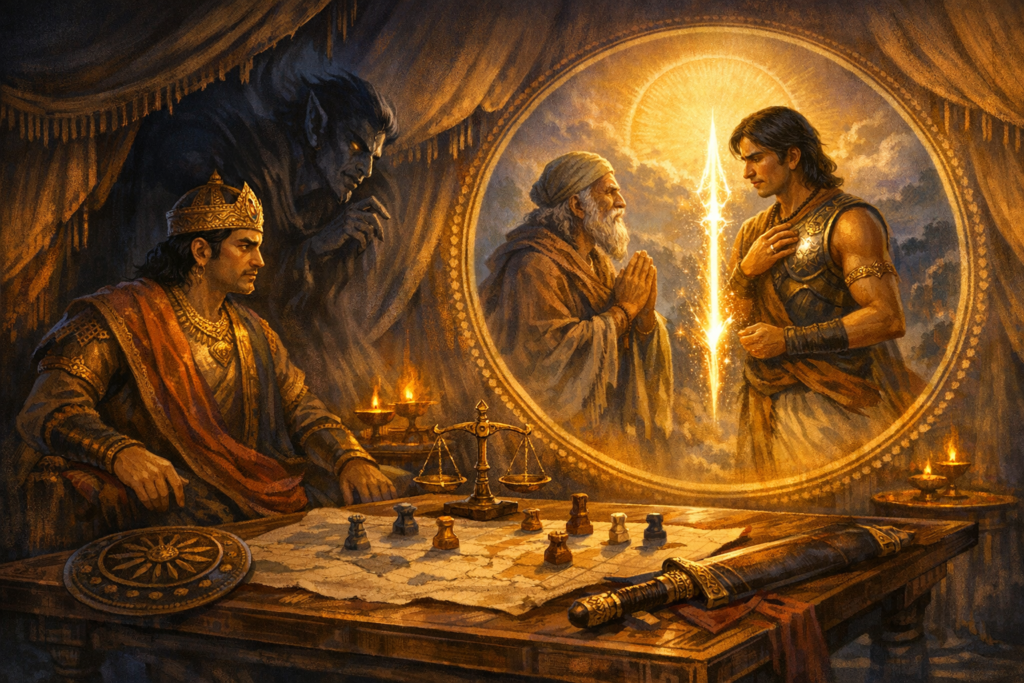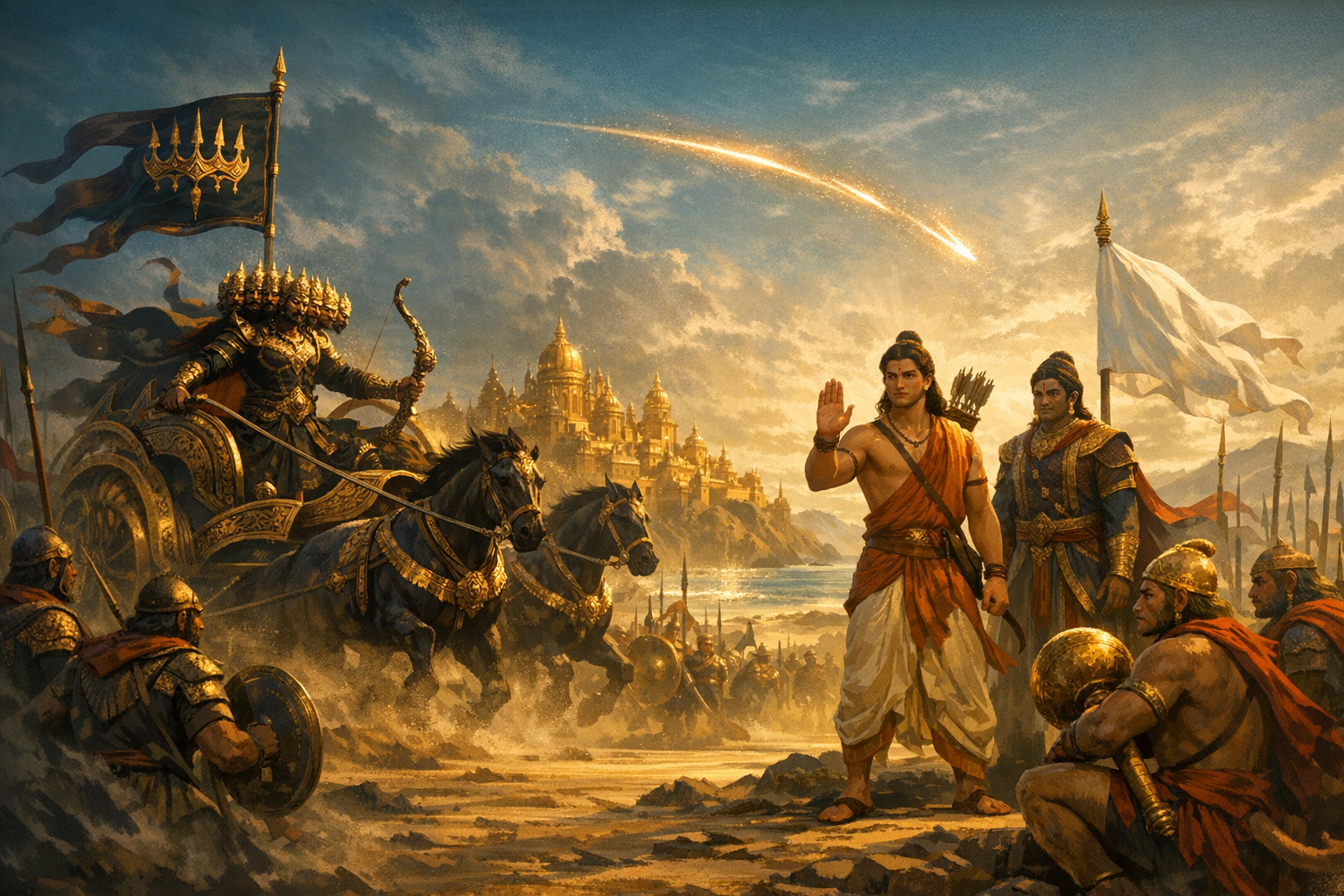
The third day of the Ramayana war marks a decisive inflection point in Lanka’s strategy. Rather than pressing a direct assault against Rama or the vanara commanders, Ravana reoriented the campaign toward a singular objective: the elimination of Vibhishana, his own brother and a recent defector to Rama’s camp. This shift, catalyzed by severe battlefield losses—including the death of the seasoned commander Prahasta—was tactical in its logic yet deeply personal in its motive. It combined counterintelligence instinct with wounded kingship, revealing how a ruler’s inner anxieties can recast an entire theatre of war.
Textual witnesses to the Yuddha Kanda broadly agree that Prahasta’s fall destabilized Lanka’s battle order and spurred Ravana to assume direct command early in the siege. Day-by-day enumerations vary across recensions and regional retellings; however, a recurrent motif is Ravana’s turn from conventional targets toward the “internal threat” represented by Vibhishana. In several later narrations, this shift is framed as an explicit royal vow to slay the defector; in the Valmiki tradition, the logic of such a vendetta is implied by the dramatic stakes Vibhishana’s defection created—moral, strategic, and psychological.
Vibhishana’s decision to leave Lanka before the war fully escalated is inseparable from this episode. Earlier counsel urging Ravana to return Sita and avert catastrophe—preserved in the tradition sometimes referenced as “Vibhishana Gita counsel to Ravana”—had been rebuffed. When conscience and dharma compelled Vibhishana to seek śaraṇāgati (refuge) under Rama, the balance of the conflict changed. The defection supplied Rama’s coalition with timely intelligence about Lanka’s defenses and commanders while also signaling—within both camps—that dharma (righteous order) stood apart from clan loyalty and royal fear.
Against this backdrop, Prahasta’s death was more than a tactical loss. It eroded the confidence of an army accustomed to winning by shock, sorcery, and speed. For Ravana, who already perceived Vibhishana’s departure as an unforgivable breach, that loss suggested a dangerous synergy: insider knowledge now aided the enemy’s field decisions, and Lanka’s veterans were no longer invincible. In such conditions, removing Vibhishana appeared to him a way to cauterize internal doubt and reassert dominance.
From a strategic studies perspective, Ravana’s fixation can be read through the lens of “center of gravity” analysis. The center of gravity need not be the most visible battlefield champion; it can be a node whose removal cascades into confusion, moral collapse, or disrupted decision loops. By that reasoning, eliminating Vibhishana promised three dividends: depriving Rama’s side of insider intelligence, restoring Lanka’s shaken morale, and warning potential dissenters that defection carried a lethal price. The move was ruthless, but intelligible as wartime calculus.
Yet an equally important layer was psychological. Epic warfare often dramatizes the interiority of leadership under duress. Ravana’s reputation, bound to the grandeur of Lanka and to the aura of invincibility, had already suffered a wound in council when he rejected dharmic counsel. The battlefield defeat of Prahasta pierced another layer of confidence. In this climate, the hunt for Vibhishana became not only a strategic act but also a ritual of reassertion—a king’s attempt to purge the symbol of his own fallibility.
Accounts of the early engagements following Prahasta’s fall show Ravana personally entering combat and clashing with leading adversaries. In many Valmiki-aligned tellings, Rama cuts down Ravana’s bow and flag and forces a retreat, a humiliating scene that magnifies the urgency of a different line of attack. Several retellings then emphasize detachments tasked with locating Vibhishana’s standard amid the vanara ranks, indicating that the defector had risen from moral irritant to operational priority.
Across the epic’s narrative ecology, the pursuit unfolds with the distinctive textures of Ramayana warfare: rapid chariot maneuvers, aerial arcs, deceptive formations, and the interplay of astra (divine missiles) with śastra (conventional arms). Rakshasa units, adept at ambush and nighttime strikes, probe the vanara lines for the familiar crest associated with Vibhishana. Hanuman and other vanara commanders repeatedly interpose massed strength and mobile screens to break these hunts, illustrating how the coalition adapted to protect a high-value target whose worth lay in counsel as much as in combat.
Vibhishana’s battlefield role was not primarily that of a frontline slayer but of a strategist-ally. He optimized vanara deployments against Lanka’s defensive habits, identified rakshasa vulnerabilities, and decoded many stratagems based on illusion and feints. Read this way, the “hunt for Vibhishana” is the military corollary of an ethical drama activated days earlier: the very person who advocated the just resolution in council had become the pivot of just conduct in war.
Rama’s response clarifies the dharmic stakes. The moment Vibhishana sought refuge, Rama articulated a principle foundational to the epic’s moral architecture: the absolute duty to protect one who surrenders seeking righteousness. This śaraṇāgati-dharma reframed risk assessment. Protecting Vibhishana was not negotiable. It was a test of what “dharma-yuddha” (righteous war) actually means when the pressures of victory tempt expedient compromises. In the coalition’s daily conduct—guard rotations, counter-ambush patterns, and prioritization of escorts—this principle became policy.
Technically, the early Lanka battles illustrate how intelligence parity or superiority frequently outperforms raw might. Vibhishana’s briefings about commanders (Prahasta’s methods, Indrajit’s artistry with astra, and Kumbhakarna’s scale of force) were the intangible that translated into tangible advantage. Conversely, Ravana’s vendetta attempted to neutralize that intangible. The targeting logic thus foreshadows modern doctrines: disable the enemy’s decision-making aids, disorient their counsel, and the frontline will crack on its own.
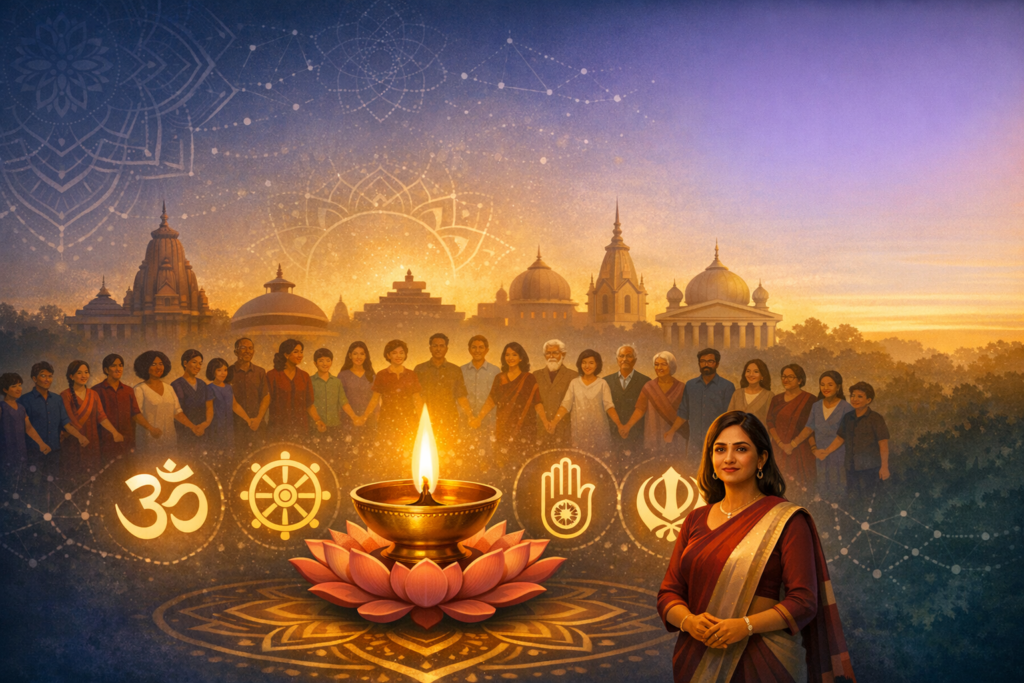
This episode also illuminates a layered ethic recognizable across dharmic traditions. In Hindu thought, Vibhishana stands as the archetype of conscience elevated above kinship when kinship strays from dharma. Buddhist teachings such as “na hi verena verāni” (hatred is never appeased by hatred) frame the futility of Ravana’s rage as a means to lasting order. Jain emphasis on satya (truth) and ahiṃsā (non-violence) underscores the primacy of truthful counsel before conflict and restraint even within conflict. Sikh reflections on dharam yudh highlight that righteous struggle is defined by its ethical compass, not merely by its outcome. Read together, these perspectives converge on a unifying insight: lasting strength flows from integrity, not intimidation.
For readers tracking the chronology, a caution is necessary: “day three” functions as a didactic marker rather than a universal timestamp. The Valmiki Ramayana and regional epics (e.g., Kamba’s Ramavataram, Tulsidas’s Ramcharitmanas) distribute events with different emphases and sequencing. What remains consistent is the narrative logic: early in the siege, once Prahasta falls and Ravana enters the fray, the obsession with Vibhishana emerges as a recognizable throughline. It is an interpretive anchor, not a rigid calendar entry.
The code of war that the Ramayana projects—restraining fury, honoring refuge, punishing only with proportionality—makes Ravana’s hunt ethically revealing. Targeting Vibhishana was not an illegitimate strike on a noncombatant; the defector fought on the battlefield. The ethical breach lies earlier: in the king’s refusal to heed just counsel when it could have prevented the conflagration. War magnifies prior moral errors. The hunt becomes a post hoc attempt to silence the voice that foretold those errors, a gesture the epic frames as tragically self-defeating.
Leadership analysis brings further clarity. Great commanders convert setbacks into learning; failing commanders convert them into vendettas. By chasing a symbol—Vibhishana—the king neglected the operational logic that symbols only channel. The result is predictable: Rama’s coalition tightened protective rings, Vibhishana’s advisory value actually increased under threat, and the hunt expended elite rakshasa effort against a target shielded by both doctrine and design.
There is a poignant social angle as well. Many families encounter moments when ethical conviction strains bonds of affection and obligation. Vibhishana’s arc gives that experience an epic form: the pain of separation from one’s own, the loneliness of principled dissent, and the resilience required to persist. Readers often recognize here an abiding Ramayana theme—dharma is not a banner for triumphalism, but a discipline sustained through loss, patience, and service.
Culturally, the episode has had long afterlives. In temple discourse, classical dance, and vernacular retellings, Vibhishana is remembered not as a destroyer of home but as a keeper of dharma when home departed from it. This memory fosters unity across communities that value moral courage: to stand for truth without hatred, to disagree without dehumanization, and to heal without forgetting. The Ramayana’s reach—across Hindu, Buddhist, Jain, and Sikh reflections—rests on this shared ethical grammar.
Technically minded readers may also note how the coalition safeguarded Vibhishana through layered measures: rotating escorts by high-mobility vanaras, intelligence masking to confuse rakshasa scouts, and judicious use of counter-astra fields that suppressed aerial pursuit. These practicalities animate the text’s narrative: devotion is not passive; it is organizational excellence informed by principle. In that union of ethics and method lies the coalition’s durability.
Ultimately, the “hunt for Vibhishana” is best understood as an ethical mirror held up to power. Ravana’s military acumen was formidable, yet it was compromised by a refusal to integrate just counsel. Vibhishana’s courage was not only in crossing the lines of Lanka, but in bearing the weight of that choice when war made him a marked man. The Ramayana proposes a simple, searching question to any age: when fear and fury tighten their grip, will leaders protect the voice of conscience—or pursue it?
Thus, day three becomes emblematic: a lesson in dharma-yuddha, a case study in strategy versus vendetta, and a shared inheritance for dharmic traditions that prize truth above tribe. In illuminating why Ravana hunted Vibhishana, the epic reminds that real sovereignty begins within—where dharma makes courage possible, and where courage makes unity endurable.
Inspired by this post on Hindu Blog.