Angada Abharanathe sacred armletoccupies a distinguished place in Hindu iconography and temple sculpture, where ornament is never merely decorative but charged with meaning. Positioned on the upper arm at the bahu desha, this armlet is a key visual marker in the portrayal of divinity, heroism, and auspicious sovereignty. In sculptural programs across the subcontinent, the angada abharana is carefully differentiated from other ornaments, including the wrist-worn keyura, to guide both devotional recognition and scholarly attribution. While terminology varies by region and text, the function of the angada as a sign of spiritual protection, auspicious power, and royal dignity remains consistent.
Classical shilpa literatureoften grouped under the Shilpa Shastras and allied iconographic compendiacatalogs a rich array of ritual adornments (abharaṇa) for deities and heroic figures. Within this broad system, the angada abharana signifies an upper-arm ornament aligned with strength, vow-keeping, and divine protection, whereas the keyura, in the present usage, is identified at the wrist. Textual traditions such as the Vishnudharmottara Purana and regional Agamas indicate that such ornaments convey rank, role, and rasa (aesthetic mood) in images, ensuring that viewers can distinguish a yogic ascetic from a triumphant deity, a bodhisattva from a royal donor, or a goddess in battle from one in benign grace.
Formally, the angada abharana presents multiple typologies that can be read with precision by students of Hindu sculptures and temple art. Common types include the banded angada with bead rows, the chevron or V-shaped vanki favored in many South Indian bronzes and stone icons, the serpentine sarpa-angada evoking nāga guardianship, and the floral patrika-angada with leaf finials. Terminal motifs often feature makara heads facing one another, kirtimukha masks radiating protective ferocity, yali scrolls, or stylized lotus medallions. These iconographic cues not only date and localize a sculpture but also articulate narrative and theological resonances.
Craft techniques mirror the status of the piece. In metal imagesespecially South Indian bronzes in panchaloha (a five-metal ritual alloy)angada details are modeled in the lost-wax process, then refined by chasing and incision. In stone sculpture, carvers create high-relief bands, beadwork, and clasp terminals with crisp undercutting that captures the play of light. In painted murals and manuscript illuminations, jewel-like rendering imitates granulation and filigree. Across media, the armlet’s carefully balanced width, curvature, and terminal geometry reflect canonical proportions that harmonize with the bāhu (upper arm) and shoulder mass.
Material signification deepens the reading. Gold or gilt surfaces suggest royal-solar radiance and prosperity; silver intimates lunar serenity; copper-alloy warmth conveys vitality and martial readiness. Although gemstones are materially absent on most stone and bronze icons, sculptors often imitate settings to signal auspicious qualitiesruby for energy, emerald for fertility, sapphire for disciplinetranslating the language of jewelry into the semiotics of sculpture.
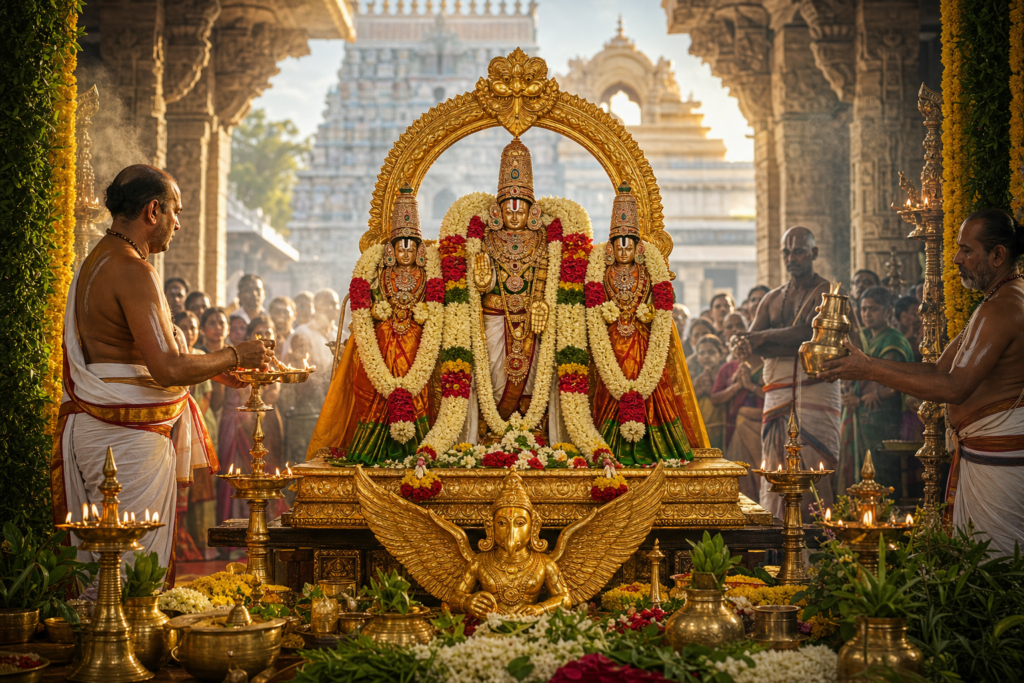
In Vaishnava iconography, Vishnu and his avatars frequently wear angada abharana to declare kshatra (protective sovereignty) tempered by dharma. Rama and Krishna are portrayed with upper-arm ornaments in narrative friezes, underscoring heroic virtue and divine grace. In Shaiva art, angada appear variably: the ascetic Shiva may be minimally adorned, while Nataraja and Bhairava radiate kingly and cosmic energies with pronounced armlets. Shakta images of Durga and other Mahadevis emphasize the armlet’s martial promisean auspicious binding of intent at the seat of strength to vanquish adharma.
Buddhist Mahayana art extends this language through elaborately adorned bodhisattvasAvalokiteshvara, Maitreya, and Manjushriwhose armlets communicate compassion joined with regal responsibility. Jain sculptural programs typically present the Jinas without ornaments to foreground spiritual renunciation; however, Yakshas and Yakshis within Jain traditions, as well as attendant deities, commonly wear armlets that align with the broader subcontinental aesthetic vocabulary. In Sikh historical art and regal portraiture, the martial bazuband (armlet) similarly channels protection and valor. Together, these cross-dharmic visual continuities showcase a shared Indic commitment to ethical power anchored in compassion and restraint.
Symbolically, the upper arm is the fulcrum of directed action, and the angada abharana proclaims both capacity and consecration. As a visual mantra, the armlet encircles the locus of effortyoked to the heart’s resolveso that strength serves dharma rather than mere force. Many viewers, even without formal training, intuit this gestalt: before a bronze Nataraja or a standing Vishnu, the eye travels from the serene face to the powerful arms where angada bind cosmic will to compassionate enactment. The ornament thus mediates between intention and deed, transforming adornment into ethical architecture.
Regional styles sharpen attribution. In early Mathura and Gupta sculpture, armlets tend toward rhythmic, bead-strand bands that complement soft modeling and gentle tribhanga postures. Gandharan bodhisattva armlets show classical inspirationscabochon-like settings and scrollworktranslated into a Buddhist devotional idiom. In Pala-Sena Bengal and Bihar, bodhisattva and goddess images often exhibit lush, continuous bands with lotus medallions, while Odisha’s Kalinga idiom (e.g., Konark and Bhubaneswar temples) favors emphatic terminals and crisp foliated scrolls.
In the Deccan and South, regional signatures are unmistakable. Chalukya and Hoysala soapstone carving produces lace-like armlet borders with deep undercuts. Kakatiya and later Vijayanagara art favors pronounced vanki profiles punctuated by makara or yali finials, especially in dynamic goddess and royal donor figures. Chola bronzes, among the most celebrated, temper fluid anatomy with perfectly scaled angada: the V-shaped vanki on Nataraja’s lithe arms or Parvati’s supple silhouette imparts majesty without disrupting movementan exquisite balance that has become a hallmark of South Indian sacred bronzes.
Field method helps decode these forms. When approaching a sculpture, note the angada’s cross-section (rounded, flat, beaded), terminal type (makara, kirtimukha, floral), continuity (hinged clasp versus continuous band), and integration with nearby ornaments (kankana at the wrist, upavita across the torso, haras at the chest). Matching these features with regional carving habitswhether granite’s broad planes or chloritic schist’s filigree-ready softnessenables confident dating and provenance hypotheses. For students of Hindu iconography, such close looking is as essential as textual study.
Ritual and performative continuities keep the angada abharana alive in living culture. In classical dance traditions such as Bharatanatyam, Kuchipudi, and Odissi, the armlet reappears as a codified element of aharya (costume), sustaining the canonical silhouette of divinity and heroism. In weddings across regions, the bajuband or vanki echoes temple sculpture, sacralizing the bride’s and groom’s vows as commitments grounded in strength and compassion. These practices underscore the seamless bridge between sacred image, ritual performance, and everyday dharmic life.
Technical conservation deepens appreciation of historical armlets on sculpture. On stone, armlet beads and clasp edges are often the first to weather, making high-resolution documentation and gentle cleaning critical. On bronzes, differential patination may obscure delicate granulation; conservation ethics favor minimal intervention, allowing ritual accretions to testify to centuries of living worship. Accurate museum labelingusing terms like angada abharana, bahu desha, and keyura with regional qualifierssupports public understanding and scholarly dialogue.
Terminological nuance deserves emphasis. While the present discussion distinguishes the upper-arm angada from the wrist-worn keyura, readers will encounter sources that invert or blend these terms. Such variation reflects the subcontinent’s linguistic and regional diversity, not inconsistency in practice. The underlying iconographic principle is stable: ornaments are purposefully placed to communicate theological roles, aesthetic moods, and ethical ideals that harmonize across Hinduism, Buddhism, Jainism, and Sikh heritage.
For iconographers, the angada is also a diagnostic clue to the deity’s bhava (emotive state). A wrathful form may amplify terminal ferocity through kirtimukha or yali motifs, while a benign form favors floral bands and smooth bead strings. Narrative panels in the Ramayana and Mahabharata employ angada to distinguish kings, heroes, and divine allies from lay devotees, aligning visual hierarchy with dharmic responsibility. Across epic storytelling, the armlet effectively declares: capacity is consecrated only when yoked to virtue.
From a design standpoint, proportion is paramount. Canonical grids ensure that the angada neither overwhelms the biceps nor disappears into musculature. Sculptors modulate width relative to arm rotationslimmer on extended arms to preserve agility, broader on akimbo or resting arms to emphasize poise. This thoughtful scaling mirrors larger Indian aesthetic commitmentsbalance over excess, clarity over clutteryielding images that remain legible from sanctum to courtyard.
Ultimately, the angada abharana functions as an ethical ring binding strength to service, sovereignty to compassion, and ritual beauty to everyday responsibility. Its presence across the dharmic spectrumHindu deities, Buddhist bodhisattvas, Jain attendants, and Sikh regaliaarticulates a civilizational unity that honors many paths while upholding the shared ideal that power must protect, not dominate. For viewers and devotees alike, recognizing the angada opens a refined way of seeing: ornament becomes scripture, sculpture becomes teaching, and beauty becomes a doorway to dharma.
In contemporary scholarship and curation, careful attention to angada abharana enriches both academic discourse and public engagement. As museums, temples, and communities collaborate to preserve and present sacred images, clear terminology, precise description, and cross-dharmic framing foster understanding rather than division. Reading the armletits placement at the bahu desha, its typology, its symbolic chargeinvites a contemplative gaze that aligns knowledge with reverence, ensuring that the living legacy of Hindu iconography remains accessible, respectful, and profoundly unifying.
Inspired by this post on Hindu Blog.